Shahayra Majumder-BEYOND HYDRATION IV THERAPY. NAD+. PROACTIVE WELLNESS.
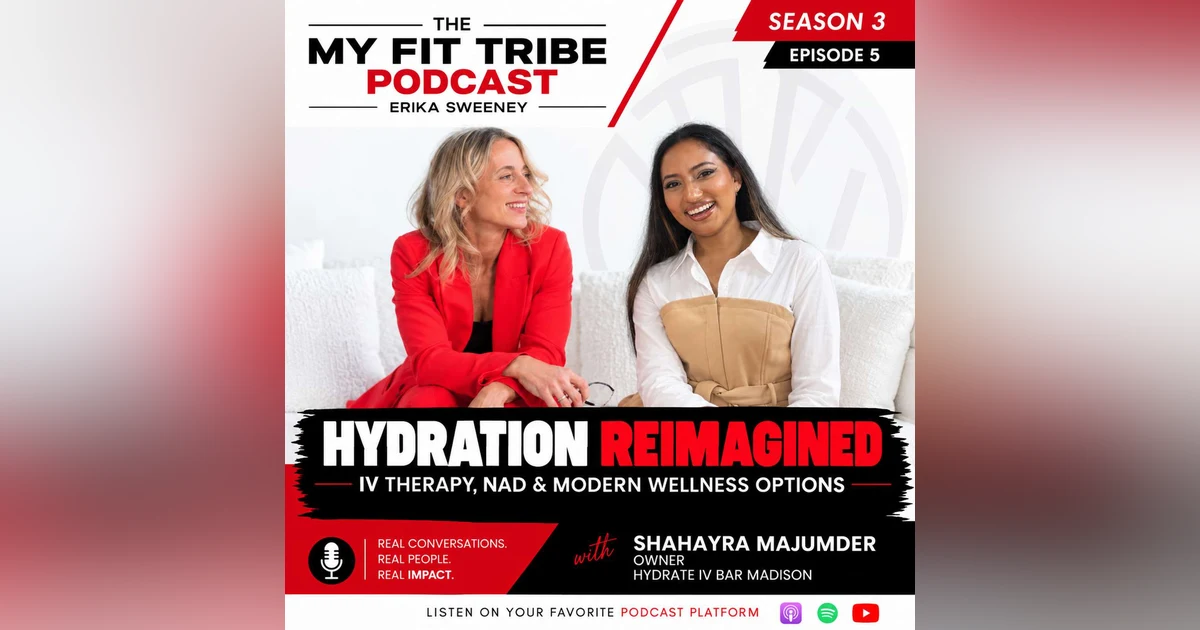
Send us Fan Mail Welcome back to the MY FIT TRIBE Podcast! Today I sit down with Shahayra Majumder, owner of Hydrate IV Bar Madison. The more conversations I have, the more I realize there isn't just one path to bettering your health. We explore how IV therapy fits into a proactive wellness routine, what people can realistically expect, and why asking questions and exploring your options is an important part of taking control of your health. We also dive into NAD, vitamin supplementation, pep...


Welcome back to the MY FIT TRIBE Podcast! Today I sit down with Shahayra Majumder, owner of Hydrate IV Bar Madison.
The more conversations I have, the more I realize there isn't just one path to bettering your health. We explore how IV therapy fits into a proactive wellness routine, what people can realistically expect, and why asking questions and exploring your options is an important part of taking control of your health.
We also dive into NAD, vitamin supplementation, peptides, hydration, and some of the newer wellness therapies becoming more accessible right here in Madison. And as we discuss, these aren't replacements for the basics—they're additional tools and options to explore as you advocate for your own wellness.
With Best of Madison coming out this week, the timing of this episode feels especially fitting. One of my favorite parts of MY FIT TRIBE is highlighting local businesses and the people behind them who are bringing new health and wellness options to our community.
MY FIT TRIBE LISTENER OFFER:
Visit Hydrate IV Bar Madison and use code MYFITTRIBE for 20% off a service.
Here’s my conversation with Shahayra.
Throughout my own life and fitness journey, I have had the privilege of meeting incredible people who've shared valuable insights on mindset, health, fitness, and spiritual growth. The profound impact of this knowledge on my own life has inspired me to share it with all of you. I'm Erica Sweeney, host and founder of My Fit Tribe Podcast. Join me as we explore inspiring conversations with experts, thought leaders, and everyday heroes who offer their stories and practical tips to help you on your own journey. From nutrition and fitness to mental well-being and personal or spiritual growth, our mission is to empower you to take charge of your health and live your best life. We are more than just a podcast, we are community. Through coaching, a wealth of shared knowledge, and a strong support network, we are here to guide and encourage you every step of the way. Come be a part of our tribe. Welcome back to the podcast. Today I sit down with Sahara Majumdar, the owner of Hydrate IV Bar Madison. The more conversations I have, the more I realize there isn't just one path to better health. Today we explore how IV therapy fits into a proactive wellness routine, what people can realistically expect, and why asking questions and exploring your options is an important part of taking control of your health. Here's my conversation with Sahara. I'm joined by Sahara Majumdur, owner of Hydrate IV Bar Madison. After building a successful career in healthcare technology and sales, Sahara combined her passion for wellness and entrepreneurship to bring Wisconsin's first hydrate IV bar to Madison. Through IV therapy, vitamin injections, and NAD plus therapy, she's committed to helping people take a proactive approach to their health while making innovative wellness services more accessible to our community. Hello, thank you for joining me. Hi, thank you for having me. I'm so excited to be here today. I'm excited to hear about the IV bar because that's something that we all talk about hydration and to have so many more options to find wellness, right? Yeah. But before we learn about that, I want to know more about you. Like what's your story and how did you end up owning this IV bar?
SPEAKER_02Yeah. Um, I guess where do we begin? Um, I am originally from South Florida, um, born and raised in West Palm Beach, um, went to the University of Florida, and after school, um was looking at offers in New York, Madison, Wisconsin, and Los Angeles. And I ended up in Madison, Wisconsin. And I think that was the right call. Um, you know, right after I graduated and moved out here six months later, COVID hit, and life as we know it changed. Everything went remote. You know, if that was the situation um when I was graduating school, I'd probably still be in Florida working remote for someplace. But life has a way of taking you where you need to be. So I ended up in Madison and I worked at Epic. Um, I worked at a couple of healthcare tech startups, and I had a small stint in capital equipment sales for uh med devices, and I worked at uh Esker for a little bit, it's a company out in Middleton. I really developed a strong background in B2B sales and just kind of felt super removed from my actual community. Anytime I was going on vacation or traveling for work, I was always seeking out the IV bar or the spa or a way that I could pour back into myself and keep up with the demands of work and modern life. And I just kind of got to a point where I was so tired of working for other people, like not really having a say in my schedule at the end of the day. Like if a client needed me somewhere, I had to go. I had to travel. Um, and my project workload really dictated my work-life balance. There really wasn't a routine that I could healthily maintain. So I kind of got to a point where I was like, I'm tired of having to travel to go to an IV bar. Um, in the past in Madison, I would have to go to the ER if I was ever struggling with like severe dehydration, food poisoning, and still paying off some of those ER bills. So um I just really saw the opportunity to jump ship now or never, make it happen while there's opportunity and um interest in this. I'm really excited about the trajectory that Madison is on with how much growth that we're expected to have. And it's just been an incredible journey. We've been open four months and two days as of today. And I'm so glad that I took the risk. So, what was your degree in then? I went to the University of Florida and my degree there, it's interesting because I have a degree that no one else from the University of Florida has. I basically created my own major. Um, so my degree is in applied biomolecular sciences. And I didn't use that degree for as long as I was in my tech sales or med sales career. I was maybe tangentially using it when in life science settings or medical settings, but really not being able to really explain the science behind what's happening in our bodies. And that was what I was really passionate about growing up. If money was no object, I probably would have gone to grad school and been a brainiac scientist the rest of my life. But I didn't really want that lifestyle that I saw that a lot of the PIs and the labs, principal investigators in the labs that I was interning at had where they were always struggling to get government funding, always applying for grant money. I just saw them living like struggling artists, and I was like, I might as well just, you know, be be an artist rather than go through school and go into debt and you know, go go through that lifestyle. So I I went into the tech sales route um purely because I had the opportunity that I couldn't turn down. And I started that career at Epic. So that's what brought me out to Madison. Um Yeah. So my degree was in this very specific track where I was heading towards getting uh like formal graduate degrees, um, like a like a postdoc and a PhD, like going that traditional science route in pharmacology studies. So I was really interested from a young age in just understanding like all of this amazing science that's coming out with genetic engineering and biohacking and understanding how you know, drugs or different therapies that we might take actually affect our bodies on the cellular level. Um, so it's it's really a nice full circle moment for me with Hydrate IV bar that I really get to use that degree again and kind of flex my science chops and explain to people like this is how NAD works in your body on the cellular level. This is how vitamin supplementation via IV really does work. I think there are a lot of people that look at this industry and think that it's like woo, or like not really grounded in science, but it is, and it's exciting that I kind of carved my own way to be able to really talk about what I'm super interested in.
SPEAKER_00Well, it's fascinating that you were interested in that from a young age, right? Because uh those those little breadcrumbs, as I call them as we go along the way, guiding us to what kind of what gives us our purpose and what we are meant to be doing. Um, I do want to get into what all the benefits of the hydrate bar and what they do, but is there anything when you were younger that really, you know, impacted you to really have curiosity in it for your health?
SPEAKER_02Yeah, absolutely. Um, you know, it wasn't a personal health uh instance that made me super interested in this, but I think just like that was my academic interest. I was always kind of a nerd. And when I learned about Dolly the Sheep being cloned, I was like, this is incredible. Like, this isn't science fiction, we can actually do this. And then CRISPR came out, or it became very popular, at least. If you're familiar, it's a method of gene editing that people are looking at for um basically being a way to solve different genetic bases for certain conditions that folks have. There's a lot of emerging research on CRISPR, um, and it's used in a lot of different studies for all kinds of different treatments that people might be studying. So I was just always super interested in understanding like how our cells are working. It's like a whole universe inside of our bodies, and they just have these instructions and they carry out these marching orders that, you know, we have no understanding of unless we really dive into it, and there's so much there. Like it's overwhelming sometimes to really think about um, you know, how interconnected everything in our body is, and how, you know, you change even just how much water you're drinking, and that has a cascading impact on the ability for you to have hormonal regulation, better quality sleep, better mood balance. Um, it's it's really incredible to me. So I started to lean into the biohacking side of things really just from like a wellness standpoint of recognizing that, okay, I feel a lot better and I get along with everyone better when I make sure my blood sugar is not running low and I'm I'm eating all of my meals on time and having nutritious foods and not just, you know, going through sugar crashes um just to kind of get through the day, um, you know, eating like donuts in the morning because it's easy and quick to do, really just making healthier life choices. I noticed a big difference in the quality of my life, my ability to show up for other people. And yeah, at school, I just really so I mentioned that I started kind of like my own degree at the University of Florida, and it was through um an interdisciplinary studies program that they have that I applied for and basically pitched my own degree to them. And I was like, look, I have changed my major six different times. I started, I think, maybe like a chem major, then I switched to biology, and then I switched to biological engineering, and then I switched to biomedical engineering, and all the courses that I was taking, they were either like only focused on basic sciences or they were focused on applications in a way that I didn't see that translating to what I was interested in my career with my interest in like therapeutics and things like that. I mean, I was taking classes in like soil mechanics and biological engineering and like med device um product manufacturing as a bio med engineer. And that wasn't really my interest. But I also didn't want to just be like a bio or a chem major where all I was doing was memorizing different amino acids and right um without really knowing how to apply that knowledge. So I created this major where I was able to take basically my pick of courses there. And I literally cried in the dean's office and I was like, look, I am paying you tens of thousands of dollars in tuition. I want to get a degree that I actually care about and that advances me towards my goals in life. And ultimately I didn't use it for a while, but I'm so glad that I fought for that because now with the business that, you know, I just opened, I use it every day. And it really helped me to be able to have research in undergrad where I took those basic science classes, but I paired them with interning at Dr. Jay McLaughlin's lab at the University of Florida in the College of Pharmacy, where we studied peptide therapy when I was an undergrad. And just on Monday, we launched peptide therapy at Hydrate IV Bar. So it's pretty incredible.
SPEAKER_00It's amazing how much everything has changed even in the last five years, you know, with peptides and everything. But one thing, a couple things that you brought up. One is that how many people are running ragged in their career or in their life, like you were talking about when you were working in these fields, you know, you just you're just on go mode. So you like you mentioned, your nutrition is not great, you're grabbing food to go, you're burned out, you're tired. And how much there are there are therapies that will help us, but a lot of it goes back to basics again, the hydration, the sleep, the rest, and just listening to your body, the sugar crashes, something we've talked about too. So it's good to know there's there are simpler therapies or things you can do to help make sure that you're healthy. So let's dive in a little bit to the different options that the IV bar provides, then.
SPEAKER_02Yeah, yeah. Um, so yeah, I you know, I appreciate you saying that too, because a lot of people, you know, have the misconception that doing IVs is a replacement for drinking water or eating healthily or working out. It's not, it's just another tool in your toolbox to really help you recover better if you're maybe traveling a ton, like I was, or if you've got little kids that, you know, come home with all kinds of germs from school, or you know, everybody's got different things that they're dealing with in their life. Maybe they're, you know, working really long hours and struggling to get nutritious meals in. Um, we really only absorb about 30% of the nutrients from our diet every day. Um, and even from oral vitamins, we're only getting about 30% of the um actual vitamin content when we consume things orally. So, what we do at hydrate is we do intravenous vitamin supplementation through our IV cocktails. So, if you've ever had an IV in the hospital, they give you just a liter of saline, usually, just to really like up your fluids, just rapidly rehydrate you. What we can do is actually add different vitamins and nutrients to that bag so that in addition to that rapid rehydration, you're also getting straight into your bloodstream nearly 99% absorption of these different vitamins that we might not be getting in our diet. We also offer L lysine, which is it's an amino acid that we don't produce naturally in our bodies. We have to get it through the foods that we eat. So a lot of folks like coming to us for that because they can effectively supplement that. It's a great antiviral as well. So it really helps with, like, course, cold sores or different kind of breakouts, um, helps with collagen production. We also have NAD therapy. That's kind of its whole thing, I could talk about NAD like a whole podcast in itself. Um, but we also just released niogen therapy, which is kind of the next evolution in NAD therapy. What NAD is, is it's a coenzyme in our cells. Are you familiar at all?
SPEAKER_00You know, I was gonna ask you about that because I've heard I've heard about it and I've talked a little bit about it, but I don't have a lot of knowledge behind it. And I've heard very beneficial things from it, and I've also heard things like if it's if you're not ingesting it correctly, that there can be concerns. So let's dive in and just learn a little bit about that.
SPEAKER_02Oh my gosh, yeah, I'm a very high context person, and like I said, I like to understand things on the molecular level. So please feel free to like pause me or ask me any questions or so, yeah, NAD, it's an enzyme that we're all born with. Um, it's present in all of our cells. It's used by our mitochondria, the powerhouse of the cell. Um, and it's a vital enzyme in basically breaking down sugars, foods into energy. As we age, though, we deplete our natural resources of it. So, what a lot of longevity research has shown is that by supplementing your natural NAD levels, you can kind of help your body turn back the clock on a lot of those age-related things that have kind of just degraded in your body, like chronic inflammation, joint pain, um, sleep quality, hormone function, um, mood, your ability to really recover as quickly as you used to if you put your body through stressful scenarios. Um, so NAD, we can provide it via IV, like I mentioned, um, straight into the bloodstream, or we can do injections of it as well. Some people tolerate the injections a little bit better because it's faster than it going into your blood, which some people feel like right away. I personally like it more in my IV because I can slow down the speed at which it's dripping. So I don't feel as much of the side effects as if I were to just do a straight injection. I feel like when I do a straight injection, I just feel the side effects like right away.
SPEAKER_00What kind of side effects does it have?
SPEAKER_02Yeah, so great question. Um, it can cause it's everyone's different. Some people actually don't even experience any side effects. For me, what I experience is just a little bit of like like my blood pressure drops a little bit. It's a vasodilator, so it can have that effect. But some people they get a little nauseous, some people feel a little flush. Actually, the first time I ever did NAD, I did a hundred milligram injection and I felt a little flush, but I just had to sit down, drink some water, and I was fine. You really do feel it on that cellular level, like right away. It's pretty instant and incredible because you know that it's doing something. And the reason why it has that impact is because of the charge on the molecule molecule. So NAD, it's actually NAD plus. And when we administer it into the body, basically the body has to work to get that into our cells, into the mitochondria where it's actually gonna make use of it. And some of it makes it in, some of it doesn't. So to your point about like the route mattering and how you consume it, really impacting whether or not it's efficacious, it does matter because if you're taking it orally, you're really probably not getting a ton of it. And it's gonna take you a lot more time to build up those levels. What we typically recommend to people that are looking to feel better fast is to do a loading dose of NAD via IVs. So to come in in like a two weeks period for four IVs. But it can take people it's it's kind of difficult to find time to come in for four IVs in a two weeks period, especially if you're like me and you want to drip it a little slower. It took me four hours to do for one drip, my first NAD drip, yeah, at 500 milligrams. And so the reason people have side effects is because of that charge on the molecule. It can make it a little bit more difficult to get it across the cell membrane into your cell. And when it's kind of floating freely in the blood, your body sort of sees that as like, whoa, like, what's this foreign substance in my body? I need to like have a reaction to this. Um, kind of warn you that there's something going on. But the symptoms subside very quickly after your infusion is done or um pretty shortly after an injection. Like I said, I sat down, had a glass of water, and I was okay. Um but that's kind of why people have that reaction to it and why it's a longer experience. What I'm super excited about is the niogen therapy that I mentioned. We just rolled out on Monday. Niagen is actually nicotinamide riboside. So NR is a precursor to NAD. Nicotinamide adenine dinucleotide is what NAD is. So because of that, it's a little bit easier for people to supplement the precursor because it doesn't have that charge. It's about half the molecular weight of NAD, and it um is easily, it's more easily taken up by our cells, and then our cells are able to convert it into NAD more easily. Studies have shown about 20% more NAD post niogen slash NR infusion versus just straight NAD infusion because our cells are actually taking up more of it and producing more NAD and it has significantly less side effects for that reason.
SPEAKER_00So it could be more beneficial and less side effects, which is a win-win.
SPEAKER_02Which is a win-win, yes. So I and for reference, I did a 250 milligram NR drip recently, and it took me half the time. So pretty incredible. Um I'm super excited about that. Yeah.
SPEAKER_00So let's talk about the the benefits. We talked a little bit about the side effects of how you can feel, which can sometimes intimidate people not to try it. So let's talk about the actual feeling people get when it when it starts to work.
SPEAKER_02Yeah. I guess it's most easy to talk about, like talking about different clients' experiences with it. We have a gentleman that comes to see us. He comes in nearly weekly to get his NAD drip. And he can feel like towards the end of the weeks when he's low on his NAD levels. He's in his late 80s. Um, our NAD levels about half around age 40. And then it's kind of like an exponentially declining curve from there. And he's been, he's got Parkinson's, he's been struggling with having had a stroke. He's also uh recovered from prostate cancer. So he's had a lot of things go on in his life, and he uses kind of like a cane to really get around every day. And he started doing NAD with us, and him and his wife, they're like our top advocates now. They're telling all their friends about us because he doesn't need his cane like the day after his drip. He like has very great sleep quality. He's able to walk around without needing much support. He's gaining more independence in his life. It really helps with his pain management, um, his energy levels. I mean, it's incredible. It works on the cellular level. So really it's getting to the root of a lot of what you know our bodies struggle with. Um, rather than, you know, giving you something that treats a symptom, we're really letting your body do what it does best with being able to produce energy better and recover better at the mitochondrial level. Um, yeah, so people come to us to use NAD for all kinds of different wellness goals, but it's pr it's pretty miraculous. I mean, and I and I hesitate to say that because there is a lot of marketing fluff out there that will talk about NAD being this like miracle anti-aging molecule. And I really like to stay grounded in the science. Like this is not a miracle molecule, but it's a therapy that I think more people should have access to. Yeah.
SPEAKER_00So sometimes, you know, for with hormone replacement therapy, the more you use it, then your body stops producing on its own. So do you have a risk of that when you do something like NAD plus?
SPEAKER_02That's a really interesting question. Yeah. Um, I don't actually know for sure, but I think what's different about it is that we already are low in like adult age and our NAD levels, especially in that post-50 age range. Um, so it's really more like we're giving our body back things that it's sort of used up versus hormones which we're still, you know, producing on our own. NAD helps with the hormonal production as well, too. So it's pretty incredible. But I honestly don't know the exact answer to that question. So I'll leave that to the doctors and the scientists.
SPEAKER_00Yeah, I'm just curious because there's all these revolutionary therapies, which are really great because as you mentioned, it's not just treating the symptoms, it's helping you to feel better on the molecular level. But I do have always questions then like, yeah, are we disrupting our body that might cause us to need these regularly for the rest of our lives? I mean, which that's being dramatic. But you know, realistically, we don't necessarily always have that long-term knowledge to know how that's gonna affect us.
SPEAKER_02Yeah. What I can speak to is what our medical protocols typically recommend for folks that come into us. Like I mentioned that loading dose that we suggest to folks that are really hoping to rapidly feel a difference with NAD therapy. Usually folks will do that within that two-week course that like I mentioned. And the reason we recommend that is because it really kind of like helps build up your foundation. It's like building up your house of NAD, and then from there, people can maintain with injections. So your body kind of like stores it, and then you can kind of just like top off your levels every now and then. Um, but everyone's body is different. So, like that gentleman I mentioned, he feels it by like the end of the week that he needs to come back in. But I did my niagen drip like last month and I feel fine. And I did an NAD drip like two months before that, and I'm I was still doing okay. So, you know, I probably don't need it as much, but when I do do it, I can tell like if I put myself through a lot, like if I'm going out with friends and I'm, you know, enjoying myself, I notice that I don't feel terrible the next day. I actually still get good quality sleep, and I don't wake up with like, oh my gosh, my neck is like completely given out, which is a common theme that I was experiencing before I was doing IV therapy was anytime I was dehydrated, I would feel it in my neck. Like I would feel a lot of muscle tension. Um what really, really helped was just increasing my water intake. So that's another thing that's nice about NAD therapy with the IV, too, is you're still getting fluids with it too. So that helps with just hydration on a base level.
SPEAKER_00Interesting.
SPEAKER_02Yeah.
SPEAKER_00And then some of your other uh IV therapies, I'm assuming the Myers cocktail is one of them that you do. So if you want to explain to our listeners what all is included in that, because that's a pretty common one tip for people to die.
SPEAKER_02Yeah, yeah, Myers cocktail, it's got just so it's again a liter of saline, but it's got B5, B6, B12, B complex. So all of the fun B vitamins and then calcium, magnesium, uh, vitamin C. And at Hydrate, we actually also have um a cocktail that's only available at Hydrate IV bars. It's called the Katie Cocktail, named after our CEO. Everyone was asking her like 10 years ago when she first started this franchise in Denver, what like what do you do? What's your drip? And she always got the Myers plus an extra dose of vitamin C and glutathione. And so we just added it to the menu, and now a lot of people come to us for that. I also love the Katie cocktail because we partner with local nonprofits every quarter. Since it's our top IV, we give back part of the proceeds to our quarterly partner every quarter. So it's a fun way to also like just root deeply in our community. Is that's a big value that we have. Wellness is not about just like this individualism self-care culture. It's really about taking care of one another, too. A lot of IV bars, you'll see, you know, you're kind of isolated, you're in like a spaceship that they put you in by yourself, or um there's like curtain dividers, and we don't have that at our location. It's meant to be more of like a lounge third space where you talk to your neighbors and you actually get to know the other members that are coming in. Yeah. And then, gosh, we also just rolled out peptide therapy.
SPEAKER_00Yeah, it's gonna happen that we have had a couple conversations on the podcast about peptides. Oh, yeah. And one thing that drives me crazy is because sometimes it's just everything's a peptide when it's really not a peptide. Yeah. And you know, there are a lot of questions, there's a sourcing of it. Um, you know, there's it's just everywhere where I think people are a little overwhelmed, they're optimistic, and then they're trying everything and nothing, and it's just a a lot of chaos sometimes. So, what have you found with the new peptide therapy? Like, what's your favorite part of what you're rolling out?
SPEAKER_02Yeah, what I love is how Hydra really was conscious of everything that you're saying, and all of the peptides that we rolled out were ones that we really studied. We talked with all of our medical advisors. We have a medical oversight company called Guardian MD, and the CEO of Guardian MD is also the chief medical officer at Hydrate IV Bar, and he's got a team of amazing clinicians around him that do this like for a living. They prescribe peptides and they've been in this scene and know where to order from and what's legit, what needs more research. And so we rolled out the ones that we felt really confident advocating for to people, and we created a process that made people feel more safe and like they were getting quality peptides and not just, you know, something from a shady reseller online because you really don't know. Yeah. Yeah. So what I'm most excited about, honestly, I haven't tried any of them yet. Like we literally just rolled them out on Monday. So I'm super excited to honestly make the time to just go in and do my consult and meet with the doctor. So the way that it would work if someone were to come to us for peptide therapy, you would come in to hydrate for a peptide consultation. You'd sit on a quick telehealth visit with one of our clinicians that are part of our medical oversight team, and they would review your medical history, they would review your medications, they would talk to you about your wellness goals. Um, and we would talk to you as well if you had any questions about like which peptide you might be considering versus another one based on what you're seeking. Um, but then the clinician would basically tell you, okay, this is safe to stack together. This is not. Um, this is what I'm gonna prescribe you. And then based on the prescription, we will actually place the order, ship it to your home. And we have RNs on staff. So the only person that would ever give you any type of poke or administer services at Hydrate IV bar is a registered nurse. So the same person that you might see giving you an IV in the hospital is the same person at hydrate that would do that. And the nurse will send you home with clinical um education packets that basically tells you, you know, this is the peptide that you're taking, this is how to take it, whether that should be like in a fasted state or um, you know, whether it's um a certain period of time before activity. Um and we provide you basically kind of like in the pharmacy when they give you like all of the instructions with your prescription, we do the same thing and the nurse shows you how to self-administer the injections. It is a lot easier for folks to just do at home rather than have to come into us and have the nurse do it. But there are, I mean, like myself, I'm very needle shy, believe it or not, and I don't like the idea of giving myself injections. So I probably would be coming in every day anyway to have the nurse do it for me. And so we do have that option too. That's how we do it. We also order only from 503A compounding pharmacies that are FDA regulated. So we're not ordering from um resellers on the internet, um, from pharmacies that we have no clue how they're, you know, compounding these medications. We order from vetted sources, and um there's kind of a the misbelief that some of these peptides are not FDA approved. Some of them are not, but hey, neither is IV therapy. And we do it in the hospital. So I mean, I feel like don't get me on my soapbox about FDA approval and everything that that means, but we do have some peptides that are also, like PT141, I believe, is FDA approved. Um and to your point, like not all peptides are necessarily just peptides. Like, what is a peptide? On the molecular level, they're just strings of amino acids. Um, and I really like the ones that we chose because they pair very well with the IV therapy that we provide. You know, IV therapy gives you your cells what they need to do what they do best. Peptides are the signals to your cells to kind of say, hey, all of that beautiful hydration and vitamin supplementation and all those cofactors that you're, you know, keeping on storage now activate and trigger this function within the body. So they really just kind of act as signals for your cells. Um we have peptides that are also hormones like oxytocin, we administer intranasally. Um and it's it's it's the bonding hormone that we release naturally when you might be breastfeeding. Like the baby releases that and the parent does, or if you're ever doing skin to skin with a baby, you both also release it. If you hug your pets, if you cuddle your pets, you're both releasing it. Anytime you hug another person, you're releasing it. It's the social bonding hormone. Um, and it really helps to supplement some people if they struggle with social connection. Um interesting. Yeah, so not every peptide is necessarily just a peptide, it's also things that we do produce naturally.
SPEAKER_00So see, I have like mixed emotions on all of it, yeah, to be honest with you. Because I think it's great that there's alternative therapy, and you brought up the FDA thing. Like my big thing is if you have all peptides controlled by the FDA, then the pharma school companies are gonna control everything and then your prices are gonna skyrocket, and that's another soapbox you can get in. Yeah, yeah. But the other part of it is like I don't want everybody to want to even take ten different things to be optimally healthy. Like you still have to do the things, you have to move, you have to breathe in more than just the the necessary way. Um you have to eat well, you know, whole foods, you have to l strength train, you know, there's certain things that you still have to take some ownership of. Yeah. And I've seen a lot of situations where like with the GLP ones, people are losing too much too fast and they're losing their bone density and their muscles, and throwing everybody on all this stuff is a bit of a concern for me. Yeah.
SPEAKER_02Yeah, no, I a hundred percent agree with you, and I have the same concern with GLP ones. And honestly, I was very hesitant to roll out these peptides until I was just like, you know what? I'm gonna put my degree to work and I'm gonna figure out how these are actually working in the body like myself. If I can't explain that to someone, then I don't feel confident even selling it. Like I don't, I don't want to just push products that I don't understand. Um, and we don't offer any GLP ones for that very reason. Um, GLP ones, I have my mixed feelings on it too. You know, I love what I've seen it do for people's mental health. Um, but also it's a little scary to me that people, well, one, you know, they stop taking it and a lot of people gain all the way back, and that's very hard on your mental health as well. Um, but also it can affect your hormonal balance because of the receptors that it's working on. I mean, Ozempic, originally a diabetic medication, um, it's meant to influence insulin production. Um, and it does impact your lean muscle mass, your bone health. Right. Um, we offer a peptide, it's called AOD 9604. And from my research and studying this, what I understand is that it works on different receptors than what GLP1s work on. So it is a GLP1 alternative and it bypasses basically the biological pathways that implicate hormonal function, and it can help target more of the fat loss specifically by working in the cellular pathway that breaks down triglycerides into glycerine and fatty acids. So it really breaks down the components of fat itself, and that's how it works, versus really just being this, you know, medication that has this desirable side effect.
SPEAKER_01Right.
SPEAKER_02Um so that's one that I felt safe rolling out because a lot of people also, and it and it is safe depending on the person. Um, a doctor's always gonna recommend the best thing, but it is generally safe to add on to a GLP one because a lot of people end up having resistance to GLP1s, their body gets accumulated to it. Um the idea with all of our peptides, they're generally prescribed for three months max. And we monitor your progress every single month to see how you're doing. We don't really want you to have to be on it forever. They're kind of meant to just be like a tool that's there for you to help you like catch up to a good place and then kind of maintain, or maybe like we have um what's commonly known as the Wolverine Pack. The actual peptides that they are is BPC157 and TB500. And the way that those work is they basically help your cells kind of recover from soft tissue injury.
SPEAKER_00Yeah. I I took BPC 157 after my shoulder surgery to help um to get it from my n my functional doctor and to help with the recovery. And I remember sitting down with the medical doctor post-surgery as my follow-up, and I was like, you know, is there a reason, you know, why you guys don't ever even like mention peptides for helping to heal? Because I think that made a big difference to my recovery. And he's like, Well, it's out of my scope of care. And I'm like, I g I get it, but that's too bad because people could really benefit from that.
SPEAKER_02Yeah, it is, and that's that is truly like a whole other conversation. Why I truly I think, you know, I feel like maybe I'm a cynic, but I feel that a lot of the things that don't make sense or feel overly bureaucratic are that way for a reason by design. And who does it ultimately benefit for these things to not be that accessible to people or not that well researched?
SPEAKER_00Yeah. I know it's a good idea.
SPEAKER_02It funds a sick economy. Yeah. It funds an economy where we're focused on reactive health care versus the proactive kind that really helps people get back on their feet.
SPEAKER_00Right. Which is what I love is that now things like peptides are so readily available. Where, you know, four years ago you heard it, but you couldn't access it very or know where to go to access it. And now you've got information about it, you've got podcasts about it, you've got the IV places that will be able to provide you with it. So luckily, we're all being exposed to alternative therapies to help us with our health care, our welfare instead of the sick care that we've had for the last you know decades.
SPEAKER_02Yeah, yeah. Really well put, yeah. Yeah, so I mean, yeah, of other peptides that we're offering, um, I don't know if you've heard of any of these, but I'll just name them off. Uh GHKCU, that one's really great for like hair, skin, nails. It basically deposits copper into the body to really help with like collagen and elastin production. MOT C, um, that one also really helps the mitochondria. It's great to pair with NAD or niten therapy because it helps that NAD enter the cell and really kind of helps the mitochondria do what it does best. Oxytocin, we talked about PT141, that really helps with intimacy and low libido, but not in a way that like a Viagra might work with blood flow. It actually works in the areas of our brain that are responsible for arousal and desire. Um, and that one is FDA approved. So um a lot of people really like that and have success with it. And then Surmorlin and Tesmorlin, those are also both hormones or at least analogs of growth hormone releasing hormone, which we do naturally produce as well. But we have feedback mechanisms in our body that kind of like stop the release of that hormone, and supplementing with this peptide allows our body to kind of put the brakes on that negative feedback pathway that stops our natural halting of its production to influence some things like um tesamorin, great for visceral fat loss. It's a long chain of amino acids that binds to multiple receptors on fat cells. So it really helps us to achieve significant weight loss in those stubborn fat zones. Um and it's another way to really have targeted fat loss if that's a goal, without really going through the GLP1 route.
SPEAKER_00Um so are all those peptides administered then like by needle, or are some of the I mean, is that so that's how the all those would be done?
SPEAKER_02The only one that's intranasal is oxytocin. Okay. Um I believe that's just because it's, you know, safer to administer straight into the brain since we're bypassing the blood brain barrier that way. Um The other ones, they're all injections. Interesting.
SPEAKER_00So it's not something that you add to your IV. They would be the separate injections exactly. Exactly. How often does one need to inject those peptides? Does that depend on the peptide? It does. Yeah.
SPEAKER_02And so basically when you would get a prescription from a doctor and come see us to talk about it, they would explain and the nurse would explain the SIG, basically, the way that you should take the medication. Just like when you get, you know, uh uh pills from the pharmacy and they tell you like how to take it stuff.
SPEAKER_00Right. Interesting.
SPEAKER_02Yeah.
SPEAKER_00Huh. I think I feel like the like we're just at the beginning of what new medicine's gonna be. Like there's gonna be a point where we just check our blood every morning and then it tells us what we need, and then we're able to just inject stuff to support. Yeah. You know, with technology and AI, it's it's gonna move quickly, I think.
SPEAKER_02It's pretty incredible. Yeah, I had I there's a guy that just shot me an email saying, Can I send you a sample of this biomarker um device that I have? We look at all of these different levels, and I was like, Yeah, dude, sure. Let's see how it goes. Because um, it would be really interesting to offer that to our clients too, um, so they're able to kind of track their progress as they're with us.
SPEAKER_00That's one thing I started doing. I mean, I get my blood checked regularly through my functional, but I was able to get add on to a service where I get it checked monthly and can do it right from home so I don't have to, you know, fast and go in three hours later. Yeah. Um, and to be able to see what I did during the last month and how that affected my numbers is you that's data that you can use, which otherwise if you go into the doctor just once a year, you don't that's a snapshot. You don't have a full view of what you're doing and how your health is. So it's kind of nice to have those options become more pre readily available. Nice. Well, I'm so excited for you. I'm running out of time. So I know and we've covered a lot. And again, I'm I think that these, you know, a lot of the med spas have more wellness geared options, but for you to have this IV bar where you're bringing together community and you're offering these therapies that can help, you know, those those IVs can you can get even just every now and then and it really makes you feel better. These aren't all treatments that need to be administered regularly.
SPEAKER_02Yeah, absolutely. Yeah. Our memberships are honestly the most cost-effective way to even stay consistent with it. And I think a lot of people are used to like living in a sub subscription culture where you have like use it or lose it benefits, and if you're not making it in to, you know, use your credits that month or whatever it is, then you lose it. But we're not like that. Like we don't want people to not get the value out of what they're paying for. Our credits roll over for folks and you can share them with your family. Like, if there are people that you know that would really benefit from this and you want to, you know, gift them IVs, we have the ability to do that, but it's honestly the most cost effective on our membership. So we really I love hydrate in general because it's really designed to put the client's health as the top priority. The top priority is not, you know, pushing services. I don't want to be a pharmacy that's like pushing pills. I want to be a wellness hub for people to really feel safe. Gosh, we didn't even talk about taurine, but we also did release taurine on Monday.
SPEAKER_00Interesting.
SPEAKER_02Um, are you familiar with taurine?
SPEAKER_00Um so that's so again, my sister gets her labs done regularly and all of her amino acids, and that was the one that she was low on.
SPEAKER_02My gosh, amazing. Yeah, we I as of Monday, we have it. I did an injection of it and I, I mean, I felt great. It didn't hurt at all, actually. Like some, some of these uh amino acid injections, they can be a little spicy, like lysine is a little spicy, honestly, but no, taurine felt great. You can put it in your IV too, just like L lysine, you can also put that in your IV. But um, yeah, it's so good for brain health, heart health, eye health. Um, and it's one of those amino acids. A lot of people think amino acids, they're building protein, they're gonna build muscle. Taurine is actually not building muscle, it's on a basic biophysical level. It's basically helping your cells maintain their ideal volume, and it's uh essential for vital organs. Um, so a lot of athletes love it for recovering after hard workouts and keeping their body in check. Yeah. Awesome.
SPEAKER_00See you so much for everybody to check out when they come and see you. Yeah. So let's tell everybody how do they come find you?
SPEAKER_02Yeah, so we are located right across from the Whole Foods um in Madison Yards, um, right off of university. We our address is 4707 Madison Yards Way. Um, you can check us out at hydrateivbar.com forward slash Madison. We're on all the socials, Hydrate IV Bar Madison. Um, and Erica, if you'd like to share our special promo code for our listeners.
SPEAKER_00So for our listeners, if they want to come in and use the code MyFitTry, they can get 20% off service. Yes. That's amazing. Thank you for offering that for our listeners.
SPEAKER_01Yeah.
SPEAKER_00Yeah, it'll be nice to see again. I think the biggest thing for people to know is that you can be an advocate for your own wellness. And I'm changing that to say wellness, you know, because so people really need to know that you can do things for your longevity and can just to feel better so that you can have that quality of life that you're hoping for as time goes on. Yeah. Because getting older is tough. Yeah. Speaking from experience. Oh goodness. It doesn't have to be. It doesn't have to be right. We have tools to help. Well, I thank you again for coming in. Before we wrap up, I've got I've got three questions now that I add. Yeah. Um, for season three, we're adding a third question. So for our listeners, you know, a lot of times we you know listen to podcasts or we hear something and we go, oh, that's a good idea, and then it kind of disappears and we don't really change our our steps. So based on your experiences, on your your choices, and now being able to provide this option, what's one thing, one actionable item you would suggest for our listeners that they could do today to to help, you know, be that best version of themselves?
SPEAKER_02Yeah. This is gonna sound salesy, but I don't mean it to be. Um, book the consult. Like, just come in and talk to us and we'll talk to you about what does what, even just the vitamins. I feel like a lot of people don't even understand, like, what the hell is B comp? Can I say that? You can say that. Okay. Like, what is B complex? Like, what does that even do? And being able to just tell people, like, these are the things that your body really depends on you to supply it. Your body knows what to do, but you just gotta kind of help it out. Um, and even if it's just calling us, like, we're happy to just kind of chat with you about what your wellness goals are. It doesn't have to be, you know, you don't have to have the degree that I have to figure it out on your own. Um, there are people there that, you know, do this for a living and can help you. Um, and I truly mean that. There's no pressure to really book ever really with us. Um I just believe in what we're doing so much. And I know that once people learn about it, try it, it's it's, you know, the rest will take care of itself on on my end at hydrate. But um, yeah, I think that's my actionable step. Like just book it, like have the conversation, and then you have the information at least, and then you can decide what you want to do.
SPEAKER_00And it's important for people to know that vitamin deficiency can cause symptoms that they can it can make you sick. Yeah. So even correcting some of that and the hydration can really be one first step in making you feel better. Yeah, absolutely. Yeah. Okay, so my final two questions is if um you may have ended listened to the podcast, but if you today could have a conversation with your past self, you can pick you in college, you as a little girl, when you're excited about this topic, what advice would you give your past self?
SPEAKER_02Oh my gosh. Um, I would tell myself to be just like less worried and less anxious. I think that for a long time I thought that I would only achieve success if I stressed about it and I wasn't deserving of it if I wasn't stressing, but I created a lot more stress for myself than was even worth it. Um and I would have had a lot more fun if I just kind of leaned into the things that I loved and had more of a I don't have to, I get to attitude. So yeah, I think I'm trying to take that advice still to this day. Um, and leaning into the fun parts of what I'm doing now.
SPEAKER_00Awesome. Yeah. So now you can have a conversation with your future self. So you're very young, so you can pick 10 years, 20 years, 50 years, whatever you think. If you could sit down with who that future self have you envisioned her to be, what would you ask her and what do you think she would say back to you?
SPEAKER_02Oh I would ask, uh, you know, what's like the one area that you want to give back to? Because I when I picture my future self, I picture someone that has a lot of agency and choices and you know how she wants to spend her time. And I would really ask, like, where do you want to reinvest and really go hard? I feel like I'm involved in a lot of different organizations and doing a lot of things, and I have a I mean, I I love it. I like staying busy, but I would hope that I can reflect and think that's where I lit up the most and that's where I want to just like pour into in the future.
SPEAKER_00So what advice do you think your future self would give you on that?
SPEAKER_02Um, I think she would say to enjoy it. Kind of like what I would tell my younger self. I think she'd probably tell me the same thing, like really take time enjoying the journey so that I can answer that question.
SPEAKER_00Oh, I love that. Yeah. And I really think it's important, you know, we've talked a lot on this podcast, and just through my journey, is that the point, I mean, the entrepreneurship, the working hard, the taking care of your body, like all of that is all part of the process. But when you start impacting people, whether it be through providing wellness or your advocacy in other areas, like that's that's where the difference is made. So thank you for all that you do. Thank you so much.
SPEAKER_02Thank you for having me. This was so much fun. It goes by so fast. I know.
SPEAKER_00I'm so grateful for your conversation. I'm gonna come check you out and get it get an IV. Yeah. Um, and then we'll share that with the listeners as well. So thank you again for your time. Okay, thank you so much. Thanks for listening to the My Fit Tribe podcast. Tune in weekly for our latest episode for more health and wellness insights and inspiration. For more information, visit myfittribe.org. Don't forget to share, like, and download this episode, and thank you for your support. Please know that the opinions and comments presented here are those of the guests and do not necessarily constitute medical advice or the opinions of MyFitTribe. Copyright 2026, all rights reserved. This podcast is recorded and produced by Jake Johnson at Paradigm Productions in Madison, Wisconsin, and is a production of My Fit Tribe LLC.