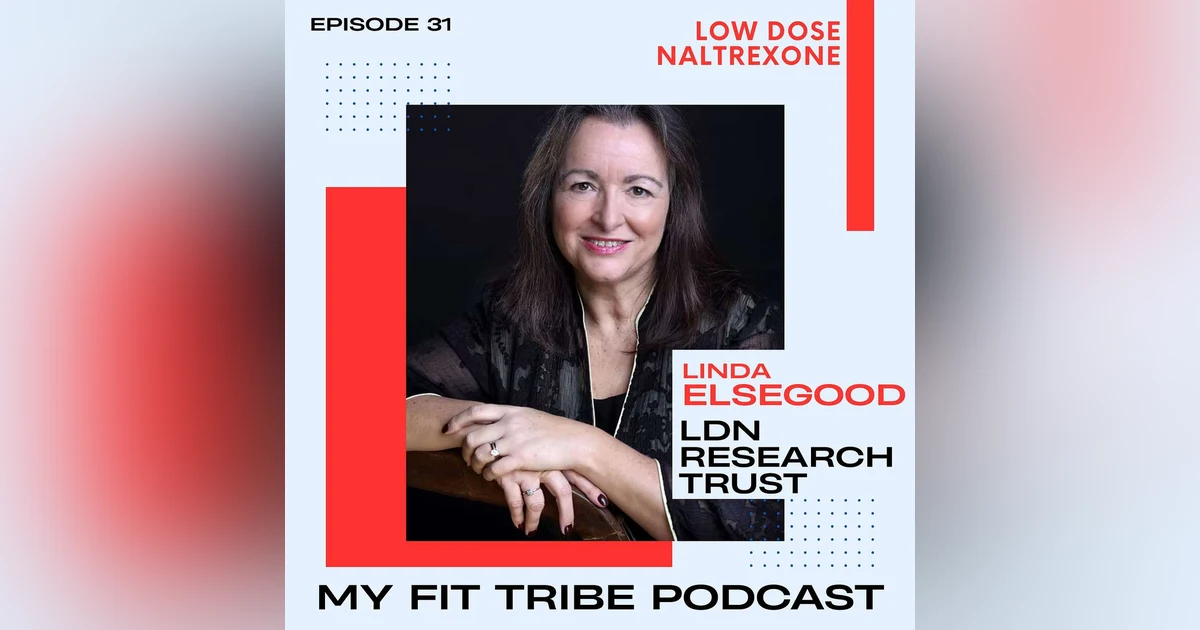
Linda Elsegood- Low Dose Naltrexone

Send us Fan Mail Welcome back to the MY FIT TRIBE Podcast. Chronic health conditions can leave people feeling lost and hopeless—especially when answers or effective treatments are hard to find. In today’s episode, I’m joined by Linda Elsegood, founder of the LDN Research Trust. She shares her powerful personal health journey and introduces us to Low Dose Naltrexone (LDN)—what it is, how it works, and the wide range of conditions it may help treat. This conversation is eye-opening, deeply inf...


Welcome back to the MY FIT TRIBE Podcast.
Chronic health conditions can leave people feeling lost and hopeless—especially when answers or effective treatments are hard to find. In today’s episode, I’m joined by Linda Elsegood, founder of the LDN Research Trust. She shares her powerful personal health journey and introduces us to Low Dose Naltrexone (LDN)—what it is, how it works, and the wide range of conditions it may help treat.
This conversation is eye-opening, deeply informative, and potentially life-changing. Whether you’re searching for new solutions on your own health journey, or you're a coach or functional health provider, this is an episode you’ll want to listen to—and share.
21:16 - [Ad] Just Be True ~ A Soul-Led Podcast
22:02 - (Cont.) Linda Elsegood- Low Dose Naltrexone
Throughout my own life and fitness journey, I have had the privilege of meeting incredible people who've shared valuable insights on mindset, health, fitness, and spiritual growth. The profound impact of this knowledge on my own life has inspired me to share it with all of you. I'm Erica Sweeney, host and founder of My Fit Tribe Podcast. Join me as we explore inspiring conversations with experts, thought leaders, and everyday heroes who offer their stories and practical tips to help you on your own journey. From nutrition and fitness to mental well-being and personal or spiritual growth, our mission is to empower you to take charge of your health and live your best life. We are more than just a podcast, we are a community. Through coaching, a wealth of shared knowledge, and a strong support network, we are here to guide and encourage you every step of the way. Come be a part of our tribe. So many people living with chronic health conditions are left feeling hopeless when they can't find the answers or effective treatment. In today's episode, I'm joined by Linda Elzigood, founder of the LDN Research Trust. She shares her powerful personal health journey and introduces us to low-dose naltrexone, LDN, what it is, how it works, and the wide range of conditions it may help treat. This conversation is eye-opening, informative, and potentially life-changing. If you or someone you love is searching for new answers in their health journey, this is an episode you'll want to hear and share. She leads the organization in raising global awareness of low-dose naltraxone, otherwise known as LDN. She works closely with medical advisors and pharmacists to answer questions from both patients and healthcare professionals. Through her efforts, Linda has helped countless individuals worldwide access knowledgeable LDN prescribing doctors and reliable support on their healing journey. Hi, Linda. Thank you for joining me today.
SPEAKER_00Thank you. It's an honor and a pleasure to be here with you.
SPEAKER_01Can you tell us a little bit? Let's start with your health journey.
SPEAKER_00Okay. If you go far enough back, I was always ill as a child. Um I was born partially deaf. I had repeated tonsillitis until I was 21 when I had my tonsils out, and I was told that my tonsils were so perforated they were full of stapula cocci, and I was poisoning my system. So I had done that for years. So that had quite a big impact on my health. When I was 13, I had Epstein-Barb virus. Um I had it acutely, I nearly died. I had the whole school year off, so that was difficult to get over. I had chronic fatigue, so I just wanted to sleep basically for quite a while after that. I met my husband when I was 18, and hindsight is a wonderful thing. And he said that I definitely had MS then, but I think looking back, having relapses, I probably that Epstein Barr virus when I was 13 was the start of my MS journey, if you like. He said that I was always ill and I always had weird things happening to me. And I took the you were always ill as meaning I was a hypochondriac or something. So I was quite upset. And he said, No, you actually always had something wrong with you. I had repeated UTIs constantly for years as well. So I was having numbness, pins and needles, lots of problems going on that were transient, they would come, they would go, maybe last two or three weeks. So I didn't ever go to the doctors with all these niggling things because I was busy, you know, I didn't have time to uh worry about something that had then gone. And I um when I was how old was I 44, and um I was working full-time, I was a bank manager, my husband worked in television and films, and when he was working, he was away, so he was away from home every week for a certain length of time. And um I've got two girls, we lived in a village, I was the taxi, I was constantly taking exams, I was really, really busy, and it was just before Christmas 2000. Um, my father was disabled with uh rheumatoid arthritis in his knees and his hips, and he was in a wheelchair, didn't use the phone because he was hard of hearing, and I just got in, my friend was there, she was going to cut my hair, and my dad phoned and said that your mum's had a heart attack, they're now taking her in the ambulance, they won't take me because I'm in a wheelchair, and I was like an hour and a half away. So I just put my coat on, I said, Well, tell them to take you in the ambulance, I'm coming, I'll sort it out. So I got to the hospital, it was touch and go whether my mum was going to live or not, and I had it in my head that if I went to sleep, she would go to sleep and she wouldn't wake up again. So it was a case of I sat up with her, which was really ridiculous because I'd had a full day at work and I was had to drive there and it was snowing and it took even longer to get there than normal. Um, and then my it was just as though I hit a brick wall, basically. Everything started to go wrong with me. Um, my mum survived, um, but my mum and dad came to live with me. I had to go back to work. A friend who was a nurse came to stay and she looked after my mum and dad while I was working. It was um very, very stressful. I I had gastroenteritis, I had this numbness, some pins and needles, um, I had a tooth abscess, everything happened all at once. I just couldn't get on top of all these things that were happening to me. So this was, I'd say, Christmas. So by the Easter, I was struggling really badly. My mum and dad had gone home, and I said to my husband, can we go away for a week at Easter? Just so I can have a break, go away, come back, and hopefully leave the illness away, you know, and I I'll I'll recover. Well, he couldn't because he'd got so many things scheduled. Um, my eldest daughter had left home and I took my youngest daughter. We went to Portugal, it was meant to be 90 degrees, so we packed shorts and t-shirts and we got there, and it was very wet, cold, and windy. And I was very fatigued still, and I was very, very cold. They drained the heating system in the apartment we were in because it was meant to be hot. Every time you went out, you got wet, and there was nowhere to dry your clothes, it was pretty miserable. But we had to decide did we want to stay inside for a week or did we want to just go out and get wet and enjoy the sight. So we went out and naively I thought that the left-hand side of my face, the wind and the rain hitting it was making it really, really numb. But luckily, it was an apartment for six, and it was only the two of us, so we kept putting all the bedding from the other beds on top and to try and keep warm. And I said to my husband, When I get home, I'm gonna have to go and see the doctor because there is something wrong with me. I really don't feel well. So we got home, uh, I went to the doctor's, and the doctor made an appointment for me to see a urologist, and I didn't get the appointment until August, and I had deteriorated a lot between April and August. So I was in a wheelchair by this time, I couldn't stand, I had no balance, I had very bad vertigo, I'd lost the hearing in my left ear, I had double vision, optic neuritis, and many other things. And they decided it was funny really. Um, I was in hospital and the nurse came to me and said, after I'd had all these tests, um, how long have you had MS? So I said, Well, I I haven't got MS. She said, Oh, I must have the wrong patient. And I thought, I I bet I've got MS. And then the consultant came and said, Oh, you have MS. And I thought she'd obviously read my notes but didn't realise I hadn't been told. And I'd I had a three-day course of intravenous steroids, which, if you know what intravenous steroids are like, I'm a very pale person and I went red, and my face was like a beach ball, red beach ball, my whole body was puffy, but it they didn't work, and the neurologist was really worried that I was going to end up blind and deaf, as well as being in a wheelchair, if I didn't have another course of the intravenous steroids, which you're only meant to have every 18 months maximum, and this was only six weeks later. So I had another course which then impacted me even further with all this bloating and swelling and so on. Um I I went on um rebif and when I started, or before I started, my liver function tests were normal, and they have to be normal for you to be able to start. And three months later, they were in the red, and my neurologist said, Oh, don't worry about it, it will settle down. So then when I went at the six months of review, it'd gone even further in the red. But by this time, I was very sick. I was under a gastroenterologist, a urologist, gynecologist. I virtually lived at the hospital, falling asleep. I was the person that was slumped in the corner in a wheelchair asleep. Um, there was just so much going wrong with me. And the gastroenterologist said, Um, what are you doing? You are killing your liver. Um, and she said, Why are you taking this interview and drug? It's killing you. And she said that she would discuss it with the neurologist, which I uh when I came home, I thought, well, if it's killing me, I'm stopping taking it. So I stopped taking it and I felt an awful lot better once I'd stopped um taking it. But I was having relapses every I can't remember now, so let's say like six weeks, I was having a relapse. Something new would happen, and my life looked like being on rungs of the ladder. I'd have a relapse and I would drop, let's say, four rungs, and then I'd improve and I would go up two, but then I would have another relapse and drop another four, so the bottom was coming up very quickly, um, which was really scary. So by 2003, the left hand side of my body, if you drew a line, was completely numb with pins and needles, and the right hand side was fine. It was just this complete line, and it was hard to describe. Um, you'd think numb with pins and needles wouldn't be painful, but it was excruciatingly painful, and even a sheet touching me on a limb would start off the pain, and the pins and needles, especially my feet, felt like walking on broken glass with stingy nettles in it. It was awful. So I've got this numbness, pins and needles, still got no hearing in my left ear, I still had the double vision, I had terrible pains in my head, I had no balance, I had very bad vertigo, I fell, I stumbled, I tripped, I lost my bowel and bladder control. Cognitively, it was as though English was my second language, I couldn't recall any vocabulary, and listening to people used to be such a struggle. I'd quite often fall asleep while people were talking to me, or fall asleep while I was talking. I would try to put a sentence together and it would take a long while because I would have to think of each word, and the sentence in my head made sense, and when I said it, it would come out garbledygook and nobody could understand a word that I was saying. So I was bedbound, um, I couldn't do anything for myself, I didn't know where my mouth was. I had to be fed, had to be washed, I had to be cleaned, and I felt as though I was lying in bed watching one of those Rolex diaries, you know, the first of the month, second of the month. And what have I done? I'm still here, I haven't done anything. Um, I'm a workaholic and I like to achieve things, and I couldn't achieve anything. Nothing. I couldn't even do what a three-year-old can do by going to the toilet and waiting until you're in the right place at the right time. I couldn't even do that. It was very, very depressing. Um, I had to go and see the neurologist, and he did several different tests on me, and he sat me back in the chair, he reached across the desk, he shook hands with me, and as he was shaking hands, he said, I'm really sorry to tell you your secondary progressive MS now. Then he got up, went to the door, opened the door, and said, Well, I'm really sorry, there's nothing more we can do for you. So there was no plan B, there was no, okay, so what we're going to do now, there was nothing. I was stripped of any hope, and what was I going to do? I did contemplate ending it all, but my 15-year-old daughter was going to find me, so that wasn't an option. So if there was nothing that Western medicine could do for me, I tried alternative things and they didn't seem to help either. I'd got to either give up completely or prove everybody wrong. So once I decided that it was down to me, I going back to 2003, there was no Google, there was no Facebook, there was no internet like it is today. It was slow dial-up, so it took a long while to connect and it was expensive. I can only do 10 minutes at a time because it exhausted me. I needed to find somebody else who had MS similar to me, and what were they doing? That's what I that was my goal. Let me find somebody else and see what they're doing. So I managed to find an MS chat room, which was what they had in those days. They probably still do, but anyway, um, in America, and I managed to find some people who'd got MS who had similar symptoms as I had, and everybody was telling me the same thing. Have you heard of LDN? And it was like, no, what is LDN? And they said, you know, if it doesn't do you any good, it won't do you any harm. Did I really mind if LDN had any awful side effects at that time? Because there was nothing else to try, you know, I would have tried anything. So I managed to find a doctor in England who would prescribe LDN. He'd got 400 patients on LDN at the time, and he couldn't take me on as a patient because he was just one man on his own and he was at capacity. He gave me some information which I could take to my own GP. My GP had retired by this time, and I had a young doctor. Um, she wasn't a partner in the practice, so she didn't get the vote on whether they would prescribe it or not. And it came back, no, they wouldn't prescribe it. But she said, I've read it, and if it was me, I'd like to try it. So if you can get someone to prescribe it for you, I'll monitor you. So that gave me some reassurance. So I went back to it was Dr. Bob Lawrence in Wales and told him, and he agreed he would prescribe it for me. So this was the 3rd of December 2003, and I I wanted every possible side effect. In those days, it was different, the protocol of starting than it is today. You at that point took three milligrams for a month and then you went up to 4.5. I was very, very lucky because some people initially 1.5 is the maximum that they can take. I was able to take the three milligrams, and I was told you might have headaches, disturbed sleep, vivid dreams, your bowel might be upset, or you might have worsening of pre-existing symptoms. But I had nothing. I was devastated. I wanted to have side effects to know it was working because how do you know it's working otherwise? I could have been taking saccharin, it was just nothing. Um, and living inside my head was like living inside a television set that wasn't tuned in. I couldn't hear properly, I couldn't think properly, I couldn't see properly. But after three weeks of being on LDN, it was as though somebody had tuned in that television set. I could start to think. And that perhaps if you don't realize when you can't think, how amazing it is to be able to have clarity of mind. I mean, a really big deal. If that's all it had done for me, because I felt like me again. Not the me that could do everything, but I did feel like me again. So I improved slowly. I didn't have any more relapses. I continued improving for about 18 months. Um, some people say that on LDN they don't catch colds or flu, they don't get sick. I do. Um that it hasn't protected me in that way. Um, I'm now um suffering with a cold, and it can affect me, and does affect me when I have a cold or a virus or a UTI because I still get the occasional UTIs, and it can affect my legs, so I have to use my wheelchair. It can make my fatigue really bad, and it can bring on some numbers and pins and needles, but once I've got rid of the virus, those symptoms settle down again. So that has given me reassurance because I've been on it now since 2003, so this year it would be what 22 years that I've been taking LDN. So I'd never be without it, and it was only in the February the following year after I started that I founded the LDN Research Trust because I wanted to help those people that were in that deep dark place that I was in. To not to say it's a miracle drug or a cure, but it's something you can try. It gives people some hope that there is something else out there. So, in a nutshell, that's my story.
SPEAKER_01One of the main reasons I wanted to have you on is because I talk to a lot of people who are facing so many different illnesses, especially with the rise of autoimmune diseases. And they're at that point where they've gone to their doctor and the doctor has prescribed whatever medications they can do, and then there's nothing more. There's no care, and that hope dissipates very quickly. And it takes a lot of courage to continue to advocate for yourself. Uh, LDN was first brought into my radar probably 15 years ago from a friend of mine who had chronic fatigue syndrome and had gone to many, many, many doctors and not found any solutions, and on her own journey of trying to find a solution, she was able to find LDN. So, can we talk a little bit about what LDN is, like the history of it? It was originally created to offset opiate symptoms, correct?
SPEAKER_00Um, and initially it was used for addiction, for um, like you say, opiate use and for um alcoholics. And what it did, it blocked the endorphins completely. And your endorphins are your own body's natural feel-good factor and and painkiller. And I have met people who have used LDN in the full strength, they used 50 milligram tablets three times a day, and because of it blocking all the opioids all the time, these people felt completely flat, empty. It was very, very hard for them to continue using it in those. Way. Dr. Ian Zagon from Penn State has done thousands of studies and tests by now. He started in the late 70s on the altraxone, and Dr. Bernard Bahari started using it in his practice in 1985. He was given the task of helping with the AIDS epidemic. So he worked hard and was having great success with using LDN, and we're talking sort of three milligrams, 4.5. So for the AIDS patients, he was noticing those AIDS patients that had an autoimmune disease that the autoimmune diseases were improving. And a friend of his daughter had MS, and he tried LDN on this friend's daughter, who had, it would seem, a similar success story to myself. So after a few years, he thought, why am I taking this? I don't have MS anymore. You know, I'm just wasting my time. So I'll just stop taking it. So she stopped taking it, and all those symptoms like I had all came back. I didn't ever hear the story whether she got back to where she was before, but I know it wasn't an instant success for her or such a rapid success as she'd had initially, but I would never risk stopping taking it just in case. So getting back to LDN, once um Dr. Bahari did well with using it for this friend's daughter and the success he'd seen with the AIDS patients that had autoimmune diseases, he then started to use it for other patients with autoimmune disease, and obviously he told um colleagues and then they started prescribing it. And it has, as you can imagine, 1985. It's taken an awfully long while for medical professionals to actually take notice. Now, Naltrexone was patented back in the late 70s, early 80s, and then once it was out of patent, it then became a generic drug, which means that it was can be made cheaply by any pharmaceutical company. So the problem we have with LDN is that it's a very cheap drug, it's still around about a dollar a pill. Some people can buy you know three months, nine months at a time, and they can get it even cheaper in the US. So it's not going to be of interest to any pharmaceutical company because they make their money when a drug is in patent, and of course, you can't patent a drug that's already a generic drug. So that's the issue there. But it's very easily available, and we've just had the LDN 2025 conference in Portland in Oregon, and Dr. John Kim was saying that the hospital that he works at in Texas is prescribing LDN and they're taking Medicare and Medicaid. So that's good news for people in the US and hopefully more clinics will accept the insurance.
SPEAKER_01You mentioned in your third book that it's able to be used for long COVID. Have you noticed from all of your contacts with through the LDN Research Trust that the amount of you know cases for you know POTS and other autoimmune diseases have risen since COVID and the long COVID? Is that you finding an increased need for LDN because of that?
SPEAKER_00Yes, definitely. Um and it's it makes me smile. A lot of the people who have long COVID and they've got chronic fatigue have been unaware that chronic fatigue has been an issue for people for decades now. Um they think they're the first people that have had this chronic fatigue completely unaware. And why would you know if you haven't come across anybody who's um sick? So, in one way, um, having COVID has risen awareness of chronic fatigue syndrome and all these other conditions that have become more prevalent since COVID, which has then raised further awareness of LDN. So, in a roundabout sort of way, it has made LDN more visible, should we say, to people. But um, Professor Angus Del Gleish for St George's in London, he's a virologist as well as an oncologist, and he's also a researcher, and he's done a lot of research into COVID. He was one of the first researchers when COVID hit to do research and have papers published. And he says that the first line treatment for COVID should be LDN. Everybody should have LDN to calm down the immune system, or should I say, calm down the inflammation that it causes. You can get sick if you've had the vaccine or not had the vaccine, and as you say, POTS has become more widely known since the pandemic, but also um MCAS is a really big thing. MCAS is you have mast cells in your body which are meant to protect you, and there are triggers, which is unfortunate, environmental triggers, smells and food and things around you that can make your mast cells go out of whack completely, and they produce far too much um histamine. And for some people with POTS, MCAS, EDS, the inflammation is very, very high. The triggers for these people are all individual, so they can be all different things, but there are some people that can only tolerate like five different foods a day, you know, they vomit. Um, if they're not vomiting, they feel nauseous, they have headaches, they have chronic fatigue symptoms as well, um, and they have problems with sound and light. Um, and a lot of these people find it very, very difficult to get a diagnosis. There are many easy treatments to treat these people if you know what you're looking for to diagnose them. Diagnosing them, the testing that is available, many of the tests are going to come back negative, like for Lyme disease as well. So then people begin to think if you haven't got a well-educated doctor in those conditions, that you think that you're making it up because nobody believes you that because the tests are negative. So, you know, why are you like you are? And to be constantly telling yourself it must be me, and some doctors even tell people, you know, you've got too many things wrong with you, it must be psychological. I mean, how awful is that when you feel so sick? It's very, very difficult for people. So to have a doctor that is aware of what these conditions are and are able to diagnose them and then treat them, the earlier the better. So these people don't suffer for decades.
SPEAKER_01I'm really glad you brought that up because I, as well, had gone to a doctor 20 over 20 years ago uh with some fatigue, and he told me that I must have wanted attention and that there was nothing wrong with me. And it took me five years to go back again to have another consultation because you know I already had a hard time going to the doctor to begin with because I'm really good at denial. Um but when you're that, you know, exhausted and uh frustrated and concerned, and then to get shunned so quickly, it's really hard to uh keep advocating for yourself. And so I'm really glad that you brought that up.
SPEAKER_00I had uh one young lady phone me and she'd just been diagnosed with MS, and she'd got my phone number. She'd never heard of MS, she didn't know what it was, she didn't know what the future was for her, and she was in her twenties, early 20s, and she said to the neurologist, when he said, You have MS, she said, What is MS? What does it mean to me? You know, is it going to kill me? And she was asking all these questions. What's my life going to look like? And she said he bent down and was opening drawers and rustling papers and looked at her and said, I haven't got my crystal ball with me today. And she was talking to me, sobbing, breaking her heart. He didn't give her any information at all. She thought it was like having cancer and that she was going to die. You know, doctors, some of them do not have a bedside manner at all, um, and and don't help people. You know, when you are first diagnosed, you need help and support and to be understood.
SPEAKER_01Right. I I have someone else that's close to me that learned about LDN and brought it to her doctor. Um, and the doctor said, I will not keep being your doctor if you choose to use LDN outside of my, you know, because he would not approve that prescription. And that that blows my mind because as you said, there there are it works side by side with many medications. It has a low risk. Why do you think that doctors are so hesitant to add that? I mean, not saying that regular Western medicine prescriptions are bad, but if you can use it in conjunction with why are they so hesitant to approve it and to learn more about it in order to help their patients?
SPEAKER_00Okay. Now, trexone in the full strength went through clinical trials and was found to only be harmful to the liver in doses of 300 milligrams a day. LDN is generally from 0.001 to help people get off opioids up until it can be, let's say, 9 milligrams in some cases. Some people take a higher dose. So you can see that it's a very minuscule dose that it's not going to be harmful, but it's not taught in medical schools. So a lot of these doctors, I mean, and it's not easy being a doctor, it's very stressful, they have a lot to learn, and they're focused on the information that is put in front of them. LDN isn't put in front of them, it's something that they have to learn on their own. And some of them are just too busy to do that. I would say that the more people that have got on LDN and have gone to their doctors and asked for LDN, whether the doctor would or wouldn't prescribe it for them, and many are told if you take it, I'm not going to be your doctor anymore. That is quite common too. But for those doctors who are open-minded and see the success that one patient has on LDN, they find it mind-blowing in a lot of cases, and that makes them do their research, and then the next patient that comes in that's got an autoimmune disease, they may well say, Would you like to try LDN? So you get one doctor on board, and that can help, I don't know, 150 maybe more patients. But then when that doctor has meetings with other colleagues and they're discussing patients, and it's then that they learn about LDN. I mean, we try really, really hard with the books that you said, um, our documentaries, and we've got a new one that was released last week called Understanding Stealth Syndromes, which is about the triad, which is MCAS, EDS, and POTS. So we try our hardest to bring out this information, and our we've got our fourth LDM book in the series. We've got the LDM books one, two, three, and four was released last week at the conference as well. And the medical professionals, everything in the books are backed up by clinical trials, studies, and the um doctors' own experience of the different authors that wrote different chapters, and doctors use those as in pharmacists too, as Bibles, they use it as a reference because there isn't the data and the information out there on full clinical trials. There have been small trials which have shown the efficacy and um safety, and it always ends up with it needs a full clinical trial, which would be a gold standard, um, which would be a double-blind placebo trial, and it would have to be you know, hundreds of patients over like three years, you're talking of about three million pounds or dollars to actually do something like that. But the reason they don't prescribe because many of them don't know about LDN and it's about getting them, getting them educated. The answer would be if we're not going to have these full clinical trials, is to have it taught in the um medical schools. But that's uh a big ask for something that hasn't been through the full clinical trials in a low dose.
SPEAKER_01Is getting the clinical trials something that is doable? I mean, is that obviously that's a goal, but how possible is that in the next five to ten years?
SPEAKER_00Well, that was my goal when I started nearly 22 years ago. I'm now 68. I doubt if I've got another 22 years of doing this left in me as much as I would like to. Um it would need funding to be able to do that. I mean, our goal is to get clinical trials, but we don't get any funding. So the bigger the charity that gets, the more expensive the overheads are. Um I don't get paid. We have now one part-time lady who is getting paid. Everybody else is a volunteer. So we don't have the funds to do clinical trials. We need we need some philanthropists who would support us to help get these clinical trials off the ground. I have researchers, I have people who I could go to tomorrow if we had the money to say, let's let's start, let's put it together. And it would take quite a while to initiate before we could start because you've got to make sure what the criteria is, what your benchmarks are, and all this kind of thing, and to get the right people. So there got to be people who haven't actually started LDM. But it it would be doable if we had the money.
SPEAKER_01I have some specific questions for my own research. So I'm going to ask about um mold toxicity, and then I also want to talk about dosage. So let's start with mold toxicity. How does LDN help with that? Is it just the inflammation or what's the the key?
SPEAKER_00With mold, before you can actually start to treat the mold, you have to get rid of the mold where you you live. If you've already moved, fine. But if you are still exposed to mold in any degree, that has to be addressed first because you're not going to get rid of it from your body if you've still got it in your environment. So that's not always easy either.
unknownDr.
SPEAKER_00Kent Holtoff wrote a chapter in the LDN book three on mould and sears, and he goes into a new protocol. So LDN is only part of what doctors use to treat mold. As you were saying, LDN really helps with the inflammation. When you're sick, your body creates a lot of inflammation, and the inflammation makes everything a lot worse. But the other things you can do to reduce inflammation is have an anti-inflammatory diet. It's very important with what you eat. There are supplements you can take. So there are things you can do to improve your health. For example, if you were a couch potato and you didn't do any exercise, you lived on fast food, you weren't looking after yourself, your body isn't going to be at its optimal health anyway. So you need to address several factors to get your body working correctly. And if you were that couch potato, the chances are if you haven't got it down the line, you may be getting type 2 diabetes as well, on top of everything else. So addressing all these different points, as well as taking LDN and other supplements and protocols for mold, um, and LDN works synergistically with um CBD, we know that, and it works very, very well with peptides. And Dr. Kent Holtoff is a big advocate of um peptides, which work really, really well. But as with most things, Western medicine tends to treat the symptoms of a condition where you get um a doctor that is open-minded who says, Okay, you've got all these symptoms, but let's find the root cause that is causing those symptoms, and they then treat the root cause, and then the symptoms go away. So everybody is individual, and everybody's symptoms are individual too.
SPEAKER_01Yeah, the increase of functional medicine doctors too is I know many, and all of them prescribe LDN regularly. So I know that with um as you mentioned, the internet being our source of of information now, that the outreach for LDN is increasing all the time, which is really encouraging uh for your research trust and also for all these patients that are looking for a solution.
SPEAKER_00And on our website, we have LDN guides which can be downloaded. There's um a patient guide, a prescriber guide, and a dosing protocol guide. And they're freely available. And we have hundreds of pages on our website, and a few years ago it was getting difficult to navigate. So what we have now is a search condition data button. So let's say mold. Um, if you wanted to see what was a what we have information-wise on mold, you go to this search condition data, you put in the search mold, and it brings up all the information we have for mold, as in any clinical trials, anything that's been in the news, past conference presentations, any radio shows that were uh discussed mold, QA's that discuss mold, webinars. So everything is in one place, so people can find that information quickly. And doctors absolutely love that because they don't have to go searching in several different places, everything is there, and it's updated monthly. So That's a great resource for people as a place to start when you are first diagnosed, or you're looking to see what your symptoms can possibly be. And we also have a very busy LDN research trust Facebook group as well, where people can share their experiences.
SPEAKER_01Can we talk a little bit about what the side effects are with LDN? You mentioned the vivid dreams and the sleep, which is one thing that I've heard from people. So let's talk a little bit about that and what can be done to offset those.
SPEAKER_00Okay. So as I said, when I started, it was three milligrams and then moved up to 4.5. Those days the side effects were like 5% of people had side effects. But now with a slower introduction, those side effects are becoming rarer. So if you have sensitivity to drugs, then you probably want to start on 0.5 milligrams just to have a slower introduction so you don't get the side effects. But as I say, these days people either start on 0.5, some might start on 1.5, which is half the dose that I started on, and people generally don't get the side effects. But should they get any of the side effects, reduce the dose and don't increase the dose until those side effects have gone. Side effects are virtually the same. They can be headaches, they can be sleep disturbance, they could be gut issues, vivid dreams. Um nothing horrendous, and they're usually transient, so they they don't last, you know, more than maybe two or three weeks if you didn't decrease your dose.
SPEAKER_01I'd like to touch base a little bit on the success stories too. And obviously, you just shared with us your success story. But is there another one that comes to mind that is one of your favorites of knowing how well Editon worked?
SPEAKER_00Yeah, um a lady with Crohn's disease, I shall never forget her story. It was so touching. She'd got, I believe, two children, and she had very bad Crohn's. She was bleeding from her vowels, she was had chronic fatigue, she could just manage to get out of bed, lie on the sofa. She'd got two young children, and family had to look after the children, she couldn't look after them, she couldn't cook, she couldn't clean, she couldn't do anything. And she'd um been told that if she didn't have her bow removed and had a stoma put in, um she was going to die. And she was late 20s, early 30s, some somewhere around about that. She went into hospital and they'd given her the pre-med and she was all set to go down and have surgery. And they came to collect her and she had a panic attack, and she said, I can't do it, I can't go through with it. I want to go home, I want to go home, I don't want the operation. And they said, If you don't have the operation, you are going to die. She said, Well, let me just go home, let me get my head around it, and I'll come back. So she went home and she found out about LDN, she found me, gave her the information, her doctor prescribed it for her, and slowly the bleeding stopped. She started to get some energy, and she had an appointment three months after the hospital surgery that she didn't have. So she went back and she saw the gastroenterologist and he did more examinations where you have your uh camera put in your colon and to check the Crohn's disease. Now, if you've seen pictures of Crohn's disease, if you think of your um intestines in being like the back of your throat where it's just pink, if you've got Crohn's disease, you've got big ulcers, you know, and their hers were obviously bleeding and horrible. And when she went back three months later, they couldn't find any Crohn's disease at all. It had gone. Can you believe that? It'd gone. And she was sobbing, um, telling me all of this because she she phoned me up. Do you remember me? You know, and she was crying, and she said that she could have actually had this surgery, you know. She she was that close to having it done. And not only that, she contacted me again further down the line, and she was pregnant. I think she'd got two girls initially, and then she went on and had a boy, which she wasn't possible before that, you know, and that was just such an amazing story. I shall never forget that. But uh, another one, um one of the ladies, she'd got chronic fatigue syndrome, and she was studying to be a teacher, I believe. And she was in a really bad way with her chronic fatigue. She had to wear headphones because she was so sensitive to noise, she had to wear dark glasses, and if she went out, she'd have to wear eye masks, you know, to stop any light getting in, and she would have to lie on the back of her car with a blanket over her head because it was everything was too much, and she couldn't function at all, and she just slept the whole time. So she her her life was was zero, and she got on LDN, she did really, really well, and I do radio shows interviewing people um telling their stories. She's not got back to me because she's always so busy, she went back to work full-time, and it's like, I'm taking the children here, I'm doing this, and I'm doing that, and I'd love to tell you, but I'm just too busy. Um, and that is quite common with people with chronic fatigue. Once they improve, they're very busy people, so that's that's good. Uh, we have some very good cancer interviews that I have done. I'm always very wary of talking about cancer success stories because they're not all success stories, and I wouldn't want to give people false hope, you know.
SPEAKER_01Right.
SPEAKER_00There are just so many conditions. I mean, fibromyalgia, I mean, fantastic um outcomes with fibromyalgia, and and also with um infertility, believe it or not. It's used in lots of um fertility clinics where women can't get pregnant, but again, all that inflammation in the body, not eating correctly, there's lots of things you can do to get your body in tip-top condition um before you try and get pregnant. And Dr. Phil Boyle in Ireland, he's been using LDN in his fertility clinic longer than I've been taking LDN. And he said to me, I was interviewing him, and he said, because LDN is really addictive. And I was thinking, what LDN isn't addictive? He said, it is to the prescriber because when you've had success and somebody else comes in and you think, Oh, you've got rheumatoid arthritis, LDN could help you. He said, I'm addicted to prescribing it. And he's had so many pregnancies of people that couldn't get pregnant um prior to taking LDN. And he said that the babies generally on LDN are a better weight than those babies that haven't been exposed to LDN. Better weight, they don't have the chest infections, they don't have to go on the antibiotics, they sleep better, they're calmer, they're happier babies, and they meet all their markers, you know, as they develop, which is pretty amazing. But I also am blown away by the fact that ultra-low dose LDN, and we're talking microdosing, and it could be 0.001, just like even a smaller sugar, you know, very, very, very minuscule. How that can work for people who are what I call legal drug addicts, people that have been prescribed opiates for pain, and then they've become addicted to these opioids. So some of these people that are addicted to opioids, they they they may have, let's say, had a car accident and they were injured and they were given an opioid, and their pain was still bad, and they they had to keep increasing the dose of the opioid, and then they would get to the maximum, but then they would be given a second opioid, and so it would go on where they couldn't stop, but the pain was still there, and they rate pain on a scale of one to ten. And a lot of these people that I've met, their pain on a daily basis has been a nine or a ten where they just can't take the pain. And using this microdosing alongside of the dose of opioid that they're already on makes the opioid more effective, and that means they the doctor can titrate the opioid down while titrating the LDN up, and they can get them off of the opioids without going through withdrawal, which is, I think, absolutely phenomenal. And the pain I've been told by people who have come off the opioids and only taking LDN that where their pain was a nine to a 10 every day, some people said the pain had gone completely zero, that they had no pain, and some said that they their pain was a three to a four, and a three to a four meant that they could feel the pain, but it didn't stop them from doing any of their everyday tasks. So they were more than happy.
SPEAKER_01That's just amazing.
SPEAKER_00Yeah.
SPEAKER_01I've I've listened to you on uh quite a few podcasts and I've been reading your books, and you know, I know that you had a choice to, you know, feel better and move on with your life. But it was so important for you to be able to share this information because of what a difference it made in your life. And I mean, you've mentioned a few of the cases that you know about, but imagine all of the cases that you don't hear back from, and all the way the the word of mouth is expanding and how many more people are going to feel better because of LDN because of you. So I just want to take a moment to thank you for all of your time you and energy you spend on it and your generosity for people and improving their health. It's just it makes me emotional. It's pretty, pretty awesome.
SPEAKER_00Thank you. And the other thing is which isn't as widely publicized as let's say um autoimmune pain, cancer, is the mental health aspect that LDN treats. PTSD, I automatically years ago thought of veterans, but that's not the case. It's also children bullying at school, um, domestic abuse. I mean, anybody can be suffering from this. And bipolar and depression and disassociative syndrome, there is just so many mental health issues, OCD as well, where LDN is being used to help people with all these problems, which you need obviously an experienced doctor and a counsellor to work with, but these people can get better with LDN. And a lot of the the drugs can make people feel a bit spaced out or not quite right. LDN doesn't do that, so it's something worth trying if anybody has any mental health issues, and people are talking more about mental health issues these days than they did 20 years ago. It was, you know, something that people didn't want to discuss, but there was sort of like shame attached to it, but these days it's more open and it's easier, I think, for people to admit that they have problems.
SPEAKER_01And ask for help and get treatment, definitely.
unknownYeah.
SPEAKER_01So I'm gonna share the link to your website on the show notes. But if someone is listening and is going through health issues and is just now hearing about the LDN, step one, I'm assuming, would be to talk to your doctor about it. But can you give just a breakdown of how someone can approach it if their doctor's not willing to, or how they can move forward in trying to start the LDN process?
SPEAKER_00Okay. I always say download the guides that we've got and take them to your doctor because that's the the first information. It's I don't know whether you've seen the guides, then it's not like a book, it's information very simply and not too much of it, so they can just read it easily. To take the information to your doctor and try. In England, we don't have the option of going to different doctors because you you can only choose doctors in your area, you can't go out of your patch if you like. But in America, you can choose more which doctor you go and see. So, you know, if the first doctor doesn't try another doctor. Um, and if you can't find a doctor on our website, we have a list of doctors who do face-to-face consultations or telemed consultations. And I must admit, we were promoting the telemed consultations way before COVID, but people are more comfortable since COVID when everything was virtual to do telemed consultations, and there are also on our website lists of LDN pharmacies. And I always say if you can't find a doctor and you have looked on the website and the telemed and you wanted a face-to-face, have a look at those pharmacists. You know, look for your area. Let's say you're in New York, have a look at the the pharmacies in New York and contact the pharmacy and say, could you tell me which doctors um you're filling prescriptions for? And they they will probably say, Oh, the doctor da da da you could try those those doctors. So there are always different ways of um finding a prescriber and and a reputable pharmacy. Um, not all pharmacies are equal, some are better than others, and it is a compounded only drug. Um, some people think that you can buy it, you can buy it off the internet, um, but you don't know what you're buying, there's been no quality control. It's really, really important not to play Russian roulette um with your life. Um, several years ago in England, the medicine's regulatory body had confiscated a lot of drugs that had been imported into the UK and they tested them. Now, I would have thought if you'd got counterfeit drugs, it was probably just full of fillers. You know, if you hadn't got active ingredients, it'd be fillers. Some of them actually had harmful drugs in them that could do you harm. So please don't ever buy any drugs off the internet because there is no quality control or checks. You really need a reputable pharmacy. And some pharmacies you you'll be able to check them. Some of them do third-party testing, so that that's another reassurance that what you're buying is not just what the pharmacy says is in your capsules, it's a third-party verifying that that is what you're getting. So there are things you can do to make sure that you're getting the best for your health.
SPEAKER_01That's great advice. That yeah, with a compounding pharmacy and LDN can also be put in eye drops for eye diseases and also in cream. So can a compounding pharmacy do that as well, or is that something that you would have to purchase from a special provider?
SPEAKER_00So LDN can come in tablets, it can come in capsules, liquid, sublingual, chokies, gummy bears, cream, nasal spray, eye drops. Wow. You can have it virtually anyway. And the good thing is if you are sensitive to anything, your compounding pharmacy can, as a process of elimination, make sure that there are no elements in there, fillers, or if you've got the liquid any flavorings, because now trepsone is very bitter. They can make sure they can use a filler or whatever that you can tolerate.
SPEAKER_01So much amazing information. I I just I I can't thank you enough for taking the time again to talk with me today about LDN, and I plan to share this with everybody I know and have them share it with everybody they know so we can keep the knowledge of LDN out there to help people live uh have a better quality of life. Um before we wrap up today, I have a question, a two-part question that I ask all my guests that I'm gonna ask you today. The first part is if you, Linda, today could have a conversation of Linda of the past who was you know bedridden with MS, what would you say to her? Sorry. Don't be sorry. I think a lot of people need to hear that. We're dealing with really difficult times right now. I'm sorry. I'm sorry. So will you, Linda, today, after you've accomplished all this and you've helped millions of people, so many people, and touch so many people's lives. Now you today can have a conversation of Linda of the future. What would you ask her and what do you think she would say back to you?
SPEAKER_00I would people tell me that I should look back and see how far I've come and what I've achieved. But I only look to those clinical trials, that's my goal. So I'm focused on that. And if I could even in my lifetime initiate those clinical trials, even if I didn't live long enough to see the end, it would be job done. And that's what I would really like to do.
SPEAKER_01If people want to donate towards those clinical trials, are they able to do that through your website? Yes, we will share that as well.
SPEAKER_00Yes.
SPEAKER_01Well, again, just I'm so honored to have this time with you, and I hope that we can keep impacting and we'll get some donations in there and raising money. And hopefully that future self, Linda, will be able to look back at you and say, You got those clinical trials, and hold on, world. That would be amazing.
SPEAKER_00It certainly would. So I could say to myself, job well done.
SPEAKER_01Exactly. That's exactly what it is. And already, I'm telling you, Linda, job well done.
SPEAKER_00Thank you.
SPEAKER_01Thanks for listening to My Fit Tribe Podcast. Tune in weekly for our latest episode for more health and wellness insights and inspiration. For more information, visit myfitribe.org. Please note that the opinions and comments presented here are those of the guests and do not necessarily constitute medical advice or the opinions of MyFit Tribe. Copyright 2025, all rights reserved. This podcast is a production of MyFitTribe LLC.