Julia Ubbenga-Rich In What Matters


Have you ever felt overwhelmed by clutter—not just in your home, like your desk, closets, or kitchen drawers—but in your mind and spirit too?
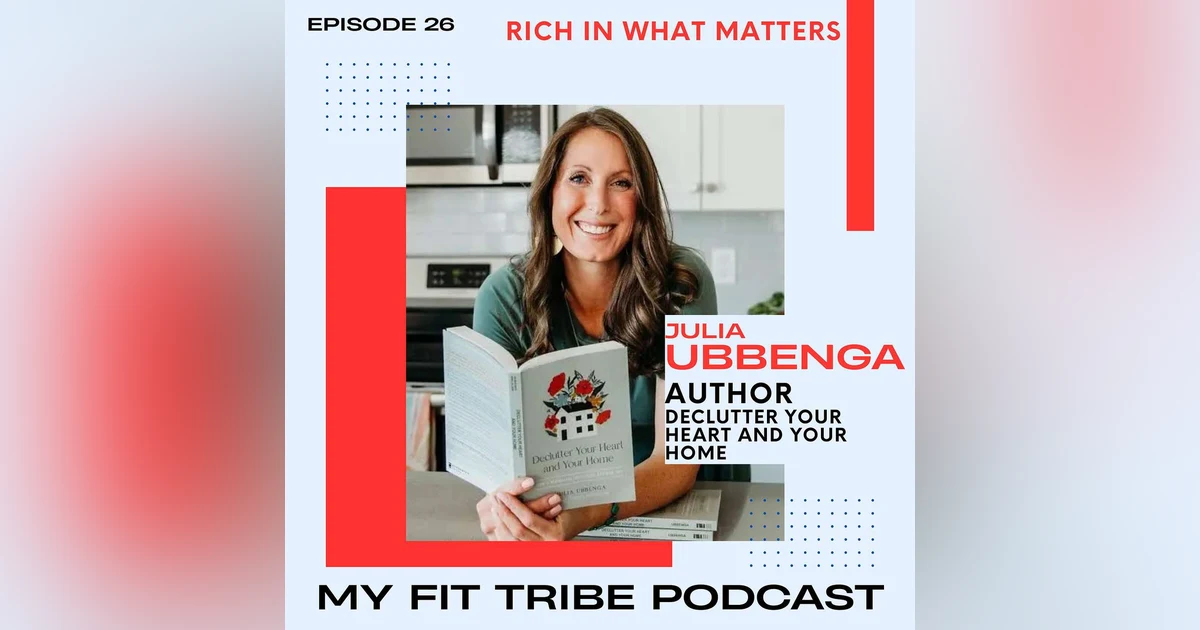
In today’s episode, we’re joined by Julia Ubbenga, who shares her powerful journey into minimalism. She is the Author of Declutter your Yeart and Your Home and Founder of the Rich in What Matters Blog. We’ll explore insights from her new book, packed with practical tips to help you simplify your life and create space for what truly matters.
Throughout my own life and fitness journey, I have had the privilege of meeting incredible people who've shared valuable insights on mindset, health, fitness, and spiritual growth. The profound impact of this knowledge on my own life has inspired me to share it with all of you. I'm Erica Sweeney, host and founder of My Fit Tribe Podcast. Join me as we explore inspiring conversations with experts, thought leaders, and everyday heroes who offer their stories and practical tips to help you on your own journey. From nutrition and fitness to mental well-being and personal or spiritual growth, our mission is to empower you to take charge of your health and live your best life. We are more than just a podcast, we are a community. Through coaching, a wealth of shared knowledge, and a strong support network, we are here to guide and encourage you every step of the way. Come be a part of our tribe. Have you ever felt overwhelmed by clutter? Not just in your home, like your desk, closets, or kitchen drawers, but in your mind and spirit too? In today's episode, we're joined by Julia Abengay, who shares her powerful journey into minimalism. We'll explore insights from her new book, packed with practical tips to help you simplify your life and create space for what truly matters. Let's dive in. With me today is Julia Abengay. She is the author of the new book titled The Clutter Your Heart and Home and founder of Rich in What Matters, a blog that offers tips and inspiring lessons on her journey towards minimalism. Hi, Julia. Thanks for joining me.
SPEAKER_00Thanks so much for having me, Erica. It's great to be here.
SPEAKER_01I love your book. It was just released last month, was it?
SPEAKER_00Yep. In April it was released.
SPEAKER_01It's a wonderful book. So I'm really excited to cover all that you have to cover in this book. Your first chapter that you titled Stressed Out by Stuff, which I think everybody who is listening can agree and relate to that sentence. What was your life like when you would talk about this first chapter?
SPEAKER_00Yeah. So I'm so excited about this book, first of all, Declutter Your Heart and Your Home, How a Minimalist Life Yields Maximum Joy. And I'll start with my story. And it starts in childhood. So I have not always been a minimalist. Pretty far from it. I'm an unlikely minimalist, actually. And I grew up close to my grandma. My grandma loved to shop. So that was her love language to buy people things, to buy me things. She did it whether she had the money or not. It was her just she loved it. And so we strolled the malls together and I learned that shopping was fun. It was a way to feel good. It was a way not to feel bad, to kind of cover up hard feelings. And I carried this mindset with me into my 20s. So I started making money. I started spending money. And pretty soon I had all this stuff and $40,000 worth of consumer debt. So when I thought about the debt, I felt bad. But when I feel bad, I'd go buy something new because that's what I thought would make me feel good and make me feel happy. And so the cycle really continued until the time our second daughter was born. And I was working outside the home as a speech language pathologist at the time, but I'd always wanted to stay home with our kids. That was my dream to be a stay-at-home mom. And so at the time, my husband got a promotion and I could stay home. I was so excited. But I had this really idyllic vision of what stay-at-home mom life would be like. So in my mind, my daughters and I would be giggling over tea parties, we'd be snuggled on the couch, reading a little house on the prairie. So in my mind, it was just going to be great. Well, a couple weeks into the stay-at-home mom gig, I wouldn't have even called myself a stay-at-home mom. I would have said a full-time stuff manager would have been a better title because that is what I did. I was constantly looking for things and cleaning things and picking things up and tripping over things that I hadn't picked up yet. It was all consuming. I was exhausted. I was distracted, like I was there, but I wasn't really there. I couldn't really be present to the people around me. And I was stressed. I was just overwhelmed. So a couple of months into living this way, I was diagnosed with postpartum depression. And my faith is something that I really leaned into during that time. And I have this memory where I was up in the recliner chair, I was feeding our baby, and I was talking with God, really pleading with God. I was like, God, what is going on here? This isn't what I signed up for. Something needs to change. And I was reading the Bible and a couple of verses from Luke chapter 12. They jumped off the page at me. And they said, Your life does not consist of possessions. Be rich in what matters. So I paused right there and I asked myself, was I rich in what mattered? Was I rich in relationships, time for a fake life, time for a hobby that I loved? And no, the answer was I wasn't. So that planted the seed that something in my life, in the area of possessions, needed to change, but I didn't know what. I didn't know where to go from there. But that same week, I had a therapy appointment. And at the end of the session, just as I was leaving, the therapist said, Julia, have you ever heard of minimalism? I'm like, oh, you mean houses with white walls and next to nothing in them? And she's like, No, there's more to it than that. Look into it. I think you might be interested. And so I was curious and did a Google search right there in the car after the session and realized that there's a lot of resources about minimalism. And so I started reading books and blogs about it. I started listening to podcasts about it. And this idea that I didn't need all this stuff to be happy. And in fact, I'd be a whole lot happier with less of it because then I'd have the time and the energy to focus on who and what mattered. It was a mindset shift that was life-changing. And it finally gave me a vision of how to get out from under all this stress and anxiety that I was feeling at the time. So I went all in on minimalism and I started a blog at the time. I called it Rich in What Matters after the verse that spoke to me. And yeah, we let go of 75% of our stuff over the course of the first year. We downsized to an apartment home for a couple of years, got out of our consumer debt, then we built our own intentionally smaller new home. And so we've been living this way as a minimalist family for six years now. And we have five kids, ages 11, 7, 4, 3, and 4 months. And yeah, so then I wrote the book just to help any other women who feel, or anyone really who feels called to live a lighter life with less stuff.
SPEAKER_01Yeah, it's amazing how much we are attached to our things. And I love the way you start with your book. You talk about that first chapter of what your mindset was, but you don't go into like like you can fix it overnight. You really go through your journey of finding out what's gonna work and getting there because sometimes if you jump too quick, it's easy to not follow through, right? So, what did that transition look like when you're like, okay, I'm gonna try this? What steps did you take that navigated you to be successful in it?
SPEAKER_00Well, I think the first thing that I did was I just raised my awareness of what the clutter in my environment was doing to me. And I think that's really the first step for all of us to become aware that the clutter in our home is not neutral. In fact, um, just to look at the research, and that's what I did, that's what helped me. I dug into the research and realized that there's a study out of UCLA that they did. Um, it's been a few years back, but it was a four-year study, and they looked at 32 families, 32 homes in Los Angeles, and they looked at how much stuff was in the home. And then they looked at the stress levels of the moms who are in the home, and they measured their cortisol, the stress hormone. And so what they found was that women who were in homes that they described as more cluttered or messy had higher cortisol levels than those who were in homes that were restorative or tidy. And so in the messy homes, the women's cortisol stayed high throughout the day instead of tapering off in the evening like it's supposed to. And this led to poor sleep, it led to anxiety and stress. And when I read that study, I was like, yes, I can relate to this. This is me, this is true. You know, the average American home now has over 300,000 things in it, and we aren't made to manage that much stuff. And there's a study, too, out of Yale that was done just last year that showed that our brains expend so much energy trying to ignore the visual stimuli in a cluttered environment. So even if we aren't consciously thinking about our clutter, our brain is still trying to ignore it. And this can make us feel distracted. It can make us feel exhausted at home. So if we're looking to get started, realize that if you are feeling exhausted at home and your home is cluttered, that you're not crazy. There's science to back that up, and there's something then that you can do about that.
SPEAKER_01And what I love is you you talk about decluttering your home. But as you say in your book, decluttering your heart, you've got those interior decluttering tips that are so important and you can completely see how they're related. It's just you're just such a beautiful job of writing that. When you started, did you did you understand that correlation would be so deep?
SPEAKER_00No, I didn't. That's a great question, Erica. I didn't. I thought I was just getting rid of my outer physical stuff to just try to have more peace in my in my life. But what I realized is as I was letting go of my unneeded physical items, I was actually creating two homes, like an outer home and an inner home. And the first house, my possessions, but the second, the inner home was the home of my soul. And both of them actually were cluttered. And I couldn't really see that until I got rid of my physical possessions. I didn't really have that ability to look inward and have that space to realize that there's inner clutter too. And in the book, I talk about inner clutter like restlessness, comparison, hurry, reactivity, fear, and distraction. And I give tools on how to declutter these from our lives too. And it's important because, for example, I was caught up in a lot of comparison. And what was happening as I decluttered is that I would let go of my stuff, and sometimes that would give me a dopamine rush, just like buying something new would. Like I felt good. I was letting go of stuff. But then I would look and see something on social media or something that my neighbor had, and I was stuck in comparison. So I thought, oh, I need that too. And so I would buy it back. And so I was caught in this decluttering, buying it back cycle, and I never really could feel that freedom that minimalism in decluttering would offer because I kept buying it back. And so what I did is I tapped into gratitude. It sounds so simple, but I used gratitude as a tool to break free of that cycle of comparison. And what I would do is if I was in my kitchen, say I was scrolling or had been and had seen a kitchen that was beautiful, and all of a sudden I'm like, oh, mine's not good enough. Well, I would stop right there and I would catch that comparative thought, and then I would counter it with three things I was grateful for. So it might look like I have food in my fridge, I'm thankful for that. I have a roof over my head and I'm thankful for that. I have a family in this home who love me and I'm thankful for that. And then I didn't feel like I needed to go buy something new anymore.
SPEAKER_01It this podcast really just shows me, you know, we talk about mind, body, and spirit. And, you know, when you you're training your body or you're working on nutrition, it just seems so tangible. But for some reason, working on that mindset and that spiritual growth is sometimes so hard for people. And it really is so important at in our full wellness to be able to be open to retraining your brain and being open to letting God in for sure.
SPEAKER_00Absolutely. And because I also, as I made space and realized that I wanted to live a healthier lifestyle, I got into like weightlifting, into um eating healthier food, really focusing on nutrition. And I could be doing all that stuff, but if I was still super triggered when my kids left their toys all over the room, or if my home felt like I was drowning and kids' clothes, my stress levels weren't really lower. And so I wasn't really feeling, I'm just feeling better, but I wasn't feeling as well as I could be. I wasn't living my optimal life because of all the clutter that was in my environment.
unknownRight.
SPEAKER_01Um, let's talk about like where does somebody start? So if they're like, I if you can relate to that and they're picturing their home and all their stuff. And when you say 300,000 items, doesn't that just make your mind get blown? That's just crazy. So do you start with a room? You gave yourself a year, right, when you first started talking about starting this journey. So what's step one in your suggestions, advice for people?
SPEAKER_00Yeah, well, I found that I needed to start in the area of my home that was causing me the most stress. So I had read in a lot of decluttering books to start in maybe a small, contained, non-sentimental area like a kitchen drawer. And then that was going to build up my momentum and lead to me decluttering my whole home. Well, so I tried that and I decluttered the kitchen drawer. I had all the feel goods from finishing a project and it was a nice tidy drawer, but then I turned around and my home was still overrun with kids' stuff, kids' clothes, kids' artwork, kids' toys. And I didn't feel any functional change in my home from the way I was trying to declutter. So what I realized was that I needed to start in the area of my home that was causing me the most stress. And what I did is I just listed out all the areas of my home that I wanted to declutter. And then I rated them. 10 was the most stressful area, down to one was the least. And I just went down in that order. And so for me, kids' clothes was number one. That's what I started out decluttering. And as soon as I decluttered our kids' clothes, I felt this lightning in our home that I hadn't at all felt with that kitchen drawer. And my daughter, who, our oldest, who was five at the time, she started helping out with laundry independently because now the amount matched her ability level. And I was like, wow, I am on to something. And so then that really motivated me to go into kids' toys, which was the next thing. But that's how I would suggest getting started. And then also just 15 minutes a day. Um, it's amazing what we can do in 15 minutes a day. That adds up to seven and a half hours a month, which is 90 hours a year. And you can get a lot done in 90 hours. So those small, consistent efforts, they lead to really big changes.
SPEAKER_01So if do you suggest scheduling 15 minutes a day, like the same time, or putting it in your calendar? Or what is your suggestion to making that a repetitive habit?
SPEAKER_00That's a great question. I would say that it's going to depend on what your life looks like, your stage of life. Each day is a little different for me having five kids. Um, I find getting up early and doing it is great. I have a lot of energy then. If I can get up before the kids and declutter for 15 minutes, that's really great. I mean, somebody listening might be working from home and then they have a lunch break, and you can schedule that into your lunch break, do a decluttering lunch break, or maybe when you're on a call, you can declutter while you're listening into a call at work. So I think you just got to look at your schedule and then on the weekend for the week ahead, decide when am I going to declutter and then write that into your calendar and keep that commitment, just like you would a doctor's appointment or something else that means a lot to you because this is life-changing work.
SPEAKER_01I'm just thinking of decluttering. So think you already. So if we're scheduling it, do you and you do the 15 minutes and you talked about starting with your most stressful space, then do you pick just one drawer in that space, or what does that even look like? Mm-hmm.
SPEAKER_00Yeah, I mean, I would. I would say if you only have 15 minutes, just do what you can in 15 minutes. Any any progress is better than none. You know, some people might like to designate a decluttering weekend, or if you have kids, you know, have them go to the grandparents' house for a weekend. And then maybe you want to tackle one whole area. Say you want to declutter a whole closet in a day, or you want to declutter, you know, a whole category like kids' clothes in a day. So you there's a lot of flexibility with it in what you think works for you. I've heard people who have ADHD prefer to do one big category at a time rather than kind of chipping away at things because they like to just start and then finish. Um, so I think there's a lot of different ways to do it. What I found as a mom of you know five now with um a full schedule is that the 15 minutes a day really I can really just chip away. And then I'm consistently thinking about it too, where I'm starting to view my home in a different lens. I'm looking at things and questioning whether they belong in our home. When I walk into the bathroom, suddenly I see the empty bottles of product that are still sitting there for no reason. And so when I'm I can just grab those as I'm going through my house throughout the day. When I'm putting away laundry, I notice clothes with holes in them and I can take those away as I'm in my home. So yeah, I just think that you can adapt it to your lifestyle.
SPEAKER_01When you talk about the kitchen, which I love, because the kitchen to me is seems it's chaotic in my life, um, is the power of half. And I love how you're like, if you have 14 coffee mugs, put seven in a box and put it away and see if you ever need them. Because that is so true, because I probably have 14 of them and I probably use two. So I love that tip. So if you're looking at the kitchen, uh can you expand a little bit on that kitchen philosophy?
SPEAKER_00I love this tool, the power of half. In our kitchen, we have so many duplicate items, and we really have more than we need, most of us. I've had one spatula for the last six years, and it's been great. You know, that might not be for everybody, but that's worked well for me. Um, we we don't need 14 coffee mugs, most of us. So I like the idea of just going into your kitchen, into each area of the kitchen. So things you drink from, the pantry, the utensils, and seeing if you can reduce the amount you have by half. Then box them up. You don't have to let go of them right away. And I like to put them in storage for a bit and then see how your kitchen feels with less stuff. It's likely going to feel a whole lot better and lighter. And after a month or so, you'll know what you need. If you needed something else, you can grab it from storage and bring it back. But you probably won't need much, you probably won't miss much. Um, but if you do bring it back, I had to bring back more spoons when I did this and decluttered. So, this is the way also that you find out what is enough in your kitchen? How does that feel? Because most of us know what it feels like to have too much, but we don't really know what it feels like to have too little. So I say be ruthless with this experiment. Put away more than you think you need to. You can always bring it back. And once you're bringing stuff back, then you'll reach that level of enough in your kitchen.
SPEAKER_01I love that. And then when you talk about closets, you talk about writing out the intention, which you talk a lot about journaling, not only again for that cleaning up that outer clutter, but that inner clutter to really like sit down and have those moments of gratitude and establish what that intention is. So getting back to outer intention, the closet. I love this. So you recommend having a real true vision of what that closet is, pulling everything out and then starting with nothing. Can you talk a little bit more about that?
SPEAKER_00I think it's so important when we look at our spaces to ask ourselves first, what is my intention for this space? What do I want this space to look like? And then if it's not looking like the way you want it to, or if it's not serving its purpose, you can do something about that. We have agency over that. And so, yeah, for the closets, I like to take everything out of it and then just put back in what I want so that it matches that vision that I had initially. And then again, you can box the rest of the stuff up. You don't have to get rid of it right away. The reason I like this tool of putting things away for a while is because there's a term in psychology called the mere exposure effect. And it says that we are more likely to hold on to our stuff simply because we're exposed to them daily. So if it's something you see often, your brain naturally thinks that it belongs in your environment. And it's gonna be hard to let go of. But we can break that when we take things and put them away in storage and your brain doesn't have that attachment to it that it did when it saw it every day. So I really like that tool. And then, yeah, once you set an intention for a space and you make your space align with that intention, I think that that has ripple effects in your life. I think that you then start questioning your calendar commitments, your self-talk thoughts. You start questioning everything. You need everything to match the intention you have for your life, not just your space. So I do think there's connections between the way your home, your outer home looks and feels and then your inner home and how it operates too.
SPEAKER_01Yeah, and there's so much noise in our life now. I mean, as you talk about in your book too, with phone and social media and just there's so much noise. So to be able to quiet some of that, including the clutter in your home and the phone and the time and your intention is just seems so powerful. It's hard to do, I think, for most of us just because it's so much. So it really takes intention to be able to do that.
SPEAKER_00Yeah, it does, especially the digital piece. I think that if we're looking to live lives intentionally, that we can't overlook the digital piece because you know our phones are with us all the time and we are distracted by them. I've heard them called weapons of mass distraction. And I I like that term. I think that's accurate. Um, I found this to be true as I started blogging and I started having a presence on Instagram. I found that I was constantly grabbing my phone and checking how many blog hits did I get? Do I have any new Instagram comments? And that was really pulling me out of my life. And I wasn't as present to the people around me, even though my home was decluttered, even though I felt really great and peaceful in my home. Now my time was being hijacked by this device. And so some things that I did that I found helpful was I put my phone on grayscale. They did a study with college students that showed that they spent 40 minutes less time a day on their phone if it was in grayscale, not as enticing if it's not as colorful. I put a rubber band around my phone so that when I tried to scroll, I had that tactile cue to stop me and make me, you know, think do I really want to be doing this right now? And I also just started putting it on airplane mode at night and not turning it on until the next morning. Until I was really ready to interact with it, putting it in a different room at bedtime, not within arm's reach. And so these types of things helped me out a lot. What I found really, though, Erica, was that when I wanted to scroll, when I wanted to distract myself with my phone, what I really wanted was connection. And I think the antidote to distraction is connection. But again, I had to make that choice than to put down my phone and go read a book with my kids or to go take a walk with my husband. Or just to know first the intention for my life was to be closer to them. And so when I saw myself looking to scroll, then I could redirect and I could go be connected with them, which is what I wanted anyway.
SPEAKER_01Yeah, that redirect is so powerful for sure. Getting back to outside clutter real quick, because this is something that that I found a lot of people bring up to me when it comes to getting rid of things. Um, first off, there's a sentimental difficulty. And then secondly, it's how to dispose of it. Um I did a post a couple, it might have been even a couple of years ago, talking about getting rid of something like every Thursday, just a throw away Thursday. And I got a lot of like negative responses of, oh, you're gonna fill up the landfill. And I'm like, well, I get that, but if you get rid of it, it doesn't mean you're adding more and you have it anyways. So can we talk a little bit about the proper disposal of items and ways to address that along with dealing with that sentimental piece?
SPEAKER_00Yeah, well, I think that it's great to use tools like Facebook Marketplace or Buy Nothing groups. You can even set something out on your curb, post it on a buy nothing group and see who comes by and gets it. You you know, you don't have to do much other than set it out and somebody will take it, and then you don't have to worry about how do I dispose of this. Now it's in somebody else's hands. Um, I really like donating versus selling. Um, also like higher-end items will sell, furniture, maybe some clothing, but really um we overvalue our stuff a lot of times. People aren't going to want to spend as much as we think they will for our stuff that's used. So yeah, just get it out of your home and donate it. I really like donating to a cause that I feel good about. Um, maybe something that's proceeds go to a um cause that you love. So yeah, so I would recommend donating for sure. And then for the sentimental piece, um, that's hard. That's real. I mean, we we think that our memories are found in our stuff. And they're not. Our memories are within us, they're not within our stuff, but it feels like they are. And so to let go of something sentimental feels like we're losing that memory. Maybe it's something we inherited from somebody who we love, and we feel like that person would want us to keep that item. So, first acknowledging that that our memories aren't found in our stuff, and you know, we can take a picture of the item, and that can preserve the same memory, and we don't have to keep it as clutter. Uh, a lot of us have just boxes of sentimental stuff at home, Erica. A lot of us have our garage full of boxes we haven't looked at in years, or our basement, or the back of our closet. And what happens then is that we aren't actually getting any value out of those things because we're not seeing them, we're not interacting with them. Um, what I did that I've really loved is that I now have just one basket of sentimental items and I put it up on my shelf in my closet and I can pull that down and I can look at it anytime I want to. I can show it to my kids. They can see my grandmother's slanted handwriting on a card that she wrote me. They can see a little camel that I got when I traveled in Egypt along the Nile. And those stories come to life when I bring those objects out and I let them hold them and I talk to them about them. And that wouldn't happen if they are boxed away in my garage still. So I would say when sentimental items, just keep your favorites, just keep your favorite things, help those memories come to life. And the other stuff you can take a picture of. There's a tool by the minimalists, it's called the spontaneous combustion question. And this is helpful when decluttering sentimental items. You can grab an item and you can ask yourself while you hold it, how would I feel if this item spontaneously combusted? Would I feel bad, then you want to keep that item. Would I feel good, then you want to let that item go? And if you're kind of in the middle, just take a picture of it and then let it go. So I found that really powerful.
SPEAKER_01Yeah, it's amazing how much we attach our memories to things. Um, I lost my dad a couple years ago, and I still have some items that I am just holding on to just because I wasn't ready to part with them yet. And I'll have no use for them other than they're his. But that is just letting that go. It's definitely harder than I thought it would be. For sure.
SPEAKER_00I don't think we need to let go of all the things either. It's good to keep some sentimental things. I think that's important. But we don't want to keep like a whole storage unit full of stuff or a whole basement full of stuff because I don't think our loved one would want us to feel weighed down by clutter.
SPEAKER_01Right, for sure. Let's talk a little bit about your grandma because she was such a you mentioned at the beginning about what an important part she was in your life. Can you talk about that moment when you had that phone call with her?
SPEAKER_00Yeah, right. So um I, as I decluttered our outer world, my outer world, I started feeling my um spiritual life grow. And as a Christian, I would say that I have felt the Holy Spirit's promptings begin to work in my life as I made space in that inner home that is the home of the Holy Spirit. And so I had this overwhelming urge one day to call my grandma. And I was about to go get coffee with my girls. I didn't really want to go make a phone call then, but um, just again, this overwhelming urge to call her. And so I did. I picked up a phone and dialed. We talked for about 20 minutes. My kids got to talk too, and um it was a great conversation. Hung up the phone, then we went and got our coffee. Well, my grandma ended up passing away five days after I made that phone call, and nothing could have prepared me for the timing of her passing. It was completely unexpected. And I um just was so thankful that I was able then to have that space inside that I could feel those type of promptings by the Holy Spirit. And I also talk about in the book how her funeral really gave me some clarity on how important it was to detach from my possessions because I had been pretty attached to them before that. But there was something about that moment when I laid that rose on her casket in the cemetery that I realized our possessions are so transient, so fleeting, so temporary, just like just like life. And I began, um, I started to view my possessions then as things that were passing, like a bubble or an ocean wave or a firework, things that you could observe in the moment and then you could let them go. Because none of them really were ours in the first place. And we're just here to be stewards of them. And that helped me detach and then declutter.
SPEAKER_01Yeah, and it really makes a difference too, you know, as you know, as as I'm getting older, as our parents get older, you also don't want to leave all that stuff for your family to have to take care of if something does happen to you, because that can be a huge burden too, to have to have your own. Yeah, absolutely.
SPEAKER_00And that's why I think it's such an important thing for us to only keep our favorite things as we journey through life. Because then at the end of our lives, if we've curated this collection of just our favorite things, our loved ones are gonna know what was important to us. They won't be overwhelmed by our stuff because it's a limited amount. And then I think those stories of our life, that legacy that we want to leave, becomes it becomes real if we are intentional throughout our life with what we keep.
SPEAKER_01Yeah. And also, like you said, prioritizing spending time with our loved ones. Um, I I love how you talk also about people giving gifts and how hard it is when they're gonna want to give your kids toys and you don't really want them and how you approach that. For all the moms out there, I do want to have a little talk about that.
SPEAKER_00Yeah, gift giving is real. I mean, most of us have a loving grandparent who wants to just dote on our kids, wants to fill their hands with gifts when they see them or at Christmas or at birthdays. And so to have a plan for gift giving is real. Um, first of all, realize that we are the gatekeeper of our home. We get to decide what comes in. Um, with gifts, though, I think it's important to welcome them lovingly. The point of a gift is to show love and you can receive that love. And then once that gift has been given, the gift has served its purpose. Then you can decide what you want to do with it. There's no obligation to keep anything that comes in to your home. And I think that if people love us and want us well, they would respect that decision then that we get to do what we want to with our stuff. Um, it can be really helpful to tell somebody exactly what you want them to do when it comes to gift giving. So don't go say, hey, just don't give us any gifts, but tell them what you want them to do. So maybe, you know, hey, we would love to have a Zoopass now. We want to focus more on experiences now that we have five kids. Our um our house is already pretty well filled with things. So we're very grateful you want to give our kids something, but let's do something that's an experience, like a Zoopass.
SPEAKER_01I love that because you're reframing it in a very positive way. And still, like you said, creating those experiences is what you really want, anyways. My kids do not remember a single Christmas present I ever gave them. I asked them a couple years ago, like, what was your favorite when you're growing up? And they were like, uh, they they really didn't remember many after every holiday, worrying about getting the right thing and wrapping it just right. They don't remember any.
SPEAKER_00I believe that, Erica. I totally believe that. We once gave our kids the gift of an indoor water park. It's called Great Whif Lodge near where we live. So we went to Great Wolf Lodge for Christmas Eve, actually. We spent Christmas Eve there, and that was their gift that year, and that was a few years ago. And they're still asking, they remember that. They're still asking. The other day, my daughter asked, Hey, for Christmas this year, can we go to Great Wolf Lodge? Like they don't remember their gifts. They don't remember what they were given. And oftentimes they break or they forget about them within a few months after receiving them. But they remember that memory, they remember that trip to the water park. And so there is something to those experiences. They stick with us way more than more stuff.
SPEAKER_01Way more, way more for sure. Um, talking again about the inner clutter, you talk about reclaiming your time, which we discussed a little bit with social media. And but you also talk about spending time in silence. And that one really resonated with me because, you know, when I'm driving in the car, I'm listening to podcasts or music, or if I'm at the gym, I'm got all this noise. And again, keeping that noise level high. But I've noticed recently that sometimes I just want to drive with no sound at all, just to connect with my spiritual side and myself and have that conversation and how important that has proven to be. Talk a little bit about that.
SPEAKER_00Yeah, silence is so important. We live in a culture that's addicted to noise, it's become our baseline. And I don't think we were designed for noise to be our baseline. Um, in my experience, on the days that I am more quiet, when I carve out more quiet time, I feel different in my in my soul. I can feel connected with God, a higher power. And um, I don't feel that on the days I fill my days with noise or scrolling or there's some research too when it comes to our compulsion to grab our phones, that the more time we spend in silence, the more it helps balance out our brains. I write, I write about it in my book. It's like the liking and the wanting system. And so when there's addictions, the more balanced these can be, the better. And so silence can do that. So the more silence we have, the more these systems in our brain are balanced, and the less likely we will be to compulsively reach for our phone. So not only does it help our spiritual lives, um, but it also can help break addictions like phone addiction, I think.
SPEAKER_01Which is a real thing for sure for all of us. Yeah. So what do you think that you have learned the most? Like could you pick a top one thing of the outside clutter and inner clutter that you have learned through this journey?
SPEAKER_00Oh. I think that I have learned that families really have one nervous system. And I think that if the mom of the home is living in chronic stress because of the state of her home, it affects everyone around her. And this was my experience, and I hear it from so many moms that I work with too, that if we can change the state of our home, which we can because we have agency over that, that we then not only are we simplifying our environment, maybe for our kids, to spend more time with them, but also for our own health, for our own well-being. We're changing our physiology when we change the state of our home. And this makes our nervous system have more space to be in this rest or digest state instead of fight or flight. And we know fight or flight leads to chronic illness. And just we can't really experience life deeply if we're constantly feeling that stress. And then our kids will also feel stressed too. So I think that what I've learned is that decluttering is a game changer for our own health, but then also for the people around us too.
SPEAKER_01Yeah, and that goes really again for the outer clutter and the inner clutter hand in hand. Let's talk a little bit about the weekly maintenance and the monthly maintenance. I wanted to check about scheduling that and what to do in those maintenance schedules.
SPEAKER_00Yeah, so maintenance decluttering is important once you've gone through your home and you've got it decluttered. You have to have a plan to keep it feeling decluttered. So for maintenance decluttering, what I do that I've found really helpful is I schedule four weekends a year that are my decluttering weekends. And sometimes I do this right when the seasons change, or maybe I can just pick four weekends on, you know, quarterly on the calendar. But um then I just go through my home and go through every area and just question everything in my home and make sure that there's nothing in there that isn't supporting us that we don't use, that we don't love. And um, yeah, also you can think of certain daily habits that are helpful, other than just these quarterly um commitments. You can also do daily habits, which are such game changers in keeping your home cluttered. Because what I found is that clutter attracts clutter. So if you start putting your keys and your mail down on your countertops, then you're gonna start having, you know, sweatshirts and hats and whatever, it just accumulates. So you need to have a home for everything. And if it takes a minute or two to do it, do it now. So putting your keys in a little jar, do it now. Putting the paper in the paper box, do it right away. You can make your bed. Um you can just put everything back that you see out. So the the idea is don't put it down, put it away. And I think that that mantra really can help people keep their home feeling calm when it's lived in during the day.
SPEAKER_01Yeah, my husband said that to me recently because I would put something down and say, oh, I'll I'll put it in my car later so I remember it. And then I forget it anyways. So I have been really good now because I forget. So I put it away right away, so it goes where it needs to go. That's a great, great advice for sure. Do you have any other um advice that you would uh like to offer to our listeners before we wrap it up today?
SPEAKER_00Yeah, one thing to know about decluttering is that there is a study that showed that decluttering your house reduces the amount of time spent on housework by 40% in the average home. So if you're spending 10 hours a week cleaning and maintaining your home, you get four of those back simply by owning less stuff. And think what you could do with four more hours a week. You could write a book, you could, you know, do nothing, you could rest, you could pursue whatever interest you would like. So I think it's such a game changer for us who often say, we don't have, I don't have time for that. I don't have time. I'd like to do that, but I don't have time. Well, when you declutter your home, you will have time.
SPEAKER_01So, how do people find you if they want to get your book and follow you on your blog?
SPEAKER_00Yeah, the book is available anywhere books are sold. Again, it's declutter your heart and your home, how a minimalist life yields maximum joy. So you can find it at your favorite place to buy books. And then you can find me at my blog, which is richinwhatmatters.com or on Instagram at Rich in What Matters.
SPEAKER_01I am so excited to declutter. I'm still trying to figure out what the source of most stress is, but I'm gonna I'm gonna hit that refrigerator, condiments, I'm gonna hit those that spice cabinet, those things that just you put something in there and forget about it for way too long.
SPEAKER_00So yes, you feel much better in your home when it has order and doesn't have the clutter. That's awesome.
SPEAKER_01So I'm gonna wrap this podcast today by asking you a question that I ask all my guests. It's a two-part question. So if you, Julia, today could have a conversation with Julia of the past, the Julia that was had just had your second child and you're suffering from postpartum and you feel totally lost, what would you tell Julia of the past?
SPEAKER_00That's a great question. I would tell her, and this is a quote that I used in my book too, and it's one that I hear occasionally, but I hadn't heard it before. And I would tell her whether you think you can or think you can't, you're right. I love that one. Yeah, I think that we have so much power in our mind that if we decide to do something and we want to do it badly enough and believe that we can, we can.
SPEAKER_01So now if you, Julia today could have a conversation with Julia of the future. You can pick 10 years, 20 years, 40 years, however you want. And you're sitting in your favorite place without clutter and um having a conversation with future Julia, what would you ask her? And what do you think she would say back to you?
SPEAKER_00I would ask her, uh Did you have the meaningful relationships that you craved so much throughout your life? Because knowing now, I know that's what is most important to me, it's it's relationships. And so I'd ask her, how are your relationships? How were they? And she would say they were great. She would say they're exactly the way that she imagined they would be, that she has a close relationship with her kids, with her husband, and with herself and with God.
SPEAKER_01Yeah, that's a beautiful thing to tell yourself. I love that.
SPEAKER_00Yeah.
SPEAKER_01Wonderful. Thank you for joining me today.
SPEAKER_00Well, thanks so much for having me, Erica. It was a fun conversation.
SPEAKER_01Thanks for listening to My Fit Tribe Podcast. Tune in weekly for our latest episode for more health and wellness insights and inspiration. For more information, visit myfitribe.org. Please note that the opinions and comments presented here are those of the guests and do not necessarily constitute medical advice or the opinions of My Fit Tribe. Copyright 2025, all rights reserved. This podcast is a production of MyFitTribe LLC. Don't forget to download, subscribe, and follow the MyFit Tribe podcast so you don't miss an episode. Thank you for your support.