Dr Stephen Trzeciak- Why Serving Others is the Best Medicine for Yourself
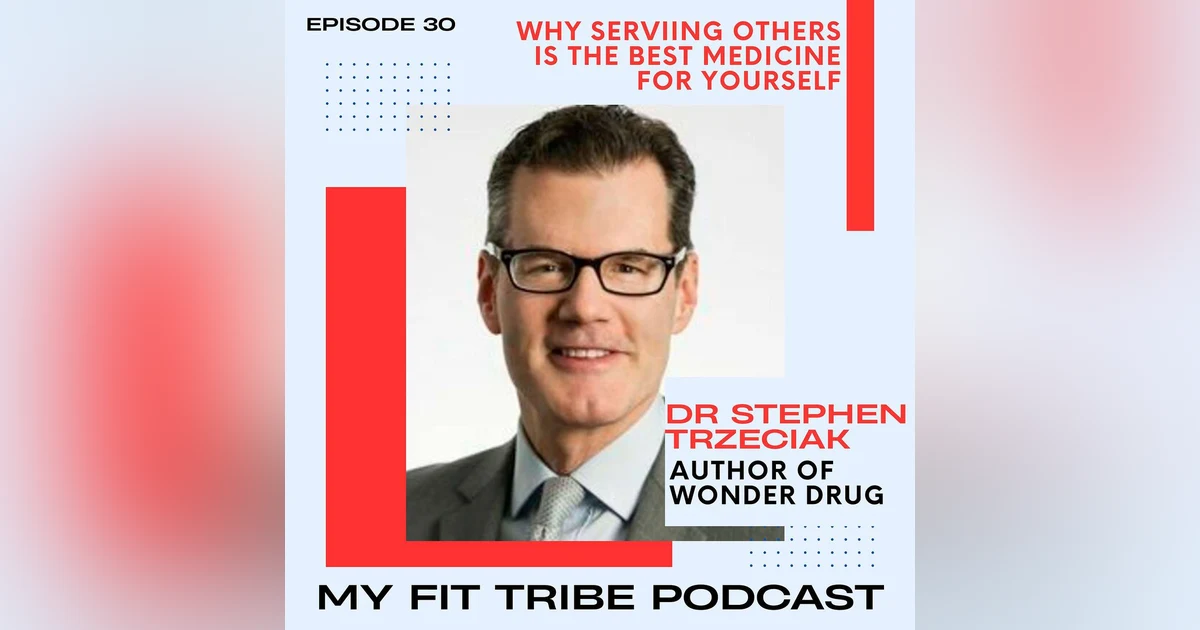


In this episode I had the privilege of sitting down with Dr. Stephen Trzeciak, the Co-Author of Wonder Drug. We talk about science based evidence supporting how helping others is not only the right thing to do, but the smart thing to do. He writes a prescription for a healthier life—by helping others.
We’ll also touch on his new study about hope and its proven benefits—not just for patients, but for all of us.
21:19 - [Ad] Just Be True ~ A Soul-Led Podcast
22:05 - (Cont.) Dr Stephen Trzeciak- Why Serving Others is the Best Medicine for Yourself
Throughout my own life and fitness journey, I have had the privilege of meeting incredible people who've shared valuable insights on mindset, health, fitness, and spiritual growth. The profound impact of this knowledge on my own life has inspired me to share it with all of you. I'm Erica Sweeney, host and founder of My Fit Tribe Podcast. Join me as we explore inspiring conversations with experts, thought leaders, and everyday heroes who offer their stories and practical tips to help you on your own journey. From nutrition and fitness to mental well-being and personal or spiritual growth, our mission is to empower you to take charge of your health and live your best life. We are more than just a podcast, we are community. Through coaching, a wealth of shared knowledge, and a strong support network, we are here to guide and encourage you every step of the way. Come be a part of our tribe. In this episode, I had the privilege of sitting down with Dr. Steven Treziak, the co-author of Wonder Drug. We talked about science-based evidence supporting how helping others is not only the right thing to do, but the smart thing to do. We'll also touch on his new study about hope and its proven benefits not just for patients, but for all of us. This is a prescription you'll definitely want to fill. Today's guest is Dr. Steven Treziak, a physician, scientist, professor, and chief of medicine at Cooper University Healthcare. Dr. Treziak is the co-author of Wonder Drug: Seven Scientifically Proven Ways That Serving Others is the Best Medicine for Yourself. In his powerful and practical book, he and his co-author reveal how acts of kindness and human connection can not only improve the lives of others, but transform our own mental and physical and emotional well-being. Hello, Dr. Treziac. Thank you for joining me.
SPEAKER_01Erica, it's so great to be here. Thanks for the invite and great to reconnect with you.
SPEAKER_00Yeah, so Dr. Treziac and I go way back to 1986-ish when he took my sister to homecoming. So we haven't talked to each other in 40 years, but um we're looking forward to this conversation. Um let's talk a little bit about what started you on this research project.
SPEAKER_01So I'm an intensivist, and uh that means a specialist in intensive care medicine. So in my clinical job, I often meet patients and their families on what they might consider to be the worst day of their life. And much of my research uh as a uh clinician and a researcher was focused on a field called resuscitation science. So I had grants from the NIH to try to find what was the optimal level of oxygen in the blood to reduce the risk of permanent neurological injury after a patient's resuscitated from cardiac arrest. And now I study things like compassion, kindness, and hope. So it's a bit of a change in trajectory. And really that change in trajectory was I um I tend to gravitate towards the big questions. A little uh factoid about me is that when I was an undergraduate, I was actually a philosophy major. And I was actually a terrible student of philosophy, but I did I did learn how to gravitate towards the big questions. And while the the work that we were doing in resuscitation science was important, it wasn't what I considered to be the most pressing problem of our time in healthcare. And the bigger questions were things like, does compassion really matter? And that was in the context of tons of data that we've got an erosion of compassion uh in in the healthcare field. Um, the next question was what is the evidence-based way to live your life? Like, what is the evidence on that? Meaning, should it be all self-focused, like it's all about meism, or are there actual tangible biological and clinical benefits to leaving a life where you're focused on helping other people? And more recently, I've been focused on the science of hope. Like, does hope really matter? If it matters, when does it matter? When does it not matter? How much does it matter? And um what is the the magnitude of the effect and the responder phenotype, so to speak? So I'm definitely uh the science nerd of your friends from high school, but I've applied that lens to some of the questions that typically we we just think about in the uh moral ethical lens or emotional sentimental lens or philosophical theological lens. And and I try to apply the lens of science. And so the way I explain it to people is I like I like to look at familiar things in unfamiliar ways, and that's how the work pivoted and changed its trajectory.
SPEAKER_00So I'm trying to determine the transition between deciding that you're gonna do research on something that is so broad. I mean, I can imagine you're you're burned out and working in this high stress environment, and then all of a sudden you decide to study compassion. Like what was the transition into that?
SPEAKER_01So there's actually an unexpected question from a 12-year-old that literally turned everything upside down and made me change that trajectory of my life's work. So that 12-year-old was my son. And one day we one evening we were at home and he asked me for help. He said, Dad, I know you give a lot of talks in your research. I have to give a talk for my class at school. Will you help me prepare mine? And I thought, this is gonna be so awesome. What an amazing father-son bonding opportunity. Little did I know what was in store for me. So I said, What's your talk about? And he reached into his backpack, pulls out a sheet of paper, and he puts it down on my desk. And on that sheet of paper was the topic for his talk at school. It was a question, and the question was this what is the most pressing problem of our time? Seventh grade. So I I don't recall what you and I were doing in seventh grade uh in in our school, but we were not doing what is the most pressing problem of our time. And so what it did for me, uh, well, for us, really, it set off a conversation. So a dialogue that evolved over a few nights. And the answer that we came to is there's there's no such thing as the one single most pressing problem of our time. But the urgent question is what's the most pressing problem of our time for you? Through your lens of experience, in whatever little corner of the world you occupy, whatever scope of influence you have. And let's face it, life has seasons. So, whatever season of life you might be in. And so I knew that the work that we were doing uh had importance and we were getting grants and citations and publishing in good journals and all that. But I had to ask myself, uh, my wife calls it a midlife crisis. Um, what is going to be the most pressing problem of our time for me right now through my lens of experience as a as a uh physician scientist and researcher, as the chair of the department of medicine at our medical school? And I'm, you know, I've got uh like you know 500 physicians that I'm responsible for uh in some way or another, um, through that scope of influence or or you know, whatever um whatever influence that I might have, what's the most pressing problem of our time right now uh for me? Um and that that is uh that uh taking that approach um has really lit a fire under me and the work that I'm doing. And and that that's really what sparked the pivot, so to speak.
SPEAKER_00So let's talk a little bit about the seven proven ways that serving others is the best medicine that you outline in the wonder drug.
SPEAKER_01So the the first question is, is does serving others really matter? I mean, we know it's the right thing to do. Like we've always, you know, um been taught that, you know, going way back. Uh the importance of serving others is like a common thread through almost every world religion and and uh philosophy. But is it just the right thing to do, or is it also the smart thing to do? So we we took an evidence-based approach. My colleague and co-author, Dr. Anthony Mazzarelli, he's uh uh an emergency physician, but also the uh co-president CEO of our health system. We took an evidence-based approach. We reviewed over 250 original science research papers and curated that evidence and found that that serving others doesn't just matter in meaningful ways, but also in measurable ways. So there are biological effects of serving others. Now, consistently over time, that is. It's not a one-and-done sort of thing. If you do it routinely and you build it into the fabric of who you are and it just becomes natural for you, it's not like uh uh a one and done where that would be like if I if I eat broccoli one time, I'm, you know, I'll be set till I'm 90, right? Yeah, of course, it's something you have to do every day. So there are biological effects. And then there are uh effects related to longevity, so just longer life, but as well as quality of life on many different uh facets of health that these biological changes, if sustained over time, can be helpful to you. There are a myriad, uh, and this may be intuitive to some extent about mental health benefits of being other focused rather than self-focused. Um, self-focus tends to lead to things like rumination and all that. And when you're other focused, you get out of your own head. And the data support that um serving others helps you to forget your own worries at least temporarily, temporarily. But there are also effects on uh one's uh professional life uh as well and happiness and well-being. So the first question really is does it matter? Um, meaning, is it is it good for you or not? And then if it is, that's where we get into the seven evidence-based principles. So I'm yeah, I'm happy to go down that list if you like.
SPEAKER_00Yeah, let's dive into that.
SPEAKER_01So the first one, uh, and we have uh, as I said, 250 original science research papers backing up everything that we share in Wonder Drug and our earlier work in the science of compassion, which we call compassionomics. Uh, but uh the first uh so we so what and the reason why I tell you that we've curated that much evidence is because it's not what I what I share with you uh either today or in these books, it's not what I think. It's not what I feel or my opinion or belief or anything like that. It's just what we found in a systematic journey through the available published scientific evidence in peer-reviewed journals. So it's just what we found. And the number one step uh of the seven different principles is to just start small. So one does not have to uh sell all their worldly possessions, quit their job, move to a third world country and start hauling water from a distant well. You don't have to do that. Rather, you can just look for little micro acts of serving uh in the people who are already in your orbit. So it's not a change in your environment that's needed, it's a change in the experience of your environment. And what researchers call that is a personal paradigm shift. So it's just looking for those opportunities to help and to serve in just the mundane, routine, um, day-to-day of life. So start small as a first principle. Number two is be thankful. And you've heard many times, probably most of us have, that an attitude of gratitude is good for you. And it definitely is, and the science behind that is very robust. But what we did in our um quasi-systematic review and meta-analysis is we looked at the why. Why is it that gratitude's beneficial? What the synthesis of that literature shows is that when, and this has been shown in a meta-analysis of over 70 different published studies, when your mind is uh in a mode of gratitude, it opens your eyes to opportunities to help and serve others around you. You see them more easily. And so one of the one of the reasons why an attitude of gratitude is actually good for you is probably because it opens opportunities to help and to serve, to get out of your own head and focus on helping other people and getting all the benefits of that. And so being thankful and an attitude of gratitude is very good for you. Uh, the next one is what we call see it. You need to be able to see into the goodness of others routinely to understand what the norms are in our workplaces, in our communities, our neighborhoods. For example, in my training program, I have 150 trainees in the Department of Medicine. I have 85 resident physicians training in internal medicine. And at the monthly meeting of all those physicians, we do something called praise cards. And these praise cards are when you can submit always anonymously uh something that you know that one of your co-residents, uh your colleagues did that was above and beyond for somebody else, and that was totally awesome. And it's, you know, we've got folks on the day shift, the night shift, the weekends. And so if we don't have a line of sight into those things, we'll never know how great people are. And so what happens is when we read these praise cards, we see how incredible our colleagues actually are, and we understand better the norms for helping and serving others. And what the research supports is that when you do that, it makes you want to raise your game yourself because you understand that that's how we do it around here. That's what these people are about. And and some of these praise cards are quite shocking. We never would know that that person did that for that patient or that patient's family. But being able to see it is really important. One of those that is perhaps the most challenging, but the most timely, is what we call find common ground. So we are in an era where people seem more divided and polarized than ever. And what the research points to is something called parochial empathy, parochial empathy. So what that means is behaviors where, hey, these are my people over here. I'm gonna take great care of them. I'm gonna show them kindness and compassion and love and take great care of them. But those people over there, you know, they don't think like me or look like me or vote like me or whatever. So I'm not gonna, I'm I'm just gonna take care of my own. What the research collectively shows is that when we practice parochial empathy, we actually behave worse on balance across all behaviors. So we think we're doing a good job taking care of our own, but we actually get a little bit worse on balance when you look at how we behave towards everyone. So finding reasons to put people in our in-group rather than our out group is super important.
SPEAKER_00Yeah, I'm gonna hop in there on that. So the common ground was one that I highlighted because I think, again, with the environment of today and social media and politics and everything, uh, so many people forget that we are all together to help each other and how important that is. Um you talk a little bit about um about the the impact of helping others and what it does to your body. And you're talking about um, you know, changing your your nervous system. Let's talk a little bit about that when you step outside yourself and and focus on someone else helping someone else away from your problems, what that does to you physically.
SPEAKER_01Sure. So we call it the fantastic four. Um, and uh many of your listeners may have heard this before, but there are molecules that circulate uh in your body, such as endorphins, um which are also the same molecules that are associated with the runner's high to tie into your fitness themes as well. But also dopamine, serotonin, oxytocin, in general, these um molecules they are upregulated and they are on average boosted when we consistently are being other focused and serving others and getting outside of ourselves rather than going deeper withinward. In addition to that, there is a fine-tuning of the nervous system. So in the nervous system, there is what's called the autonomic nervous system. So there are two sides. One is the sympathetic nervous system, that's like the fight, flight, or freeze. And many of your listeners are probably familiar with that. It's it's what happens to the gazelles when their heads shoot up uh on the savannah when they think that there's a lion uh about to pounce on them. The other side of that is the parasympathetic nervous system, which has been called rest and digest, but it's basically the chill side of the nervous system. When you feel um completely at ease, um it's a soothing feeling. What the totality of the published evidence shows is that when we are focusing on others, that it uh tilts the balance of the autonomic nervous system towards the parasympathetic nervous system. What it means is it fine-tunes the nervous system in a way that is less stressful. And in addition, serving others, if sustained over time, buffers stress, your stress response, as well as any increase in mortality risk that can be associated with chronic stress. So cortisol is what's released in a stress response, in a chronic stress response. And if you live in a cortisol-soaked environment, like a very toxic workplace or something like that, there's tons of evidence to support that that has uh negative effects on your health. And so focusing on other people just buffer and blunt those sorts of responses. And it there's even evidence that consistently serving others changes gene transcription so that chronic systemic inflammation, which gets a lot of attention now, is being at the root of things like cardiovascular disease and cancer, that chronic systemic inflammation can also be blunted. So it primes and fine-tunes both your uh neuroendocrine as well as your nervous system uh for uh good health effects. But again, it has to be sustained over the long term.
SPEAKER_00Yeah, I found that fascinating because I think most of us live in that sympathetic state where we're always on fight or flight and we really need to make intentional changes in our lifestyle to try to calm everything down. And what better way to do it than to start by helping others? When you talk about starting small, you mentioned um that we have what nine opportunities a day to be able to help people.
SPEAKER_01So there's a there's a study from the University of Toronto which asked the question, how many opportunities do we have every day in every in regular life? So this is not a healthcare study. And very rigorous methodology. What the researchers found is that on average in everyday life, regular people have nine opportunities for empathy every day. And the reason why I think that that's so important, uh, at least for me, and I try to remind myself of that, is I think, well, how many did I already miss this morning or earlier today? And when you think about that, um you see your opportunities differently. And uh, at least in my own personal experience, I'm less likely to miss those opportunities. But that's again, that's not a um like a platitude. I mean, that is a a rigorously studied, evidence-based uh finding. On average, it's nine per day.
SPEAKER_00Aaron Powell So if someone's looking to make some changes, how s how small, how big does it need to be? You say it averages about a hundred hours a year.
SPEAKER_01Most of the research points to a threshold effect at a hundred hours a year of serving others. And that can be in a formal, like volunteering capacity. It could also be an informal, like you know, helping family, loved ones, neighbors. But the the evidence points to 100 hours per year. But people, if we're going to think about this as something beneficial for your health, like a prescription, people don't take medications once a year. You know, they they take them every day. So what does that come out to be? And we refer to it um as the daily 16, because really what it comes out to be, you know, uh is about 16. Minutes per day. And it doesn't have to necessarily be daily. Like you could chunk it up and you know do two hours on a Saturday morning helping, you know, whoever needs help in your community or whoever in your life uh needs assistance. But if if we're going to follow the math of this, uh, it's it's 16 minutes per day on average.
SPEAKER_00And what do you have suggestions for people on how to be consistent? Because you mentioned it really, you have to change the fabric of your being on how you approach being kind to others. Um, what what do you have to suggest for that? Or what does the data show?
SPEAKER_01Well, one of the steps that we write about in the book, uh, but we haven't talked about yet, is something called elevation. And I spend a lot of time in my job as the chair of the Department of Medicine interviewing people. And when I interview people, I already know that they have the credentials to do the job, or or I wouldn't be talking to them. So what I try to ask myself is is this person going to lift us up or are they going to drag us down? And elevation is a is a term uh that was coined by uh Jonathan Haidt and colleagues. And it's the feeling that you get when you bear witness to another person's moral excellence or heroism going beyond, uh, you know, above and beyond to help somebody else. You know, sometimes you can even uh feel that like in your chest. Um, what the research shows collectively is that elevation, that feeling we get from bearing witness to that excellence of others, makes us want to be better ourselves. And so your listeners won't need any scientific citations for the statement, it only takes one toxic person to ruin everything. Right. Similarly, if we surround ourselves with people who are going to lift us up because that's who they are, uh, and that's what they do. Um, and I teach this to my kids. I mean, I say, be very careful who you associate with, because it has a powerful effect on you, whether you realize it or not. So I think a big part of seeing your opportunities and looking for your opportunities to help and to serve others is surrounding yourself with people who do that. Organizations, uh, you know, when you're looking uh at a prospective workplace, for example, one of my a couple of my kids are doing that right now, but you know, who are who am I going to be surrounded with? Because the people who elevate us and lift us up are going to, whether we realize it or not, it will make us want to be better ourselves. So who we who we surround ourselves with is really important. And there's evidence that helping and serving others, cooperative behaviors are just as contagious, if you will, from a social contagion perspective, as uh negative behaviors. And so who we associate with ourselves is is is a powerful, powerful aspect of our lives.
SPEAKER_00You also talk about living to give, live to give. So I would imagine that that's really the key to being consistent, because you really have to change your perspective on that.
SPEAKER_01Yeah, that was actually going to be the title of the book. What I didn't know as an author is you don't get to title your book.
SPEAKER_00Oh, really? They take that from you?
SPEAKER_01Well, if they don't like it, they just change it and then they tell you to deal with it. No, uh, so we came up with uh the title Wonder Drug because um, and and by the way, I didn't say this at the beginning, and I should have. Um, and I know uh you and I haven't seen each other for a very long time, and your listeners probably have never had the opportunity to meet, but I assure you all, I have absolutely no magical thinking whatsoever. No magical thinking. And what I mean by that is if I can't analyze the evidence, look for the confidence interval, um, examine the statistics because I'm trained to do that myself, and then evaluate the strength of that evidence, I'm not interested. It's just not me. You know, I uh so no magical thinking and live to give is just a mantra that Dr. Maz and I uh have written into the book because we just think it's an easy way to underscore and remember uh what the evidence actually points to.
SPEAKER_00It's funny that you brought that up because when I was first you know researching the reading the book and listening to you on some other podcasts, I'm definitely more of an empathetic person by nature. And so my first instinct is well, why do you need to do all the research to learn to be nice to people, you know, or to be giving.
SPEAKER_01Yeah, like like duh, right?
SPEAKER_00But you're also providing a a reason for you talk about being selfish in your actions. This also gives you a reason for yourself to be able to be kind to people. But from someone who is comes from such a research background, and like you said, if it didn't have the data to support it, you're not interested.
SPEAKER_01But if there was no data for helping and serving others, it would still be the right thing to do.
SPEAKER_00Right.
SPEAKER_01Right. So that was never in question. The question is, is it just the right thing to do? Like from a moral ethical lens, or are are there also evidence that there are beneficial effects for the giver, too?
SPEAKER_00Right.
SPEAKER_01And that's what we wanted to detect. And if we found no abundance of evidence to support that serving others makes not just meaningful but measurable effects, it would still be the right thing to do. But once we synthesized all this evidence, we thought that this message um needs to be curated and pushed together because it's um it's not just the right thing to do, it's also the smart thing to do. And importantly, if you're thinking, well, there's lots of evidence that serving others is the best medicine for yourself. So I'm gonna go out and fetch coffee for all my coworkers, I'm gonna do all these things, it's not gonna work uh because what, and we we dedicate an entire chapter to this. If it's transactional for you, like a give-to-get sort of thinking, there is evidence starting with neuroscience brain imaging uh research that shows that your brain experiences it differently. And we all know this experientially. When you're doing something that feels transactional versus something that feels authentic and something that you is really meaningful uh for you, they feel totally different to you in your emotions. There's also evidence that different areas of your brain light up in different patterns. So it's not surprising that there are also differences in the biological effects of uh what we would call strategic helping, you know, like give to get versus an authentic, like I actually want to help and serve because it's meaningful to the other person, to the receiver. And so strategic helping, you might as well just forget it. I mean, because you uh this and this is not a um a value statement, it's an evidence-based statement. It will do you no good. No good whatsoever.
SPEAKER_00Interesting. I'm glad you brought that up. You started this research. You have your first book, Compassionomics, and really focusing on the medical field and people who are you know facing burnout. Um, what made you kind of switch over to expand this to outreach your audience?
SPEAKER_01So I told you that I practice critical care. I'm an intensivist, and that is a job with a very unique set of experiences. And as I said to you earlier, you know, we meet people and their families on what's often the worst day of their life. And about 15 years into this, and I I had been, and this is where all this work sort of comes full circle for me, because um I became fascinated with the physiology and the innovation and the technology in the ICU, but I personally was not always, as I, as I look back now in retrospect, always as connected as I ought to be to the people who were connected to the machines. And about 15 years in, I realized that I was in a full-blown case of burnout myself. Now, burnout gets talked about in healthcare circles all the time. The reason is because that is the field in which almost or I would say the vast majority of the research has been done. But you don't have to be a healthcare worker to feel burned out. You know, there's nothing uh special about putting on scrubs and going to work in a hospital. Anybody can feel burned out, especially now, especially on the backside of a pandemic. You know, burnout is everywhere. It just happens to be that it was studying healthcare workers. So I had a full-blown case of burnout myself. And what was I supposed to do? I mean, the conventional or popular thinking was put on your headphones and your meditation app and block out the world, or go take nature walks by yourself, or go on more vacations and just get away more. And to me, that just seemed like escapism. And I thought that if there's an antidote to burnout, it has to be something that changes at the point of contact with the patients, not in escaping. And that happened to be when we were doing the work on compassionomics, which was focused at that time on the effects for patients and for patient care. But what we also became aware of is that there is abundant evidence that compassion can be a powerful, beneficial therapy for the giver, too. For the giver, too. To some people, that's intuitive. But what I was taught in medical school, and I mean taught, like literally, I remember the day when I was taught by my senior resident, don't care too much, because too much caring, too much compassion burns you out. I was taught that. And when I speak to groups of physicians who have gray hair like me, they all nod their head. They were all taught the same thing. And I didn't think to challenge that dogma for 25 years until I was in the throes of burnout myself. And imagine my surprise when after looking at all the published evidence, where in the past, like when I was in medical school, that was conjecture and anecdotes and stories. When we were doing the work on compassionomics, there was actually published evidence in its place. And 80% of the published literature showed that there is, in fact, an association between compassion and burnout, but it's inverse. And so, what do I mean by that inverse? So if what I was taught in med school, too much caring burns you out, you would see high compassion, high burnout, low compassion, low burnout. But what 80% of the published literature shows is high compassion, low burnout, low compassion, high burnout. Why relationships. So if it's one thing that Dr. Maz and I have learned over the all the years now that we've been studying this, it is this. The key to resilience is relationships. And as a result of that, and and seeing the evidence that compassion can be a powerful beneficial therapy for the giver too, I decided that rather than escapism, I was gonna do the opposite. I was gonna test the compassion hypothesis for myself. And so I very intentionally decided I was gonna care more, not less, lean in rather than detach and pull back and escape. And not just with patients and families in the ICU, but with the nurses that I'd worked with for you know 15 years at that point, with trainees, with colleagues, but even with my friends and even at home. And I got the deeper relationships that flowed from that. And that was when the fog of burnout began to lift for me. So it changed everything. Fast forward a couple years later, uh, our publisher says, Can you tell this story for everybody outside of healthcare? And we had already curated that evidence. And then at that time we had many stories, messages coming in from people all over saying, I tested the compassion hypothesis for myself too. I got those deeper relationships, and my burnout started to lift as well. And it was from nurses, it was from doctors, it was from non-healthcare workers, it was from uh family and friends of colleagues. It was, and Dr. Maz and I got to thinking that this can't just be true for people who put on scrubs and go work in a hospital. There's got to be a universal. I should say, perhaps there's a universal. Let's investigate this further. Um, perhaps there's a common thread. And um yeah, that's how that's how Wonder Drug came to be.
SPEAKER_00You mentioned at the beginning how you're also looking at hope and how that changes. And before we wrap up today, I want to I want to touch base on that because there are so many people that are dealing with devastating health diagnosis. Feels like more so than ever. I don't know if it's because we're getting older or what, but as you are dealing with them in the ICU, what are you finding about hope and how that helps their journeys?
SPEAKER_01I told you uh earlier I have no magical thinking. So my go-to is to go into the scientific evidence. And one of the big questions that I had was does does hope really matter? Is it just a nice to have, or is it just an emotion, or it makes us feel good? Or is there science behind it? Like, does it make a measurable difference rather than just a meaningful difference? And I personally had a bit of a bias. We try to be unbiased going into all of our uh into our new works, but I thought that hope gets a bad rap sometimes. You know, it's thought of as like this poly Anna-like, inexplicable optimism that isn't grounded or tethered in reality. And uh what we found in curating all the evidence for our new project, uh, which we call the hope effect, is that there are biological mechanisms in scientific effects of hope. And so the researcher's definition of hope is this hope is a belief that the future will be better than the present, and I play a role in making it so. And so there are inspired actions involved with hope because that's the agency part of it. I play a role in making it so. And there are also emotions. So hope is a belief, it's not an emotion, but when we are hopeful, it does feel good. We've likely all experienced that. You're hopeless through some phase of your life and you see a glimmer of your hope, and that there's an unmistakable feel-good with that. Um, but it's not an emotion. And the three components of hope theory are goal setting, uh, future casting, that is, also pathways thinking, like how am I going to get to that goal that I've set for myself? And assuming that there will be obstacles, and when those obstacles occur, planning for them, and how are we going to get around them? And then the last part is agency, which uh some also call willpower. And that is um the one part of hope theory that I think didn't totally uh capture what's going on, because it's not just one's willpower for themselves and their agency for themselves. We also have to recommend that hope can be a team sport and that there is power in the agency of others. And when we lean into that, and that's what I experience as a doctor in the ICU. My my patients that come, I mean, some of them are just unconscious when I meet them, right? So they don't have a lot of agency in that moment. But the patients and their families, they can um put their trust and put their faith in the team that's taking care of them. And um there's power in the agency of others. It's not just the topic of agency in my mind, isn't it? It's too like motivation-y if we just think it's all about us. Uh, hope can be a team sport. So we're still curating all the evidence, but the evidence points to a powerful effect of hope. Um, and um, that's what we're involved with now.
SPEAKER_00And in that effect, is it um better health? Is it recovery? Is it quality of life? Is it like are you finding all of it?
SPEAKER_01So right now we're focused on health effects, but there are also powerful effects like in kids. So like kids who uh grow up with adversity, adverse childhood experiences and conditions where it might make them uh less likely to be successful in school and in life. Um, hope, which is distinct from other uh variables, hope is a very powerful predictor of kids' chances of overcoming those sources of adversity. Within the health domain, there are tons of effects. Most of the studies have been done in cardiovascular disease, that hopelessness is terrible for your heart, but also hope on the other side of the spectrum can be beneficial. It's been shown in cardiovascular disease, in um longevity in general. Uh, in we we we've curated uh over a hundred scientific papers on this. And so uh we're just synthesizing all that evidence. But uh, I've here's the bottom line: hope is real, uh, hope can be powerful, and we ought to stop talking about hope in some sort of magical thinking language because it's just not true. That being said, I told you I have no magical thinking. Hope doesn't, it's not a panacea, of course. There's no guarantee that you're gonna reach your goal or that you're going to avoid a terrible thing that you're trying to avoid. And there is a concept called re-goaling within hope theory. That's when there is no way through. You can no longer get there from here. That can be very painful. Many of us have experienced that in life in one way or the other. It requires a radical acceptance. But uh one of my favorite authors is Victor Frankel, and much of this in my mind flows from his writings decades ago. Uh, but uh it it's the idea that even if we find ourselves in circumstances in life that we never thought we were gonna be in, we never thought our life was gonna look this way. Even in those circumstances, Victor Frankel would have said there are no circumstances that can render life to be meaningless. So accordingly, even in those circumstances that we find ourselves in, the radical acceptance of re-goaling is to say that that life may not be what I thought I was gonna be facing at this stage and this season of my life, but it can still be meaningful, and maybe it can even still be great.
SPEAKER_00It's kind of hard to ask any more questions after that. You know, it again with this podcast, it's all about mind, body, and spirit. And I feel like you brought the mind with all the statistics. With the body, we talk about the health. And for me, the spirit is is how you put it all together and you use your faith and your your mindset and your re-going and all the things you talked about to really um live that best version that you have for sure.
SPEAKER_01Thank you.
SPEAKER_00So, how do how do people find you? I will put the link to your book in the show notes as well. But if people are interested in following your contact and also your um upcoming project, how do they find you?
SPEAKER_01So uh I do much of my teaching portfolio uh on the socials. So Dr. T's Daily Dose uh is what I call it. And um you could uh link to wonderdrugbook.com uh in the show notes. That would be great.
SPEAKER_00As I wrap up today, I'm gonna ask you the question I ask all my guests. It is a two-part question.
SPEAKER_01Okay, I'm ready.
SPEAKER_00So you today can have a conversation with Steve of the Past. And I might pick going to Homecoming Steve because that's when I saw you last. But you can pick who you well, you can pick the Steve of the Past. Maybe it's in the middle of the burnout would be more appropriate. If you could have a conversation with Steve of the Past, what would you say to him?
SPEAKER_01Gosh, there's so many things. Uh besides letting him know that he he doesn't know it, but he's a total knucklehead. Um I think that uh uh I would learn a lot earlier in my life that the key to resilience is relationships. Uh not when I was uh at the age when we discovered it uh in all of our work. Um and I think I uh I would have uh saved myself quite a bit of burnout along the way.
SPEAKER_00So now you, Steve, today can have a conversation with you of the future, sitting in a calm place or maybe at an ICU, I don't know, wherever your comfortable place is, and you can ask your future self a question. What would you ask? And what do you think he would say back to you?
SPEAKER_01How'd I do?
SPEAKER_00And what do you think he would say?
SPEAKER_01The jury's still out.
SPEAKER_00Well, I think he's gonna say you're impacting people by your data, by the way you describe it, by your sharing it with everybody. And, you know, again, when I was reading it, I was looking at the the data side of it. And, you know, for me it's just raising your vibration. Like that's you know, my right brain side going, you know, if we all can help each other and serve each other and do things for the right reasons, it can just raise our vibration to live a much better life. So again, thank you for joining me for this conversation today.
SPEAKER_01The pleasure is all mine. Thanks so much.
SPEAKER_00Thanks for listening to MyFit Tribe Podcast. Tune in weekly for our latest episode for more health and wellness insights and inspiration. For more information, visit myfitribe.org. Please note that the opinions and comments presented here are those of the guests and do not necessarily constitute medical advice or the opinions of MyFit Tribe. Copyright 2025, all rights reserved. This podcast is a production of MyFitTribe LLC. Don't forget to download, subscribe, and follow the MyFitTribe podcast so you don't miss an episode. Thank you for your support.