Dr. Rob Cadwallader Chiropractic Care and Beyond
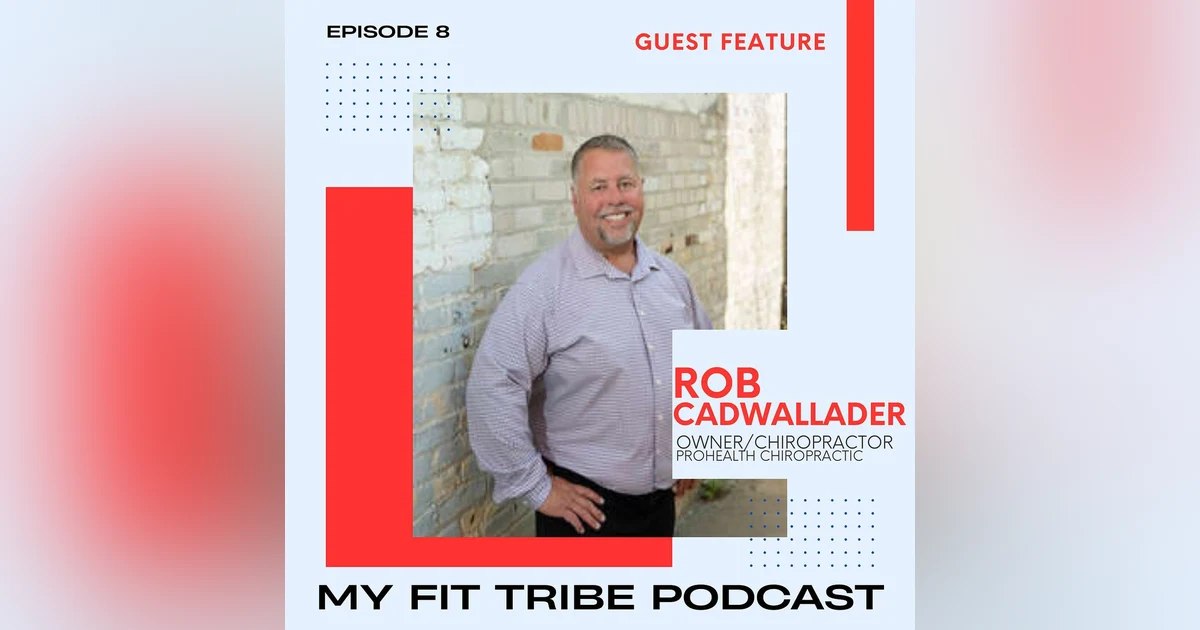


Welcome back to MY Fit Tribe Podcast! In today’s episode, we’re joined by someone who’s made a huge impact in our community—Rob Cadwallader, famously known as Dr. Rob. With his expertise in chiropractic care and alternative therapies, Dr. Rob is here to share his journey and insights into nontraditional approaches to feeling better. From his early experiences in the field to the innovative ways he’s helping people achieve wellness, this conversation is packed with valuable tips and thought-provoking ideas. Let’s get started!
Throughout my own life and fitness journey, I have had the privilege of meeting incredible people who've shared valuable insights on mindset, health, fitness, and spiritual growth. The profound impact of this knowledge on my own life has inspired me to share it with all of you. I'm Erica Sweeney, host and founder of My Fit Tribe Podcast. Join me as we explore inspiring conversations with experts, thought leaders, and everyday heroes who offer their stories and practical tips to help you on your own journey. From nutrition and fitness to mental well-being and personal or spiritual growth, our mission is to empower you to take charge of your health and live your best life. We are more than just a podcast, we are a community. Through coaching, a wealth of shared knowledge, and a strong support network, we are here to guide and encourage you every step of the way. Come be a part of our tribe. Welcome back to My Fit Tribe Podcast. In today's episode, we're joined by someone who's made a huge impact in our community, Rob Cadwalleter, famously known as Dr. Rob. With his expertise in chiropractic care and alternative therapies, Dr. Rob is here to share his journey and insights into non-traditional approaches to feeling better. From his early experiences in the field to the innovative ways he's helping people achieve wellness, this conversation is packed with valuable tips and thought-provoking ideas. Let's get started. In this episode, I am joined by Rob Cadwalleter, also known as Dr. Rob, owner of Pro Health Chiropractic in Summer Prairie. You may recognize his voice from his commercials discussing the therapy options available at his clinic. Hi, Dr. Rob.
SPEAKER_01Well, hello.
SPEAKER_03Thank you for joining me today.
SPEAKER_01Thanks for having me.
SPEAKER_03You are a doctor of chiropractic. You got your education from both the Palmer Institute and Life University School of Chiropractic.
SPEAKER_01Correct.
SPEAKER_03Um, you develop practices first in Tennessee and now in Wisconsin, focusing not only on chiropractic care, but also the multidisciplinary clinics with additional treatment options. You also helped found the chiropractic society of Wisconsin.
SPEAKER_01All true.
SPEAKER_03Extra time on your hands?
SPEAKER_01Yes, as much time as it needs.
SPEAKER_03In addition to being a bright shining light to all your customers, you were also a husband and a father. So tell us a little bit about yourself. How'd you get into chiropractic?
SPEAKER_01Well, that's a fun story. I actually, um, when I was 16 years old, I was a wrestler and I got thrown, hurt my back. I went to a chiropractor, and I was living at the time in Sioux City, Iowa. And I remember going to that chiropractor, and he had a big mirror on the wall. And when he would adjust me, he would always stare at himself in the mirror. And I thought that was pretty odd. So anyway, uh started feeling better. My parents, nobody understood chiropractic back then. That was back in the early 80s. Uh I started feeling better. Parents uh quit taking me, finished my wrestling career, went to college for criminal justice, thought that'd be fun. So after six months of that first semester, I was bored. That didn't seem as fun as I thought it was going to be. Uh switched to psychology. That was a little weird. So then I switched to sports psychology from there to sports uh health science, and then I got my um certification in kinesiology, went off and worked for Texas Instruments as a corporate fitness specialist, and then had a job offer from the Buffalo Bills as an assistant strength coach, assistant athletic trainer.
SPEAKER_02Cool.
SPEAKER_01Yeah, but then I was almost going to take that. So back then, uh Rusty Jones was the head strength coach for the Bills. My grandparents lived nearby. I decided just to walk in and ask for a job. Because I guess you could do that in 1991. Why not? Uh so I walked in and we interviewed or talked to each other and then asked him for a job, and he actually offered me a job. So uh then Palmer College reached out and said I was accepted to their program. So I had to really weigh, did I want to be an athletic trainer or slash strength coach, or did I want to go be a chiropractor? So the issue back then in early 90s is I was looking at the Doctor of Osteopathy program at uh Kirksville, Missouri. So at Andrewstill College of Osteopathy in Kirksville, Missouri had a program for osteopathy. Back then, osteopaths were different than medical doctors and chiropractors. They were the middle ground. So they would adjust you and give you something for your cough, right? They do both things, kind of middle. I like the idea because I like being all-encompassing. Well, in the early 90s, the medical society got around MDs and said, hey guys, let's not compete. Why don't you join us and you can do everything we do and we will support you? No fighting, it's all good. And uh DOs are like, yeah, sure, there wasn't very many of them. Probably like Kairos. There's 60,000 chiropractors right now. There's probably 50,000, 40,000 DOs. And if you go to a hospital today, if you read the names, you will see like Ben Smith DO or you know, Mary Smith MD. If you look behind their names, you kind of see and you'll understand their training because it's still going to be a little bit more relaxed than a typical MD training. So uh I didn't like that, so that's why I applied to the chiropractic program because I knew that then I wouldn't have to deal with drugs or death. Two things I'm not a big fan of.
SPEAKER_03That's fair. I can understand.
SPEAKER_01So that's how I got there. Real straight road, no ups and downs, real easy.
SPEAKER_03So did you ever figure out why the doctor was looking in the mirror all the time?
SPEAKER_01No, I just well, yeah, I'm typical people today, right? He's just probably a big ego, thought he was pretty cool or liked his tie. I don't know.
SPEAKER_03Oh funny.
SPEAKER_01One of those things.
SPEAKER_03So when you start chiropractic, I feel like with with it, people either get it or they don't. You know what I mean? Like some people either they it cures everything or some people don't even want to try it.
SPEAKER_01Well, chiropractic doesn't cure anything. So that's the first thing we have to clear up. So I do think there are uh mismanaged expectations on a lot of parts, and I think a lot of the doctors are at fault for that too, for not properly educating their patients. So when it when someone comes to us, um, they're not really necessarily looking for education, right? They're looking for a solve, a solve of their problem. They have a problem, right? So just like anything else, if you are going to the hardware store and you want to buy a drill, the salesman's got to find out really ultimately what you want is holes. You don't want a drill, you want holes, right? So when people come to us in the chiropractic world, we have to figure out what they really want. Are they wanting relief? Are they wanting it to be fixed? Are they just want questions answered? There are situations um where they don't even know, right? They just are coming because they heard that you could help, whatever.
SPEAKER_02Right.
SPEAKER_01So the initial information is we don't cure anything. What chiropractic does is we eliminate the area of the body that is resistant to anything else moving, right? That we always have like a traffic jam. If you look at the belt line um in the early morning, 5 a.m., it's clear, right? You go at at 8 a.m., it's gonna be a little stickier. Uh, and then there might be an accident. Now what? Now there's a bigger problem. So I I was just actually yesterday, good question. You you asked this. Um, medicine, and I'm not uh bothered to say it, and and natural health care, not just chiropractic, we look at things a lot differently.
SPEAKER_03Right.
SPEAKER_01So if you uh were in your house and you had a trash can and the trash can was starting to overflow, and you went to the medical doctor for a solve, they would tell you to put out an air freshener.
SPEAKER_03Right. Don't empty your trash.
SPEAKER_01They would and then if you went back and say, How's it going? Well, it really it's better, but it kind of quit working after a while. Okay, I'm gonna give you a stronger air freshener.
SPEAKER_04Right.
SPEAKER_01Right? This is how we go. And this is what people are receiving in the world when they go to these doctors, not not all of them, right? It's not all encompassing, but it's a more familiar story that I'm hearing these days. And then uh so you go back again and say, you know, the trash thing is just now starting to overflow, it's kind of starting to take over the house. I mean, what should I do? All right, well, I'm gonna put you on an even stronger one, and then we're gonna put you on something else so you don't see the trash. Okay. And then the alternative healthcare person will be like, why don't you just take the trash out?
SPEAKER_03Right.
SPEAKER_01Right? Let's just fix that, let's get rid of the junk. And chiropractors, not all, but many, uh, look at the body that way, a self-healing organism that we're just removing the interference from the body so the body can heal itself, right? If we have an entire pharmaceutical within our body, we can if you cut your hand and don't use a band-aid, you're still gonna heal.
SPEAKER_03Right. Right.
SPEAKER_01That's the that's the life force of our body. So that's how I think. And when people come to me, I'm trying to solve what's creating the problem. Where did it come from? What is happening in your life to make you get to this point? And there's lots of facets of that, by the way, from anyway from nutrition to lack of exercise, uh to the way they sleep, to the way they eat, to everything else. It's just uh there could be many forms of that.
SPEAKER_03Aaron Powell Right. And I that's one thing I really like to bring up in this podcast because not that I'm against standard medical care, but I I agree with they don't look for what the cause is and the solutions they offer often cause more problems.
SPEAKER_01Aaron Powell Yeah, it it has its place.
SPEAKER_03Yep.
SPEAKER_01And I'm not sure that in these days, now I did read a study, I don't have it on me to quote it, uh, but look it up on probably not Google, that's not going to give you the answer you want. But before COVID, 71% of the population sought medical help from a medical doctor. Since COVID, it's 44%.
SPEAKER_02Wow.
SPEAKER_01A lot of trust has been lost since COVID. Um and it's still coming out, the lack of trust. You know, and then not to hang this on top of what just happened to the United CEO, but insurance is not what it used to be.
SPEAKER_02Right.
SPEAKER_01There's a lot of people uh in our office, for example, we don't even take insurance except for Medicare, and that's getting tight to be able to do uh because everybody has their pre-authorizations, their restrictions, their limits, their whatever they want to do. And these are people, bureaucrats, sitting in an office that have no idea what healthcare is, no idea what was wrong with this patient. They've never met this patient. All they do is collect their deductibles and their copays and their premiums. Right.
SPEAKER_02Right?
SPEAKER_01That's all they know. That's the relationship they have.
SPEAKER_02Right.
SPEAKER_01So I often have to tell a patient as a triangle. You have a relationship with your insurance company. We have a relationship with you, but we do not have a relationship with your insurance company. So people get that confused a lot. They think they can come in and you take my insurance, like, absolutely not, because they want to pay me $12 to take care of you.
SPEAKER_02Right.
SPEAKER_01My overhead is way higher than that, and I could take that twelve dollars, but I'll be out of business in six months and not be able to help anybody. So it it's crumbling more and more, and people are starting to get sick of it, but it just shows the discourse and resentment people are having for the nature of our healthcare today.
SPEAKER_03Aaron Powell Well, I think it's the big companies too. I mean, you've got the big pharma, big food, big insurance. I mean, those are the ones that we're having the issues with that were making the you know average person feel very uh out of control of their situation.
SPEAKER_01Aaron Powell And what's behind it all? Money.
SPEAKER_03Yeah.
SPEAKER_01All of it. Yeah. Big pharma too. Big pharma has been in control for a long time. Several years ago, I saw uh Pfizer spent uh fifty-eight billion dollars on advertising. Uh they only made sixty that year. So I mean, we're the only country, I think one of very that has commercials.
SPEAKER_03Yeah, the only one that's allowed, yeah.
SPEAKER_01They're allowed to have commercials for drugs.
SPEAKER_03They might in Australia too.
SPEAKER_01Maybe.
SPEAKER_03Yeah.
SPEAKER_01Uh unnecessary. I mean, most people probably don't even think they need to have a drug. Look how cool that is to be running on the beach because you get, you know, whatever.
SPEAKER_03Because you don't read the side effects and the fine prints at the bottom.
SPEAKER_01Whatever it says death, I just that's a that's a sharp no thanks for me. Not even going to try it.
SPEAKER_03Oh, goodness gracious. Um I'm all distracted. Um so as far as chiropractic, uh you know, we've got your basic spine misalignment that people come in for. What other types of things do you do work on to help alleviate?
SPEAKER_01I tell people, and I have for I've been almost 30 years practicing now. Uh you point to it, we'll fix it, right? You tell me what's going on. We'll either if we can't, we'll find somebody who can. So we do know our limitations. We do have the obligation to refer. If it's something we can't deal with, so absolutely we have a referral network we send out to PTs, we send out to MDs. Um, you know, if you come to me with a heart attack, this don't. That's not for if you break your leg, do not come to me. That's not the right place. Right. So there are some people who just don't know where they should go, and so we guide them to what it could be. But we've had if you have a shoulder problem, we can help with that. If you have a foot problem, we can help with that. We also have uh a chiropractic neurologist in our office, and um, she is able to deal with post-stroke, post-head injury, post-concussion, Parkinson's. She's dealt with some of that. So uh it's just uh how the body works, and we have a balance center in our office now too, where people who who um have some fall issues or things like that, we can deal with fall prevention. Uh and then we also have some regeneration in our office, which will be shifting to a different uh arena for that soon, but we're still able to offer um complimentary services that just enhance what we do in the chiropractic side.
SPEAKER_03You to answer some of my questions I have to ask you, but let's go into neurology a little bit. I have a daughter that suffered one of many concussions, one that knocked her out, that she missed months of school. Uh that's a really tough injury to ta to have. Um chiropractic I know helped a bit, but there's a lot of people that I know that have suffered really feel helpless and lost. And sometimes they're afraid to do chiropractic because they're afraid of there's cause more injury. Or what types of things in the neurology section are you able to do that might help alleviate some of those symptoms?
SPEAKER_01Um well, first we're gonna back up on that. The number one reason people don't go to chiropractors is because they're afraid of the popping, cracking, and twisting. And as many people know from our office, we don't do that. We can, I mean, it's available, you can do that if you want, but a lot of people like just having the pro adjuster, just the machine to be able to scan your spine, find out where the problems are, uh, realign those areas, and then rescan to make sure we solve the problem. So we do have that advantage of not having to do that too if you don't want it. As far as neurology goes, honestly, Dr. Sophie can speak better of that. So she's got uh extensive training in neurology beyond what I even have. So she did her chiropractic program and then got her diplomat in chiropractic neurology. So she has a a better understanding that I haven't taken the time or energy to try to learn because I want that to be her needs.
SPEAKER_02Right, sure.
SPEAKER_01And that's her her thing. But she's she's been very, very successful with her neurological cases. Herself, she suffered a concussion uh in the back of an Uber one night, and that got her on the track to wanting to help more people with those issues, which is why she decided to extend her chiropractic career and get a diplomat in neurology.
SPEAKER_00Awesome.
SPEAKER_01Uh so she could help those people. Right. She she's had great luck with it. And just recognizing it and then knowing what level it is, whether it's a major, a moderate, or a minor, and then knowing what steps to take to help that to heal faster. But it's not easy, it's not sl it's not fast. It's a very slow process. And most of the population don't understand because if you can't see it, it's not a big cut on your face or anything, right? You can't see it. So you're trying to describe to people that you're slow thinking, you don't see right, you get headaches, you get fatigued easily, they they don't understand that, right? So there's no grace given for people with concussions. So a lot of times people won't want to admit they have it because they don't want to be seen in that light or put into the corner.
SPEAKER_03Right. And it can last years.
SPEAKER_01Years, yeah. It can. It can, yeah.
SPEAKER_03So frustrating.
SPEAKER_01Well, that brain is just think about it, right? It's really soft tissue in a sack.
SPEAKER_03Right.
SPEAKER_01And it's uh surrounded by bone. So it can get bounced around pretty good in a lot of things. I watch these little kids play on playgrounds, right? And they fall down, they fall off the swing, they hit their heads, parents get them up, brush them off, say get going, you know, you'll you'll work, you'll brush it off or whatever. And these kids grow up with sometimes problems. Yeah. So I often wonder how many times it's missed that a child gets something like that. And because parents aren't aware, uh, that they should be aware. Right. That w they end up having extenuating circumstances into adulthood.
SPEAKER_03Yeah, as a parent of a child who had that bad concussion. I mean, she was in high school at the time, but boy, was that scary. Because you just you know, it's just it's different than a broken arm because you don't know if or when it will heal. Right. It's very scary.
SPEAKER_02Right.
SPEAKER_03How cool for Dr. Sophie to be able to take that on and especially after what happened to her.
SPEAKER_01Yeah. Very cool. She's enjoying it. She's doing a great job, and it just adds a nice uh level to our office that uh she's the I think she's the only certified uh chiropractic neurologist in Madison. There might be some other people that have that training, but they're not board certified. Um I could be wrong on that. Maybe there's one more. I know there's a guy over in SOC and there's another one up uh in by the Milwaukee area, but there's not many in the area for sure.
SPEAKER_03Now are are you one of the only ones that uses a pro tester?
SPEAKER_01There are um other clinics in the town, and all of them except for one were my associates. So they all learned it from me. So they're awesome.
unknownA duh.
SPEAKER_01So I think there's four of us in town now that use it.
SPEAKER_03So and uh for someone who's always been manipulated for the cracks and pops, how does that w work and how um how much more beneficial is it? Or is it the same as cracking and popping?
SPEAKER_01I I think it's each their own. So what happens with the projuster, it uses a piece of electric sensor. And that sensor uses a method of it measures hardness or stiffness with derometers. Derometers is a measure of hardness, it goes zero to one hundred. So when I push the sensor in, it has six pounds of force. So I push it into your body and it will give a force back as Newton's second law. For every force there's an equal and opposite force in reaction, right? So I push it in your body and then it pushes back on me. If it gives me an exact force back, then I know it's restricted because I shouldn't, it should be some force being absorbed. If I don't get uh a force back at all, that means there's something wrong with soft tissue because there should it's getting all absorbed. There's nothing coming back. So when I'm measuring the bones, it's bouncing off the bone and coming back into the instrument and then measuring up on the screen. So I can tell from the scan which bones are fixated, which area is spasm, and which ones are normal. So then when I go to do the adjustment, I just select the one or two or three bones that need to be moved, put the instrument on those bones at a 43-degree angle, and then adjust that bone. The machine will automatically shut off when it feels something shift or move. And then I rescan to find out if the change has been made. If it hasn't, I do it again. If it has, leave it alone. Let the body go with it. Because the oscillation of the machine, as you know how it works like a little jackhammer, that oscillation doesn't go away just because we're done. Think about when you throw a pebble into a lake, you see ripples for a long time, right? So when that's oscillation is going into your body and your tissues and your structures, that's going to continue happening uh for hours afterwards. So the I myself only get adjusted with a progester. I don't like manual anymore. I'm older now. It hurts me, and um, I just get better relief with the progester. So that's how that one works. As far as manual adjusting, what I find happens in a lot of chiropractors is you sink to the lowest common denominator. So it's um a little thing that the industry calls the fly-in-seven. So a chiropractor will push three times down the middle of your back. Which on your left side adjust that? Which on your right side adjust that? Flip you on your back, adjust your neck to the right, neck to the left. See you later, have a good day. Okay, well, if you move bones around and you just get a gross manipulation happening, will the body find home for the area of restriction for the bones to find that energy symphony to happen? Maybe, maybe not. Um, but it does release endorphins and enkelins, which are the body's natural painkillers. A lot of people really enjoy that. The progester will not release those because there's no trauma. So progester does not cause trauma to the body. A hand or high velocity HVC will it will cause trauma. Um, not negatively, just creates trauma. So the body will release those chemicals. That's what it does, right? And so you feel that, oh God, that feels so good. And then often people will report, they go home and go, eh, I don't know if they got it, I still kind of hurt. Which we get different responses with the pro adjuster. So after two hours later, you're like, Yeah, I still feel pretty good because it settles in. So I'm not here to tell people what they have to have. We offer whatever they want, right? Um, but I try to educate them on the differences. And oftentimes we will use the pro adjuster, and then if we don't get like a hip to release, because it's really good for P to A, posterior to anterior adjustments, but if we don't get a hip to release, we'll have to do rotation on the manual table.
SPEAKER_02Right.
SPEAKER_01Um and that's pretty normal with uh with rotation of hips because it's the only way to get that out of there, right? Yeah. So that's the difference between the two. There's uh personal preference.
SPEAKER_03Yeah, that hip adjustment needed on the us old people who have hips there.
SPEAKER_01You know, a lot of times what happens is you also want to pay attention to is your chiropractor adjusting the same spot on both sides. If he flips you, not everybody flips, but if they do flip you, is it the same spot on both sides? Because that would make no sense, right? So if they're adjusting down by the say the ischial tuberosity or your sit bone or your butt bone on one side and then up on the hip on the other, that makes sense because that will untork the hip. But if they're adjusting both on the tops, both your SI joints, that doesn't make any sense. So it's just it's just getting the body moving and just getting some release happening. But I mean, there's lots of studies out there, there's lots of stuff. Chiropractic is 128 years old now, it's been out there for as long as X-ray.
SPEAKER_02Wow.
SPEAKER_01X-ray and chiropractic were founded in the same year, 1895. And then Palmer College started in 1897.
SPEAKER_03Wow. So there's different types of chiropractic. Palmer study is one, right?
SPEAKER_01Well, it's a school, right? So they yeah, they're the first. Right. They're the fountain head. So they, you know, named a the Palmer package. They have a certain amount of training they do for themselves. So uh then Parker College of Chiropractic down in Texas, they have a method they do, and then Logan College is over in, I think, St. Louis, somewhere in, I don't know, Missouri or whatever. And I'm gonna be wrong, so anybody that hears it let me know. They have a thing called Logan technique that they do, right? So and then Life University down in Atlanta that has a a technique for upper cervical. So everybody wants to have their own niche and their own technique. There's I think at the time last I checked, there's seventeen chiropractic schools. Uh there's one in Spain now. And there's one in I think Australia now. Some of them colleges are starting to add a chiropractic program because it's getting more popular to become a chiropractor.
SPEAKER_02Right.
SPEAKER_01It's definitely needed because people are seeking out more alternative health care than they ever have been.
SPEAKER_03Yeah. And I came to see Dr. Bob when I was having hip issues and we did the shockwave and the magnetolith. And I tell you that really helped my hip to feel better. We took you know treatments. But can you talk a little bit about what the regenerative side is?
SPEAKER_01So in our regeneration department, we have shockwave, and we have uh what that is, it's an instrument that is a focused wave, a lot like Pro Adjuster, but way faster. And it will mimic injury to the body. It doesn't really injure tissue, but it body thinks it does. So the body will release its own stem cells. It creates a mesenchymal cascade, and the body thinks there's an injury, so it releases all the responses to an injury. And stem cells then that might have been dormant or sleeping say, hey, we got work to do, so we're gonna go back to work. And so they start to rebuild. Stem cells are the building blocks of everything, right? That's your osteoblast, your osteoclasts, it's your blood cells, it's your tissues, it's your muscles. So you have stem cells for everything. The body has them within us, and that will be released to help fix an injured area. So that's what that does. The magnet, what that does is a magnetolith and it emtt, electromagnetic uh transduction therapy, that will release um the tissue that is held up. So think of your blood cells as iron, right? So the magnet makes all the blood cells face the same direction. It recharges all those blood cells, and then it gets rid of all the dead tissue. It pushes them all out because everything's all ready to go, everything's all fired up, everything's like, you know, you walk in to uh a place everybody's kind of sleeping, you say, Hey everybody up, attention up. Think about a you know, a barracks in the drill sergeant comes in first thing in the morning and you're like, hey, that's what everybody does and wakes up, pushes all the all the junk out. So that's what the transduction therapy does. Um shockwave, we get great results on knees, uh, feet, shoulders. We tend to avoid spine and neck with that because it's so complex. You have in the spine, you have a lumbar plexus and a sacral plexus, and then you have the cervical plexus, the brachial plexus in the neck, and there's just so many nerves that it's hard to really figure out where the problem is and where to focus that energy. We get a lot better results with the magnetolith with those areas because of what I just explained, how it works. Sure. Then we also have a class four laser that we use to increase blood flow, therefore increase healing. It all has to do with cellular health at the end of the day. So if we can get the cells healthy, and that's not just the stuff I do with the regen or the chiropractic, it's on you. You have to eat right, you have to drink enough. And I'm not sure I'm all about the water water thing, because I mean I grew up and uh I was a kid of the 70s, and we didn't have water bottles.
SPEAKER_03No.
SPEAKER_01We drink Kool-Aid-Aid in country time.
SPEAKER_03So we kind of need to mix it yourself with a cup of sugar.
SPEAKER_01A cup of sugar in the little packet. And you would have it in the fridge, and you would just drink Kool-Aid. Uh and you know, and always the joke is the garden hose, sure, but that was a real thing. Yeah. You go to a friend's house and drink out of the garden hose, but the garden hoses back then are made from different products than they are today. I wouldn't drink out of a garden hose today.
SPEAKER_03That's totally fair.
SPEAKER_01Right. Think about the chemicals in that hose today compared to what it used to be. It probably was just rubber back in the day. Now it's polypropylene, all is whatever, right? I don't even want to know. So everything's different today, uh, and which is why you have to look at it. But I think people get really caught up in the water thing. And I think if you just drink enough fluids and pay attention, you're gonna be fine. At the end of the day, if you look at your urine and it's clear to straw, you're in good shape.
SPEAKER_03Right.
SPEAKER_01Right? If it's if it's brown, you got a problem.
SPEAKER_03Right. There's your first clue.
SPEAKER_01Yeah.
SPEAKER_03But that's something that cellular health is really changing now. Again, with the discussion we talked about with COVID being post-COVID, I think there's a lot more knowledge out there, a lot more discussion that people are afraid to have. And eating right and the exercise and the alternative therapies are really, I think, have a lot of good places to go coming up.
SPEAKER_01Right.
SPEAKER_03Um, all the lab tests that they're doing to see where your cells are and where your genetics are. Yeah.
SPEAKER_01Yeah. I think, you know, to look back in hindsight now, could you imagine if instead of the government said, Go in your house and get a bunch of snacks, don't talk to anybody, uh, eat like crap, and don't exercise. You can't go outside. Instead, if they were to say, here, eat healthy foods, let's drink a lot of water, let's get a lot of exercise, let's get some bright light, let's get some bright sunlight, um, let's combat it that way instead of the opposite, right? I mean, so I think most of the general population has some common sense, and they say, Why were we told to go inside and not talk and not move and just eat junk instead of the opposite? Like they were arresting people on the beach in Florida, right? So my daughter was in Palmer down there. They shut the beaches down for like two weeks in Florida. Oh, California was like two years, different world over there.
SPEAKER_02Yeah.
SPEAKER_01But um, then the governor said, Well, this is dumb. Why are we closing the beach? It's wide open, it's outside.
SPEAKER_02Right.
SPEAKER_01People need to exercise and move. So Florida's always been ahead of it. They were way ahead of this whole thing. They didn't fall for any of it. They were the obviously the state to follow. Hindsight, right, shows you that. But uh, I think looking back, anytime anything happens, if you can just focus on what you need, your nutrition, your your hydration, your energy, your exercise. We all exercise different levels. So I mean, you're competitive figure bodybuilder, right? Uh I'm not.
SPEAKER_03So I don't not anymore. Right now?
unknownNo.
SPEAKER_01Nope.
unknownNope.
SPEAKER_01Nope, nope, nope. I can just go and exercise like an old man these days and walk around and wipe down the equipment and look at it and walk it. It's something.
SPEAKER_03You called up.
SPEAKER_01Yeah, no, no, I still I still enjoy it. But I think uh but everything is to your level of what's comfortable to you. Right. I think people think they need to do more than they do, and that's what tells them not to do it, right? Because if it looks if the burden seems too big, you're going to decide not to do it.
SPEAKER_03Aaron Powell But I wish that people would look at what happened and instead of getting angry, just look at things that they could do better even now. I mean, we're coming up on a new year, and everybody likes to take that opportunity to look at how they can do things different. Let's start by being active and it doesn't have to be lifting weights or you know, just needs to be something small, one thing. Get up and moving.
SPEAKER_01Well, people set their goals and standards, I think, too hard or unattainable.
SPEAKER_03Yeah.
SPEAKER_01So it almost gives them the opportunity to fail. Right. So they can say, see, I I couldn't make it, so I'm gonna go back to you know, drinking and not exercising what I did last year because it's gonna be another year like this.
SPEAKER_04Right.
SPEAKER_01Set it small. Like people, I talked to a lot of patients about meditation and getting your mind right and things like that, and like, well, I don't have time. I said, Okay, do you pray? Yeah, that's meditation. Right. Oh, it is? Yeah. So you can do that. So you don't you can meditate while you're in the bathroom. You don't have to have like 30 minutes with your legs crossed and singing ohm. You can just a positive thought for 10 seconds is a start.
SPEAKER_03Right.
SPEAKER_01But if you start small, you can build from it. If you set the goals too big, you're you're gonna fail.
SPEAKER_03So what do you think the key is to be consistent? I mean, I like meditation is something that I've told myself to do that I'm not good at because I'm not good at sitting still.
SPEAKER_01You brush your teeth?
SPEAKER_03Well, yeah.
SPEAKER_01Oh, okay. So how do you how did that become consistent? Your parents yelling at you? Right. Yeah.
SPEAKER_03I mean, you know, but I know that.
SPEAKER_01You make your bed?
SPEAKER_03Yeah, but I know that. But I just one of those things.
SPEAKER_01You have to add it. You just so there's uh uh I talk about this with my wife, Jerry, all the time. Because we'll have patients that come and then all of a sudden they don't come. And you your initial thought is, oh, what do we do wrong? Why are they mad at us? It's never that. Well, it might be, but never. I've never known. So it's a circle. So we all live our lives in a circle in a pattern. And when our patterns or circles change, something gets left out, something gets added. So for example, you live in a certain place, you get gas at the same gas station, probably the same pump. Uh, you eat, you go to the same grocery store, you walk the same way, you get the same foods, you eat at restaurants, you have your favorites, you know, you we tend to go in a pattern thing. So now all of a sudden you say, say I'm on the stop home. So you stop at me, you get whatever. I'm in the pattern. Now all of a sudden you find this new restaurant that's on the other side of town. So now your circle changes. So no longer am I even in a thought process of like, oh, I should stop and get adjusted. It's like now I'm gonna go if this new exercise place or this new restaurant, because it's in my new circle. And then it's been six months, and you're like, oh, I'm kind of hurt and wonder what happened. Oh crap, I haven't even thought about them because it's not in your circle.
SPEAKER_04Right.
SPEAKER_01So the best thing you can do, what I have found to add it in your circle to be consistent, it takes now 66 days for a habit to form. Do you know that from the five uh what is it, 5 a.m. club? You read that book? I have not. Okay. Malcolm Gladwell.
SPEAKER_04Okay, 5 a.m.
SPEAKER_01club. I have an extra copy. I'll give it to you next time in my office. I give books out to patients that I think will read them. So I have one for you there. Um, it talks about 66 days now to form a habit. It used to be 20, then it was 30, then it was whatever, right? But because of our lives, because of our attention spans, because of the distractions that we have, 66 days for something to become a permanent habit. Um, but that's gonna take hard work. So I always look at people, you do brush your teeth, you do comb your hair, you do take a shower, you do make your bed, you do eat. So if you could just tie one of those things in with that, like while I'm brushing my teeth, I'm gonna say, I'm gonna say a mantra that helps me form a good energy pattern in my head. Um, you know, patients will ask me, like, they'll how are you doing today? I always say fantastic, because always the answer I say. Always, always, always look at me like you can't be. I said, What's my other option? So when I get out of bed in the morning, I might not feel the best, but I'm not gonna admit that to myself. So you got a choice. You can get up and say, This is gonna be a great day. I'm gonna make it the best. Yeah, there might be some road bumps, there might be some issues, but you're always gonna look at the positive side of that. Um, I had an issue this morning, uh the whole thing, and uh my daughter called me out on it. She goes, What's your problem? I go, Yeah, you're right. It's stupid. I don't even know why I'm dealing with this this way. So you just flip it around and you go forward again. But you're you have people in your life to help you stay straight and you're not always gonna be 100% perfect. But if you can know where to fall back into, because if your base is big enough, then you don't have very far to fall. Because these people that build these really narrow buildings with no big base, then they fall a long way off, right? So you just go small, keep building that base.
SPEAKER_03So have you always had that mindset? Or was there a time in your life where you kind of had the aha moment?
SPEAKER_01Yeah, well, um funny. 1991. Um, my dad was before that, he was listening to some self-help tapes, uh Tony Robbins, stuff like that. And I was a kid, I didn't care. So in 1991, I had just graduated from college and I was in the middle of all these like decisions like what am I what should I do? What should I do? What should I do? So I bought a Tony Robbins uh I think it was Unlimited Power, and I listened to it on cassette tape, because that's what we had, right? And I wrote it down and I did an outline of it. I still have it today. So I wrote the title and then what he said, and then the next piece. So I have it all outlined all the way down. It's like 10, 12 pages or so. So I wrote it down after what he said, and I would review that. And I did that for many years just to get my mind right. So I think he's Tony's been there a long time. He's helped a lot of people, he's got some good stuff to say.
SPEAKER_02Right.
SPEAKER_01I still listen to him today, not as much as I did, but once I need a good boost, I'll listen to him. And he he just has a way to uh he resonates with me, uh, how he talks. So that was probably the aha thing, and then that made me decide back then, even in my life, like there's gonna be stuff that happens, but it's how I react to it is the is ultimately how the results are gonna turn out. You know, so that's that's yeah, I suppose that if I had to pick a day, that would be it.
SPEAKER_03Well, thank you, Tony Robbins.
SPEAKER_01Yeah, right.
SPEAKER_03So when you went to Tennessee, you was you built a big it never starts off that way.
SPEAKER_01It was 800 square feet when we started.
SPEAKER_03See, I love this. Okay, go ahead.
SPEAKER_01It was 800 square feet when we started, and um Sophie was born two weeks before graduation. Um my wife at the time was also a Cairo. So we graduated, and then I went and worked for a clinic in Knoxville where I was making $30,000 a year as an associate chiropractor seeing 200 patients a day. Yeah, so I was a little underpaid, I suppose. I didn't know, I went to learn. And after about nine months, I said, look, I'm making this guy 50 grand a month, and I'm getting paid um three, not even. Um, so let's go do our own thing. So we moved up to Johnson City, Tennessee. We bought a practice, didn't even know what I was doing. I paid the guy full price for it. It was no patients, it was a box of 100 charts of patients that used to come there. Oh, wow. It had old furniture, an x-ray machine, a bench, and an old STIM machine that I found out later didn't work. Um so I didn't know how to negotiate. I was brand new with this stuff. 800 square feet. So we went in there and I was remember seeing 200 patients a day. So we walked into the clinic the first day we were said we were open, opened up the door and we stood there and nobody came in. I was like, uh oh.
SPEAKER_03But you had the courage to do it. Do you know how many people would never even thought with in that situation?
SPEAKER_01Yeah, but that for me I can't even imagine not. What I can't, I I can't sit there and just say, I'm gonna stay where I am and just deal with it. I have the power to change my life at any time. Nobody else has that power except for me. So I can choose to change it or not change it. It's up to me. So anyway, within a short time, we outgrew that space, and within 12 years, we had a multi-discipline, well, within honestly two, two years. I hired a PT. Back then they did not have direct access. So I hired a medical doctor to refer to the PT. So we had a medical doctor, a PT, three massage therapists, and acupuncturist all on staff. And then we moved to a place that had 5,000 square feet.
SPEAKER_02Wow.
SPEAKER_01And then we and so Sophie was probably at this point fourth grade, and home was always I was born in Appleton, Wisconsin, grew up over in Iowa. My wife was from Monroe. My wife at the time was from Monroe. So we're like, we're we like Tennessee, but it's not really our people. I'm driving in the car and I hear Sophie go, Daddy. And I was like, Yeah, honey, can we go to Taco Bale? No, we didn't eat that food, right? But she saw the sign. And I'm like, no, we're not, and you're not gonna be a hillbilly. We're moving. No offense to the hillbilly, but I love them. I love, I love, I love the south. But I didn't want to live there. So we decided to move up here closer to family, and we rented a space over in Montana and Sun Prairie that was um 1,200 square feet. Because I said, this time I'm just gonna go small. I'm just gonna stay small. We're just gonna relax and just have fun going small. Uh within three years, we outgrew that space, had to move to where we are now. We started with 2,500 in that space, and now we're at 6,000 square feet.
SPEAKER_03Wow.
SPEAKER_01Yeah.
SPEAKER_03So that's just part of who you are. That's who I am. Yeah, I watch things grow.
SPEAKER_01Right. I love to build, I love to uh make things better. Now I'm married to a wonderful woman, Jerry, uh, who was the office manager of that clinic. It's not that kind of story, guys. But um it was much later that we got together. But uh we have a joke that I I throw everything in the air and she makes it pretty.
SPEAKER_03Well, she does a very good job.
SPEAKER_01She does. Yeah, she does. She makes my messes, and I'm a very OCD, neat freak, clean guy, but my brain doesn't work that way. So I have a million ideas at once, and she helps me organize them and put them in place so they can make something. Make them happen. Yeah.
SPEAKER_03I being a business owner myself, I love to watch where it starts and where it goes, because not people who haven't done it don't know all of the ups and downs and the hurdles and the rewards and the all of it that goes into it. Trevor Burrus, Jr.
SPEAKER_01They they do not have a clue that the risk reward, the um that so I had a staff, I had a staff party in Tennessee. This is also kind of telling. And I invited all the staff over to my house. I had a nice house, and they said afterwards that they all of them asked for a raise, and all of them says, Why do you get to live in that house and I and I have to live in this trailer or whatever? Because I went to school for nine years because I took the risk to open the business, because I continue to take the risk to employ you and to take care of all these patients. So if you want to do that, absolutely go for it. And I will support you and I will offer you a job to work here with me because I like you.
SPEAKER_02Right.
SPEAKER_01And I've done that with several associates. Um, my favorite one, Dr. Kyle, who let a girl steal him away and take him up to Minnesota. Uh he was like a son to me. We knew each other for 12 years, and uh, I told him to go to Cairo School, I'd give him a job, so he did. And um, great doctor, great person. And he um I'd still let him if he wanted to come back, I'd hire him back in a second.
SPEAKER_02Yeah.
SPEAKER_01And I never say that ever. You can ask anyone, I don't say that.
SPEAKER_02Yeah.
SPEAKER_01But he was just a great dude. And um that I mean that's how the world works, I think. You have a a guy like that who is trying to do better and trying to make himself better, and I offered him the opportunity. But I would do that. I mean, if I like you and you're in my office, I tell everybody's staff you want to go to school, go it for it's nine years, it cost you about $250,000. Right. I'll give you a job when you come back.
SPEAKER_03You've got the opportunity. Everybody has the opportunity to do that. Yeah, everybody does. Yeah.
SPEAKER_01Yeah, we all do. And I don't know what limits people. I don't know if it's the fear, the it's always fear, I guess. Yeah.
SPEAKER_03Fears do inhibit people's ability to tackle those goals. But as I've said in other podcasts, when you do hard things, it is so amazing because it rewards you, it empowers you, and it gives you the confidence to do other things, which changes your trajectory completely.
SPEAKER_01Sure. Sure. Maybe people don't want their trajectory changed, right? Because you have your little comfort zone.
SPEAKER_03Yeah.
SPEAKER_01And where is growth?
SPEAKER_03Right.
SPEAKER_01Outside of the comfort zone. People don't like to be uncomfortable. People will live in where they are and stay where they are so they don't have to be uncomfortable.
SPEAKER_03Which is they miss so much, in my opinion.
SPEAKER_01You can't tell them that though. No, no, they'll never believe you. Yeah. Ever.
SPEAKER_03They'll just think you're crazy. You say something on your website that says juice worth the squeeze. Or I what is it? Is the juice worth the squeeze? Yes. Yeah. So what what tell me about that?
SPEAKER_01When I look at decisions, when I look at things I get involved with, is the juice worth the squeeze? Meaning, is the energy I need to put into this thing going to be worth the energy I get out of this thing? I'd be honest with you, I include that with people too. Like relationships I build, are they going to be one-sided? Is it going to be two-sided? It doesn't have to be equal all the time.
SPEAKER_02Right.
SPEAKER_01But there has to be something given back, right? If you squeeze a lime and nothing comes out of it, well, that's not worth the squeeze, right? Don't squeeze that. But if you get a good juicy lemon, worth the squeeze. So for me, when I look at any situation I'm involved with, and um Dr. Injun and I uh always joke about that because he's like me, we get our minds going on different things. And I'll just look at him and go, the juices are worth the squeeze on that one. So we look at different business opportunities or we're looking at the things to do or anything I do in my life if I want to get involved with something. That's just kind of what I always lean into and go back to.
SPEAKER_03Yeah. I love that. That just hit home for me because you know, there's days where absolutely, and there's other days like, heck no, this is just not.
SPEAKER_01That's right.
SPEAKER_03But unfortunately, you have to squeeze the juice every day and see what comes out, you know?
SPEAKER_01You do. Yeah. But you don't have to have full effort into it. I mean, it's again how much energy you want to put into one thing, you can divide yourself only so far. So if something's not worth it that day, don't spend time on it. Spend time on your I always have what uh that's called a big five. And those are the five main things I have to get accomplished today. And there could be people have to-do lists, right? But that's not the same. The the big five are the bigger things. It's not, you know, brush your teeth on the dishwasher, take the kid to school, let the dog out. Those aren't the things. It's the big five things that you have to get done that day, and whatever you don't get done goes on the next day. But it keeps you focused, it keeps you driven, it keeps you on task. Uh otherwise, what do you do? Right? Time takes a hold of you instead of you using it. And time, according to Webster's dictionary, is the rate of speed of a measured activity. So we have all of it we want. Right. It's how we use it.
SPEAKER_03Yeah. Very good. So you should write a book.
SPEAKER_01No. It does, you know, books today are so easy to be written because you have these ghostwriters. Now with AI, for sure. I mean, I I don't know how do you trust a book these days that isn't written by a robot.
SPEAKER_03Yeah.
SPEAKER_01That's not even anyone's real intelligence.
SPEAKER_03Well, pretty soon we won't, I mean, we now we don't know the difference, but the the next five years or less, I don't even know what's going to happen. You know, totally different.
SPEAKER_01Alternate reality, and what'll be real, what will not be real. You can't you almost can't tell anymore, let alone five years from now.
SPEAKER_03Aaron Powell So with all the different ventures you've gone into as far as health and and wellness and mindset goes, where do you see things going for you and the health and wellness industry in the next couple years?
SPEAKER_01I think peop things are moving toward longevity and regeneration and um well-being. So people want to live longer. Um I listened to your podcast with that lady talking about menopause, and she was talking about how, not that I have it, just to clear the record. Um, but she was talking about how many women didn't live past menopausal age. Right. Right. And now we're living 50 years past that. People are wanting to live that 78 feeling as good as they possibly can.
SPEAKER_02Right.
SPEAKER_01Um, because who wants to lay there sick for 20 years? I mean, it's you know nobody wants that. You wanna I want to go out like in one day, all done, no pain, done, over with, right? At like, I don't know, 95. My grandmother is still she just celebrated her 100th birthday. Oh wow. She does fine. My her husband lived to be 92.
SPEAKER_04Oh wow.
SPEAKER_01The other side, my grandfather lived to be ninety-eight, and his wife lived to be ninety. So my grandparents ninety or better, so that's what I have to look forward to.
SPEAKER_03Wow. And I'm only lots to do yet.
SPEAKER_01A lot of time. Sorry.
SPEAKER_03So But that's one thing too. I mean, you've got your health side, but on the mental side and the being in the uncomfortable. I mean, Bill Belichick just signed a con five three-year contract, whatever. He's 72 years old.
SPEAKER_04I know.
SPEAKER_03And you go, he's got plenty of money, he's had plenty of successes, yet he's still going back to it. But it's having that purpose, that goal, that excitement, the reward, the the chase.
SPEAKER_01The chase. I think the hunt.
SPEAKER_03Yeah. That's what I enjoy.
SPEAKER_01I enjoy finding that thing that's going to give me to feed me again. That's how that's how I look for it.
SPEAKER_03Right. So if you've listened to my podcast, you might know these questions, but I asked my guests all this these questions. So if you, Rob, today could look back at the Rob that was listening to Tony Robbins that day, we're gonna pick him. What would you tell him?
SPEAKER_01Good first start. Keep going. Yeah. Yeah. I mean, that's that's uh I think a lot of kids don't know how to take those steps, or maybe the parents don't know how to guide them into that. And then if we rely on our educational system, which is not as good as it once was, I don't think, I mean, uh people are gonna argue with that, but it's different, right? Kids are at least not sitting in rows anymore in schools. There's more free time, they're learning different things, which they should be, but not every kid needs to go to college. Actually, I think a lot go to college just to avoid being uncomfortable and getting a job.
SPEAKER_04Yep.
SPEAKER_01Um, but I I think I would be, yeah, I mean, I can't see anything that I would tell myself not to do that way. Uh if I went back to that one, that was a great pick. Thank you for making that easy on me.
SPEAKER_03You're bet. Is there another one I should pick too?
SPEAKER_01That's good.
SPEAKER_03And then if you ask Future Bob, who's 92 years old, since you're gonna live past 92.
SPEAKER_01Yeah.
SPEAKER_03What would you ask him about the next forty years and what would he tell you back?
SPEAKER_01About what, about me?
SPEAKER_03About the future. What would you ask him?
SPEAKER_01Who? Your future self. At 92?
SPEAKER_03Sure. Or you can pick sooner, but if you're gonna live so late, so we're gonna pick late. I know.
SPEAKER_01Well, and by then, right? What will well we have med beds that heal our cellular uh cellular tissue, right? Heals it all up by I mean, technology is probably right there with it, right? But so that I'm gonna back up on that for a second. Think about this. So my wife has type 1 diabetic traced back to a reaction to the DPT booster when she was 14 years old. Her pancreas is not dead, it's just shut off. So she's working with a um naturopath that has given her some different things over the years that she's been able to double the time her insulin lasts on board. So it means her pancreas is starting to wake up and do something.
SPEAKER_03Wow.
SPEAKER_01Right? So we talk about insulin a lot for her, right? That's life or death for her. Right. Right. So is she worth more to the insurance company with diabetes or without? So why would they cure it? Right. For the pharmaceutical company, why would they cure it? Why would they cure cancer? Look how much money that makes, right? So we look at that kind of stuff. So what I would tell my future self is um if I stay on course, I'll tell myself, good job, right? But I gotta stay on course with this thing and not be afraid of the fights. I'm not I'm not a kind of person that backs down. I say what I want to say, I don't worry about the repercussions too much. If you don't like it, don't listen. If you do, let's hang out.
SPEAKER_03Right.
SPEAKER_01Um, but I think that we have to continue to be uh vigilant about our surroundings and not trust people on their word or what they say until we until it makes sense. It has to make sense, people. Have common sense. If it doesn't make sense, you know, like this go back to COVID, trust the science. Well, yeah, I was. And you were telling me that science is backwards. That makes no sense to me. None of that made any sense. So trust your intuition, trust your gut, trust your and trust common sense. And I think it'd be okay. And trying yourself with people that are like you, because if you hang out with five drug dealers, well, you're the sixth.
SPEAKER_03Right.
SPEAKER_01Right? So hang out with five people that are successful. I look at my friend circle, they're all successful business owners. Like I have very few friends that work at Ampham. I nothing wrong with that, but I just don't hang out with those people. I hang out with people that are risk takers and people that are don't aren't comfy. They're not comfy.
SPEAKER_03Right. Right. Well, and my my default personality or the who I am, who I was to the core of when I was young was not to take chances. I mean, I would have probably still been in the comfort zone had I not married someone who's completely you know, so he pulled you out of that. Oh yeah. But then once I did it for myself, I was like, oh, I can do it. I I am capable, and it's addicting, and it's everybody is capable. Enjoyable, yeah.
SPEAKER_01And I think that again, it's one of those fears. It's probably the fear of failure. Most people are fear of failure, uh, fear of loss, fear of abandonment, whatever it is, uh, there's gonna be some excuse you're gonna give yourself to make yourself feel better, and then go sit on the couch and eat a pint of Ben and Jerry's and then forget it all happened, and then go back to work the next day and live your whole life over again.
SPEAKER_03Yeah.
SPEAKER_01Yeah.
SPEAKER_03Wow. Cool. Okay, so you're the next Tony Robbins of Wisconsin. You're our little our I can't call you a celebrity, we talked about that already. But I know that I there's great things to come yet for Dr. Rob, and I'm really excited to see what other adventures that you can take in. So thank you for joining me today.
SPEAKER_01Well, thanks for having me.
SPEAKER_03Thanks for listening to My Fit Tribe Podcast. Tune in weekly for our latest episode for more health and wellness insights and inspiration. For more information, visit myfitribe.org. Please note that the opinions and comments presented here are those of the guests and do not necessarily constitute medical advice or the opinions of MyFit Tribe. Copyright 2024, all rights reserved. This podcast is a production of MyFitTribe LLC.