Chef Mark Allison: The Recipe for Living Well
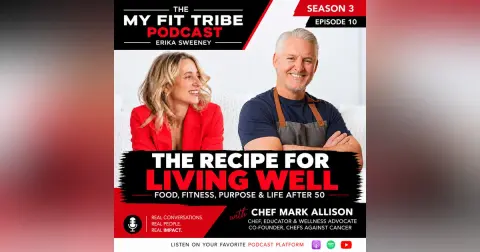
Send us Fan Mail What if the recipe for living well is simpler than we think? This week on the MY FIT TRIBE Podcast, I'm joined by Chef Mark Allison, a chef, author, educator, and wellness advocate with more than four decades of experience in the culinary world. But Mark's story goes far beyond the kitchen. From growing up in England and building an international culinary career to navigating his son's Type 1 diabetes diagnosis and losing his wife to cancer, Mark's journey has shaped his pass...


What if the recipe for living well is simpler than we think?
This week on the MY FIT TRIBE Podcast, I'm joined by Chef Mark Allison, a chef, author, educator, and wellness advocate with more than four decades of experience in the culinary world.
But Mark's story goes far beyond the kitchen.
From growing up in England and building an international culinary career to navigating his son's Type 1 diabetes diagnosis and losing his wife to cancer, Mark's journey has shaped his passion for helping others live healthier, more fulfilling lives.
Today, at 62, he's inspiring others to embrace healthy aging through better nutrition, movement, mindfulness, and meaningful connections. And he's certainly practicing what he teaches, having recently climbed Mount Kilimanjaro while raising awareness and funds for Chefs Against Cancer, an organization he co-founded to honor his late wife and support families facing cancer.
In this conversation, we explore:
- How Mark's personal experiences transformed his approach to food and wellness.
- Why healthy aging involves so much more than diet and exercise.
- Simple ways to prepare healthier meals without spending hours in the kitchen.
- The importance of movement, strength training, and consistency as we age.
- How Mark turned grief into purpose through Chefs Against Cancer.
- His incredible journey climbing Mount Kilimanjaro at 62.
- Why community, connection, and having a purpose are essential to living well.
One of my favorite takeaways from this conversation is Mark's reminder that we don't need to overhaul our lives overnight. Small, intentional changes can create lasting habits that help us feel better today and stay healthier for years to come.
And perhaps even more importantly, it's never too late to chase a dream, discover a new purpose, or make a difference in someone else's life.
This conversation is filled with wisdom, inspiration, and a wonderful reminder to make the most of the life we get.
Connect with Chef Mark Allison:
Chef Mark Allison: chefmarkallison.com
Chefs Against Cancer: chefsagainstcancer.org
Listen, download, and share this episode with someone who could use a little inspiration to live life well.
MY FIT TRIBE Podcast
Real Conversations. Real People. Real Impact.
Throughout my own life and fitness journey, I have had the privilege of meeting incredible people who've shared valuable insights on mindset, health, fitness, and spiritual growth. The profound impact of this knowledge on my own life has inspired me to share it with all of you. I'm Erica Sweeney, host and founder of My Fit Tribe Podcast. Join me as we explore inspiring conversations with experts, thought leaders, and everyday heroes who offer their stories and practical tips to help you on your own journey. From nutrition and fitness to mental well-being and personal or spiritual growth, our mission is to empower you to take charge of your health and live your best life. We are more than just a podcast, we are a community. Through coaching, a wealth of shared knowledge, and a strong support network, we are here to guide and encourage you every step of the way. Come be a part of our tribe. This week on the My Fit Tribe podcast, I sit down with Chef Mark Allison, and boy, did this conversation make me smile. We talk about his journey from chef to wellness advocate, his passion for helping others live healthier lives, and how he continues to chase his own dreams while making an impact through Chefs Against Cancer. This conversation is full of energy, perspective, and a reminder to make the most of the life we get. I have no doubt this episode will inspire you to live life well. Here's my conversation with Mark. Today on the My Fit Tribe podcast, I'm joined by Chef Mark Allison, a chef, author, educator, and wellness advocate with more than four decades of experience in the culinary world. Today, Mark is especially passionate about helping people over 50 use food, movement, and simple lifestyle changes to live healthier, more vibrant lives. He is also the co-founder of Chefs Against Cancer, bringing chefs and communities together to make an impact beyond the kitchen. Hi, Mark. I'm really looking forward to this conversation. Welcome to the My Fit Chide Podcast.
SPEAKER_00Thank you, Erica, and thank you so much for the invite. This is very exciting. It's a pleasure to be here.
SPEAKER_01Social media is one of those things that can drive me crazy, but it can also be really wonderful at the same time. And getting to know you and see your impact through social media has been really fun. So I couldn't wait to have you on to talk about your journey and then again all that you're doing that is impacting other people. So again, thank you for taking the time today to meet with me. So for our listeners, let's just find out a little bit about your history. Obviously, you've got a culinary experience. How did you get into that?
SPEAKER_00Um you know, my uh three boys, Eric, I say it was very easy for my for me to choose my career. Uh I it was easy because I didn't have many options. I left school. Uh I'm originally from Newcastle upon Tyne, which is the northeast of England. And in the UK, you leave school at 16, unless you're exceptionally bright, and then you stay on for another two years and then you go to university. Well, I left school in 1980 and uh I didn't have much choice. I could either go down the mines and dig for coal, I could go to a car factory and build cars, or I could go to the ship factory and build ships. I liked cooking. I started cooking around about the age of 14. My mother was a very good cook, and my dad loved to garden. So I'd help my dad in the garden on a Saturday and my mother in the kitchen on a Sunday. And I thought, why not turn this into a career? So at the age of 16, I left school and applied to be a chef. And I've been doing it now for the last 46 years. And being a chef has given me the chance, the opportunity to travel around the world and see different things. And uh part of them traveling took me to education, and I became an educator for 20 years, and that's what brought me to America in 2004. So I've been living in America now for about 22 years.
SPEAKER_01Wow. So were you teaching at culinary school then?
SPEAKER_00Actually, 10 years prior to that, I was teaching at a college in South Wales called Neathport Albert College. I was very competitive, Erica, when I was younger. So my student teams, my culinary teams, won virtually every competition in Europe. That actually caught the eye of Johnston Wales University, and they invited me and my family over here in 2004. So we moved from South Wales in the UK to Charleston for one year, and then after that, we moved to uh Charlotte. Uh, and I worked for Johnston and Wales University for 10 years. After four years, I was promoted to the dean. Uh, and I ran the educational program for the school for six years.
SPEAKER_01Oh wow. How is it to be able to, you know, find such a passion at a young age and then turn it into teaching others? How does that work for you? How did that feel?
SPEAKER_00Uh well, again, going back to my three points, it wasn't a passion, it was a necessity uh to get a job and make some money because I couldn't live with my parents free. Uh so I had to pay a rent until I could afford to move out, just like I think kids these days. And then it turned into a passion probably about 10 years later. I actually got to the age of 24. Believe it or not, when I left school, you know, it wasn't everybody got educated in them days, and you can't blame the teachers, they probably concentrated on the kids that were interested in education. I was more interested in looking out the window and uh thinking I was playing soccer outside. And uh so I left school and I could barely read or write. I remember going for my very first job at the age of 16, and the two chefs that interviewed me said, Well, you can't even spell your own home address. And I couldn't, it was six of Cedars, Aiden Banks. And I always had difficulty spelling Aiden Banks. And uh, but at the age of 24, after being in the kitchen about eight years, I realized, did I still want to be in a kitchen when I reached the age of 60? And I thought, no, so let's get educated. So for the next 10 years, I worked full-time and I went to night school for 10 years. I did five years culinary and then I did a uh degree in education and then a master of business administration. So by the time I was about uh 32, going on 33, I felt I was educated. And by then I was a teacher and I was teaching uh culinary students how to coop.
SPEAKER_01Wow. And you didn't just go to get a little educated, getting all three. Obviously, you're well rounded then in your position. That's amazing. Because some people will just go and try it. And I am not, you know, I went to college, but I'm not I don't love being a student. You know, I love to learn about things that I enjoy. But when you talk about looking out the window, I still have that problem when I'm doing my real work today, you know.
SPEAKER_00Well, you know what? I when I was at school, we had different names for children like me, or possibly you, now that put labels on children. I I don't know if that's a good thing or a bad thing, because uh without a label, I just thought anything was possible. Right. I think sometimes when somebody puts a label on you, you start thinking, well, is this label true? And and it becomes a bit of a hang-up to get over. I remember this might not be politically correct, but in the in the 80s, you either were grainy, you were average, or you're thick. And I was definitely in the thick category when I was at school. It wasn't, and I think everybody develops at their own age, in their own stage in life. And I was 24, and I think most boys exactly are late developers. And if you just let life take over and uh just run with life, but a bit of time, you'll find out, well, this is the time I need to start learning, this is the time I need to start growing, and then do your best to learn and grow because I think education is one of the best things in the world. If you don't know something, you need to educate yourself about it. And it's the same with health and wellness and fitness and cooking and everything you think of, you really need to educate yourself first.
SPEAKER_01Yeah, and you know, I think that's the beautiful thing about life is it really is about learning and growing all the way through. You know, you just have to keep finding a passion or a reason or uh something to put yourself into to get that fire. When did your career go then from being a culinary educator into being so passionate about wellness?
SPEAKER_00Well, uh I was on a um uh uh a Fulbright Teachers Exchange program in 1998. And uh, you know, I was brought up on Stosky and Hutch, uh the streets of uh San Francisco. So I always wanted to come to America, and then there was an opportunity to apply for a Fulbright scholarship. So I applied and I was very lucky to be accepted because there was only about 35 people in the in the whole of the UK accepted. So I thought I was going to California, and I was really excited. My wife was excited, we had two boys at the time, and we thought we're going to California for a year, and out of the 500 teachers that applied to come to Europe, there was only one chef instructor, and he lived in Anchorage, Alaska. So uh our dreams of going to California had to wait another year before we actually traveled there on vacation. Uh, but we went and lived in Alaska for a yeah. My two boys were two in eight months at the time. Matthew, the youngest, uh, he became a type 1 diabetic while we're living in Alaska at the age of 14 months, and he was the youngest ever person in the state of Alaska to become a type 1 diabetic. I was brought up with French cuisine, lots of butter, lots of sugar, lots of cream, uh, and that's how I cooked. But then when you've got a family member uh whose health relies to a certain extent on good food, you've got to change your eating habits. So our eating habits basically changed around about 1999 just for Matthew, so that we could uh make sure that he was taken care of. So it's it's been about 28 years that I've been involved in health and wellness to some extent.
SPEAKER_01So when you made that change with nutrition for him, did you see that improvement in his health? Obviously, with diabetes, you have to worry about your glucose levels regardless. You know, that's obviously the big factor. But I did you see elements of change and even for you when you were changing from the yummy, sweet, and buttery French cuisine into something a little bit more, you know, organic with not so much sugar at least.
SPEAKER_00Well, you know, I think this is where we sometimes get the mistake of saying food is medicine. Uh I think food is food and medicine is medicine, uh, because obviously without insulin, Matthew would have died. Right. Uh but definitely food plays a part in being healthy. And uh now he is 28, going on 29, and he's probably more healthy than the average 28, 29-year-old, because he he moves around a lot, he does a lot of sport, uh, he's very active, and he looks after his diet. And out of the three boys, he's the one that actually likes to cook the most. Uh, and family-wise, yeah, we did see an improvement family-wise. But the funny thing is, Erica, when we moved to America in 2004, we lived on Folly Beach in Charleston. And living in the UK in 2004, everything seemed to be so expensive. And then you come to America and everything seemed to be cheap. Those days are far gone now. Uh, but it seemed to be the boys would be on the beach every day. I'd be at work, I'd come home, I'd meet the boys at the beach, would walk back to the house, which was literally five minutes from the beach, and you'd pass all of these restaurants, seafood restaurants, fast food restaurants. And uh, so we started eating out about four or five times a week, even though I was a chef. It was easier in 2004 to eat out. And believe it or not, I put on 40 pounds in 14 months. I have got a picture of myself, which I keep on myself to remind me. Uh, and it was taken at Thanksgiving in 2005, so it was 14 months later, and I had literally put on 40 pounds, and I think we just were not used to the size portions that we eat in America, and the fact that everything is fast food, it's ultra-processed, or it comes out of a deep fryer. And so there was a lapse in that year, I think, when we first arrived, uh, because it was like uh Willy Wankus chocolate factory, it was like everything was like uh exciting and accessible, and I think we just uh made the most of that. And then it wasn't until about 14 months later we realized we're actually going down the wrong hill here. We were eating far too much and we're eating too much ultra-processed food, and that 40 pounds took three years to take off.
SPEAKER_01Isn't it so I think isn't it annoying that it's so quick to go on and take so long to get off?
SPEAKER_00It is so easy to put on, uh, and I think that's biologically uh the reason why, because when we used to be hunter-gatherers, we never used to know when the next meal was coming, so we stole the fat. Uh, but it's just so easy to put on weight, uh, but yes, so hard to take off.
SPEAKER_01It is, it just drives me crazy, especially as I get older, because you know, you you work a lot with people emphasizing the over 50. Man, that metabolism changes and it goes on so I mean it feels like a week. It's like, okay, I wasn't perfect, but come on.
SPEAKER_00And it just seems to be now you just have to look at it, a donut, and the next minute then pounds are already on your waist.
SPEAKER_01Yeah. So when you had that journey then in 40 pounds in 14 months, obviously you had that realization that you need to make better choices. Did that then affect how you cooked?
SPEAKER_00Uh yes, it did. We got back to Health Eating in 2008. It was a great year. I was promoted to the Dean of Culinary Arts at Johnson and Wales University, and that was basically at the time the highlight of my career. I thought I'd made it. But unfortunately, that was the same year my wife was diagnosed with stage four cancer, and uh she had a very rare blood cancer that liked to deposit in her liver, and she had 16 tumors. If it had been one or two tumors, they could have just cut them out, and the obviously the liver would have regenerated itself. But with 16, there was nothing that could do, there was no treatment for my wife initially. So we turned the food to make her healthy, and that's when the the process really started, probably 2007 going on to 2008, especially when my wife was diagnosed uh with cancer, and we basically completely changed our eating habits. And um, I love to do research, and the diet I came across as being possibly the most effective was the Mediterranean diet, and to this day that's probably the diet I follow most because it's not just a diet, it's it's basically being around people, it's about exercise, it's about getting in the sunlight, it's about getting adequate sleep, so it's not just one area that you focus on. But we focused a lot on food for my wife, and she lived eight years before she passed away in 2015. Uh, and I contribute the fact that our diet and the fact that she had a great outlook in life, she never ever complained. Why me? She decided that she would definitely live until uh Jonathan graduated from uh high school, which she did. And she was an amazing woman, very strong, very determined. But I think the change in lifestyle greatly improved her.
SPEAKER_01I'm sorry for your loss. You know, I I have so many people close to me right now that are dealing with a cancer diagnosis, and it is just so hard to navigate that. And there's you know, you've got the medical side where you have to deal with the chemo and the treatments, which are so hard for your body to tolerate. And then you have sometimes lifestyle changes you have to make, and then you have the exhaustion and the fatigue, and then you have the emotional trauma of trying to deal with with your diagnosis and approaching each treatment. And I just my heart breaks for people that are going through it because it just takes a different level of strength that you don't understand until you're there, right?
SPEAKER_00Erica, I think you're you're 100% right. And it's not only the person who has the cancer, it really affects everybody around that person. And um, all we can do is try and be strong, you know. Uh you've got to take that medical advice because there's really nothing else out there that is really gonna change the condition other than seeking advice from your doctor and the medicine that they prescribe. But I think also, if you like you've just said, if you change lifestyle and try and get as strong as you possibly can so that when you need treatment, that your body can recover quicker. And I think that involves eating good food. I think it involves lifting weights and strength exercise and getting outside in the fresh air, getting some sunlight, and being around people. Because I think I know with my wife, her support team was amazing. And they were always by her side when she needed them. And I think it's being part of the community that actually gives you strength as well, and having a good strong family and good strong friends that can uh also step in and help out, especially mentally wise, because it does take its toll, not just physically, because you're constantly thinking about that disease in your body. And I think you just need to get outside of your head as well, and that's the best remedy for that is being around family and friends.
SPEAKER_01There's so much to that. You know, you t they look at the blue zones, you know, uh in the world where they have the longevity. And it's interesting because you know everybody will analyze the data from those blue zones and come up with a reason of why they are, you know, why they have people with such long lives. And really what it comes down to with all of them is the community. I mean, some, you know, choose certain diets and some live in certain environmental areas or whatever, but those are all different. But one thing they all have in common is is the sense of community that they have. And I think that with the way the world is today, with so fast-paced and stuck in our phones all the time and just stress levels, we are losing that so much. And I think if there's one piece of advice for everybody is to try to find that your tribe and really with people that are gonna hold you close and lift you up when you need it with times that are hard.
SPEAKER_00I totally agree. And and and Erica, you you hit on a good topic about social media and telephones and computers and and and being active. You know, when was the last time you were bored? You know, because now there's no boredom. Because if we're bored, then we just turn to our phones. I remember being a kid or in my twenties, especially between shifts, because I used to work split shifts as a chef, finishing a shift and then going outside and being outside for about four hours before having to go back in the kitchen for another shift, being bored until I I would start walking and then going into nature and uh filling the day with just walking around. I think that takes a lot of stress off the mind. It's not boredom, it's just giving your mind a rest because we're just inundated with the social media these days and scrolling that we're not even actually taking time out. I think that's why meditation is so good for the human body as well, where you just sit and you relax for 10, 15, sometimes 20 minutes, and you're basically just repeating the same mantra over and over, and it just calms your mind and it puts your body at ease because even when you're sleeping now, if you're taking your phone to bed, it's hard to get to sleep because your mind is overactive because you've just been scrolling, and we've got to sort of slow down. I don't like to say bored, but we just need to clear our minds somewhat and just uh realize that we're here to live, we're not here just to scroll and be stressed out through social media for one.
SPEAKER_01Yeah, you know, again, there's so much good about it because again, I get to meet people like you, we get to share experiences and hopefully impact people through it. But on the other hand, it just drives me crazy because the second I, again, like you said, you my mind goes bored. I reach for my phone and I'm so sick of reaching for my phone. So I love I love what you do because you're encompassing all of wellness, right? Because it's it's not just the fitness, it's not just the nutrition, it's not just the mindset, it's it's the rest, it's the nature, it's movement, it's all of that, and how important it all is as we get older. When did your career turn from being a culinary expert into you know understanding there was a wellness side of it that you wanted to impact other people through?
SPEAKER_00You know, strangely enough, my career turned slightly different to the path that I thought it would be. I thought I would have been an educator the rest of my life. Um, but things changed, and I left Johnson of Wales in 2013, and I actually worked for the Dole food company. Dole as in bananas and pineapples, and uh I was director of culinary nutrition, and uh I worked directly with the uh billionaire owner, David H. Murdoch, uh not the um publicist, this is a different Murdoch, and um he bought Dole uh at the time, I think it was over 50 years ago, because his wife had cancer, and he was a great believer in fruits and vegetables to help cure the body. Uh, unfortunately, his wife did die, but he kept the dole company because he believed in nutrition. And um, he actually built a campus in North Carolina, it's called the North Carolina Research Campus, and he spent a billion dollars of his own money there and it encompasses seven to nine universities, all working on nutrition. So I used to work there, so I used to work with scientists, I used to work with doctors, I used to work with exercise coaches and nurses. And uh that opened my eyes to what is actually involved with the whole body, not just food. Uh, that we do need movement, that we do need sunlight, that we do need fresh air, we do need community, we need to de stress, we need to look at the additives and preservatives that we're putting in our bodies. So I worked with Mr. Murdoch for about three years and thoroughly loved that job. And the only reason I left that job was because Mr. Murdoch, at the age of 97, decided. To sell the company. So they streamlined the company, and I was one of the few people that were let go for another company to buy Dole Ober. But Murdoch, Mr. Mr. Murdoch, I should say, impressed me so much because at 97 he was still active. He was a pescatarian, so he ate fish, but along with fruits and vegetables, nuts, beans, and seeds, etc., he didn't drink. He exercised every day. He got outside in the daylight every day for 15 to 20 minutes to get that vitamin D. And he was such an impressive person. In fact, he just passed away last July at the age of 102.
SPEAKER_01Oh my goodness.
SPEAKER_00He was just an amazing advocate of what health should be like. So that was a sort of a driving force as well to working with somebody like him. And then I got a job at the Kabaras Health Alliance, which was just next door, as director of culinary innovation, where I used to teach the general public how to cook. And that sort of morphed into when I turned 60, and for the first time in my career, the company that I was working for went bankrupt because of the economy. And I just took a step out and thought, you know what, instead of just working for somebody else, why don't I take some time and figure out exactly what I want to do? I knew I loved, I knew I loved exercise and movement. I love being positive about life. And I just thought, well, why don't we just figure out how we can put this all together? And I came up with midlife wellness and beyond. So I've been running that program now for about two and a half years. I teach individuals how to cook healthy. I coach people how to uh work out in the gym, how to move, how to balance. And I also teach mindfulness. And then I combined the whole thing into seven different pillars that I think really would need to improve our lives. And it's and it's all about basically being part of the community and being mindful of what we do, mindful about what we're putting our body, looking at the food that we're putting in our body, exercising on a daily basis. And it's not like going to the gym every day, even if you just go outside and walk for five, ten minutes. You know, if somebody was to say, Where do I start? I'd say, Well, forget about yesterday, start today, and just go outside and walk in the fresh air, and then build on that, and then have a healthy breakfast. Build on that, hang out with other people, or connect with other people, or reach out to a friend that we've never spoken to in years and make that connection stronger. And it's all about little steps, little habits that build together that hopefully are healthy for everybody.
SPEAKER_01It really does create momentum, which is kind of fun when you start down that track and you start surrounding yourself with people and you're in a community where everyone's trying to better themselves or be healthier and more positive, and you just it almost just raises your your energy, your like literally your vibration to you know want to keep doing more and being healthier. And it's so fun. It just makes me so happy to hear that story. I really want to touch on the cooking part of it because when I talk to a lot of people that are busy again with their lives, that convenience seems to be something that trumps anything else. So when you're talking to people about food preparation and how to make meals that taste good but are still easy, that can be tricky, especially because there's a lot of food allergies these days and you know, just things to navigate cost is something else to navigate. Do you have like top you know advice that you give to people who like really don't know how to cook well, maybe, and want to try to find a way to be healthier and preparing food at home without it being too overwhelming?
SPEAKER_00Again, small steps. I just climbed Mount Kilimanjaro three weeks ago.
SPEAKER_01Oh, that's amazing. Congratulations.
SPEAKER_00Oh, thank you, thank you. It was on my bucket list, but then I turned it into a charity event to raise money for chefs against cancer. And um the the guides would say pule pule, which means slowly, slowly, which also means the mountain is not going anywhere. The mountain's still gonna be there, it just depends how long it takes to get to the top. So I would suggest to anybody that doesn't know how to cook, again, just do it slowly, slowly. Just change one thing. Just if you just eat some kind of fruit, the average American eats less than half a portion of fruit or vegetables a day these days, and usually it's fries. So I would just add some kind of fruit or vegetable each day to your diet and just start small, uh, start with a healthy breakfast one day a week, or then turn it into a healthy lunch, then possibly cook one night a week. I've always found when my wife passed away in 2015 and I was left with three boys, obviously I'm a professional chef, but I would cook at home six to seven nights a week. But what I would do is also get the boys into the kitchen to help me to cook. So they would do the preparation, I would show them how to cook, and it was a family event. Uh, and I think that's one of the things missing these days. We're not teaching our kids how to cook, basically, these days the parents don't know how to cook, and we're not teaching people it's high school or school to cook. So, how can you know the the best fruits, vegetables, or any kind of food item that's healthy for your body if you don't know how to cook because you don't know what ingredients to choose? So there's plenty of options these days. You can go on YouTube and you can see any chef basically in the world making some kind of dish. And I would start off with food that you actually enjoy eating uh because you're not going to stick to a diet if you don't enjoy the food. And I would just find a chef that is giving you healthier alternatives to the dishes that you like and then start there. And it's like anything, Erica. You know, we've all got that 24 hours of the day, it's what you do with them 24 hours that count. We can actually be in the kitchen for 30 minutes and cook something nice, or we can sit in the chair and scroll for 30 minutes, or we can watch Netflix. It's the same with exercise, you know, we've got plenty of time in the day, and when people say I just haven't got the time, I would look back to my situation where I actually left my job to be my wife's caregiver for the last four months of her life, and then when she passed away, it was okay. I need to get a job now because I need to pay the mortgage. I also have a son who's type one diabetic, I need uh a health care plan for him. So it was basically taking a job to get that healthcare, taking a job to make some money, but also I was still coming home every night and cooking with the boys, and uh we also started working out together in the garage. So I'd arrive home, we'd uh get together and would work out for 30 minutes, then we'd go in the kitchen and would make dinner, and it was a great family affair. And I'm not saying the boys liked it uh to begin with, but it became a habit, it became a routine, and uh it actually brought us together closer as a family. I think it's just starting somewhere and starting small. So you don't have to be a professional chef, you just have to have that passion to learn something. It's like making an omelet, you've got to break the eggs. So you you've got to take that time out and try and persevere and learn something new, and then you build on that and you gain the confidence, and then before you know it, you're inviting friends and family around for dinner. And what better? I think the best memories in life are sitting around a kitchen table, breaking bread together, having great conversations, and having great food. And the one thing about cooking is even if it doesn't turn out anything like the look of the recipe, because remember, these uh photographers make that recipe look absolutely stunning for you to eat. Normally food doesn't look that great. But as long as it smells good and it's cooked right, then normally it tastes good. So even sometimes when you think you've failed, people are still going to enjoy that food that you've made. And I think that's one of the special things you can do for your family and friends is actually cook them a meal because it's showing you or showing them that you love them because you're taking the time out to cook something special.
SPEAKER_01And and I was looking through your website and the pictures of your food is they're just beautiful plates. And you know, I am I I don't do it often or well. I mean, I'll prepare my food, but we do very basic at our house. But I want to touch base on what you said too about working out with the kids. That's something that, you know, when I started working out more when my kids were a little bit older, and it at first I felt almost a little bit guilty that I was taking time away from them to do something for myself. And now, I mean, they're all adults and they all work out regularly. So it really does instill a habit for them to start doing with you, get inspired, understand that's a way to do it, and help keep them healthy too, which is something for for parents to keep in mind as well. That was great. I want to um touch base too on your your organization, The Chefs for Cancer. So I'm assuming that your wife was a big inspiration in starting that. Let's talk about how that came to.
SPEAKER_00Well, uh, like I said, my wife was diagnosed with uh stage four carcinogene syndrome in 2004, and there was basically no treatment. Um, she survived until 2015, and then I was left with the three boys to look after. And once I got them sort of up on their own feet, um, I thought, how can I honor my wife? Because she was just such an amazing person. And uh again, it revolved around food. I just thought, why not, why don't we make an an amazing dinner and just invite people over? Uh so I actually reached out to 10 local chefs thinking, uh Erica, that two or three of them would say yes. And here all 10 of them said, yes, chef, I'll be there. So our very first year, which was five years ago, we sold, I think, about 200 tickets. And uh what we decided to do was not to make the money for ourselves, we worked with local cancer charities and not the big cancer charities. These were all local within Charlotte, North Carolina. And uh, these are the sort of charities that help people pay their medical bills, they help pay the mortgage or the rent or put food on the table or help pay for child care if a parent needs treatment. The first year we sold out, uh, had 10 amazing chefs. We found a venue, uh, we put on this amazing dinner, and it was a huge success. And I think we raised about $100,000, which we divided between the four charities we were working with. And then we just repeated the same thing the following year. And uh now this will be year five, October 3rd is the next gala. We have actually already sold out, we've sold 260 seats. We tried to hit about 200 is great. If we hit that barrier, that's great, but we decided to go for 250 this year, and we've actually sold 260. So we've already raised 100,000 in ticket sales. Uh, we're hoping to raise another 50,000 in auction items, and it's year five, and this year we became a 501c3 in our own right, and it's chefs against cancer, or local chefs bringing their resources and their talents to cook an amazing four-cost meal for 260 people, and to raise awareness for four local charities uh that help people pay their medical bills and pay the rent. So uh, yeah, five, we're hoping to grow it again. My hope is to turn it into a national charity because the whole idea was you know, you just find local chefs, find a venue, find local charities, and then put on a dinner. And that's what I'd like to turn it into, a national charity eventually. That might be after my time because it takes so much time to uh organize and run. Uh, but also I would love to build a health and wellness center at some stage in Charlotte, where it would be also for hospitality workers because these people who are the servers and the bartenders and the cooks, they don't normally have great health care. And the cost of healthcare is astronomical. It would be great to have a health and wellness center where if a hospitality workout was bottling cancer, they could come and get free advice, free medical advice, but also where we could teach people how to cook. It would have a kitchen and um a weight room, uh, exercise room, a mindfulness room, and it would combine all the thoughts that I've got about keeping uh your body healthy and well through midlife. Uh, but it would be more like uh a cancer health and wellness center that people could come, it would be free, and uh that that's the ultimate game. That's that's what I'm aiming for. That if we're gonna raise enough money, that's what we'll provide. Because again, it's about you know, I got into this because I needed somewhere to put my grief. Uh, because if you bottle it up, then you become depressed and uh you're not enjoying life, and we're all gonna have grief at some stage in our life, and that it's just refocusing where you put that energy. And my energy went in the chefs against cancer, and it's not only helped me get over my grief because my wife was absolutely amazing. We were together 20 years, and we brought three young boys into this world, it's helping other people, and I think we'll all need a purpose, and I think that's one of the things we're lacking these days is actually finding a purpose that we can put that energy into that also helps us, it give gives us a new lease in life. And for the past five years, it's it's this has been an amazing journey to build this from just an idea, like a dream uh and a thought, to something that sells out with 260 people coming to this event to have a great meal, but to raise awareness and to raise funds for these local cancer charities.
SPEAKER_01Oh, I have goosebumps all over. That is so cool, and I love your image of what could be with the Health and Wellness Center. I too have dreams of creating something similar because a lot of people that I know that are going through cancer, they get you know the diagnosis from their medical provider. Um, but there's no support in addition to that to talk about the nutrition and the mindset and the all the natural side of things that not to replace the treatments that they're doing, but to work in addition to it to keep their body strong.
SPEAKER_00Exactly.
SPEAKER_01So I think that's something that I think that we're kind of changing our tune a little bit. Like there's so many people that are in this space that are doing it for the right reason. Like you said, you spend your journey, you know, working hard on your career and taking care of your family, and then it's almost what they call like the second mountain where this is all about impact. Yeah, which is so cool.
SPEAKER_00Exactly. And it and I think what uh as we humans do, we have a tendency to overcomplicate simple things. Uh I I don't sell supplements, I don't sell protein powders. I actually I don't sell anything. Uh that's probably why I'm not making any money. Uh, but I'm not selling peptides, I'm not selling uh exercise routines or anything like that. But I think if if you just step back, everything you need is basically out there free of charge. If you want to pay somebody to get uh coached into something, then that's different. But if you've got the driving ambition and you want to be healthy, most of the information is out there. You've just got to search reliable information and then build on a program for yourself that works for you. Uh, but like you've just said, you know, if if you're battling cancer, then listen to your doctor, get that treatment he prescribes. But that's usually where it ends. Uh, you know, they're they're providing a service, they're providing their professional opinion. But I think a lot of people get left by the wayside that need that extra care and attention, and the need to look after their mental health as well when they're battling cancer, and they need support of the family and friends, and the need to support of the community.
SPEAKER_01And I think you also show like we can all make a difference. Like you're building something in your community, but there are uh so many people out there can that can be doing something to help impact others, whether it be someone going through cancer or someone they know personally where you can, you know, give them some you know nutritional food to help with their care or just checking in with people and being part of the community. We all can make an impact on a daily basis to one person or a lot of people, depending on what we're doing. But I think that the more we focus on that, on that helping other people for the right reason, that that's when things start to shift in feeling energized with what we're doing and our purpose and knowing that that we're doing what we're supposed to be doing.
SPEAKER_00I totally agree. I'm 62. I've never ever thought about retiring, and I probably never will. But when you think of how many people who are my age or older who have retired and they've got all of that knowledge and experience, just like helping people who are younger to get through life better, you know, instead of just being it's it might be nice if you've got the money to go on vacation all the time. But if you're just sitting at home and you're retired and uh you've really got nothing to do with your time, then reach out to the community and say, you know what, I I was an accountant, I can help people with figure out their taxes, or I was an educator and teaching people how to cook. Is there a class I can teach? You know, we've got all of that, thousands, if not millions, of hours of expertise just sitting in people's houses that uh they could actually enhance somebody's life with their knowledge, but also get them out the house and meet new people and uh build new communities because they've got the expertise. I think it's it's I think a lot of the time, uh sometimes, especially when we get older, uh we're a bit afraid of uh starting over or starting something new. But if you've got a career that has spanned the last 30, 40 years, then give back by giving that knowledge to somebody younger.
SPEAKER_01Yeah, we're best equipped to help the person that we once were. So if everybody can imagine that, exactly. Yeah, very cool.
SPEAKER_00Exactly. I was gonna say, you know, yourself, if you've got kids, uh they get to the certain stage where they don't want to hear it from the parents, but they don't mind hearing from a grandparent or they don't mind hearing from somebody who's older that's got a bit more experience. So sometimes these retired people, they could just spend that time giving that advice to younger people. It would it would probably change the world.
SPEAKER_01Yeah, and it changes again, it changes the person too. Once you have a a purpose that's bigger than yourself, it just changes something inside of you that really lights a fire. Super fun. Before we wrap up, I want to touch base on fitness a little bit, because like you said, you just climbed Mount Kilimanjaro. Oh my goodness. Okay, what kind of training did you have to do for that? And when did you set that as your goal? How much time did you give yourself for that?
SPEAKER_00Erica, when I turned 60, I thought, you know what? Time is running out. How many, how many years have I got? Possibly 20, hopefully a bit longer, but possibly say 20. And I just thought, you know what, I want to do at least I'll love to travel. I I I've traveled all around the world and I still love to travel. And I just thought, right, um, I'm gonna do an adventure with my three boys every yeah. So last year we uh well, last year I went with one of my boys and my nephew to Iceland, and we drove around Iceland for 10 days, which was absolutely amazing. My two other boys happened to be in Japan at the same time, so they couldn't go. So this coming year, I said, Right, boys, the adventure this year we're gonna climb Mount Kilomanjaro. It all three of them said, Well, we're not climbing Mount Kilimanjaro, Dad. You're climbing on your own. Uh, so I thought my adventure idea is going nowhere here. Uh, but it's still on my book list, so I'm still gonna do it. So I actually did it with my nephew who came to Iceland with me. So I decided that about I think it was about six months ago. And then of course I turned it into a uh fundraiser for air chefs against cancer. But the training I did, I didn't do anything other than my normal training. And and again, I'm not killing myself training. I'm 62 years old, so I'm worried about injuring my back or shoulders or elbows or knees. So um I walk my dog, Toby, uh, for 45 minutes every morning at 6:30. So we get outside just when the sun's starting to rise, we get that fresh air, we get that early sunlight, and we walk for 45 minutes, which is I think about three miles we'll walk. And then I come back and six days a week, I work out with weights. What I do is I cut my body in half. I uh work out three days my top half, and then three days my bottom half, and I just lift weights, just exercises that I enjoy doing. So my routine is pretty boring because I do the same thing over and over again, and I work out for exactly 30 minutes, and then that's it. Then I've got a Peloton and I go on a Peloton for 20 minutes. Uh, so my total workout is about 10 hours a week, something like that. My total time. That's what I've been doing for the last few years, and it works for me. I'm not an extreme guy, I'm not changing my workouts every time I go into the gym. Influencers might do that because they need content, but I just do the basics, and the basics seem to work for me. The biggest problem I had climbing Mount Kilimanjaro was uh I went through, I normally buy my uh flights direct, and uh I couldn't do it this time because most flights would land in Dubai and then fly onto South Africa. So I had to go through a third party. And um when I went to check in the day before leaving for Mount Kilimanjaro, here my name was wrong on my uh ticket. They had put Mark Allison Allison instead of Mark Allison, and uh nobody would take responsibility, Erica. So I had to rebuy my ticket, which cost us practically double the cost of buying it six months earlier. Uh, but I couldn't I could not not go because I was carrying the names of over 75 people up that mountain who had passed away with cancer, who were battling cancer, or who were cancer survivors. So the biggest problem I had was I was supposed to arrive at two o'clock the afternoon before the climb. And I arrived at 1 a.m. the day that we were setting off the climb. And we were meeting in the lobby at 5 a.m. that morning, and then we were hiking 10 miles, and I took the longest route up uh Mount Kilimanjoro to. Just because of um dealing with the uh the air and uh the altitude sickness. And uh the longer you take to actually go up the mountain, it's 19,429 feet, I believe something around about that number. Uh the longer you go on the altitude, uh the easier it becomes. So we had a seven-day hike uh until we got to the base that uh we'd have to climb the summit. Uh so the first 60 hours from leaving home to getting to Mount Kilimanjaro to walking to the first camp, I literally had five hours sleep. And then I climb into my tent, Erica, and I realize I do not like camping. I'm a hotel guy, I love hotels. I do, I it suddenly dawned on me. I used to hate camping with the boys, and we used to do it twice a year, and every year I used to hate camping. So I climb into the sleeping bag, and I think I got about three or four hours sleep, and then we started hiking another 10 miles the next day. And this went on for seven days, and then the day that we summited, we had already hiked about eight miles. They said, right, have five five hours uh rest because at midnight we're gonna summit. So at midnight they got everybody up and we hiked another six hours to the summit, and we got there at 5:57 a.m. in the morning, just as the sun was starting to rise, and it was absolutely amazing, Erica. It was uh the views were stunning and it was all worthwhile. You forget about all that hardship and all the trouble, but then we had another four hours climbing back down. We had breakfast and then we hiked another 10 miles, and we had another day of hiking before we got back to the hotel. So, uh, did I train for this? Uh I just did my normal training, and um I think Mount Kilmanjaro, uh, if you're relatively fit and you take the right route, it's one of the most accessible mountains you can do. It's the highest freestanding mountain in the world. I think it's about the 22nd highest mountain in the world, but it's one of the most accessible mountains you can climb if you just slightly more than average, uh fitness-wise, you know. Um if you can walk a few miles every day, then uh you you can probably summit Mount Kilomanjari. But it was a great experience. I loved it, I loved it. Uh uh it was on the book at list, I've done it, and um, it was it was fabulous.
SPEAKER_01Wow, it's funny that you said that about camping, because that's the first thing that I thought of too, because I don't love it. So yeah, that would be a factor, but that's amazing that you were able to see the sunrise, and I can imagine caring the names of all those people really must have been quite the spiritual moment for you.
SPEAKER_00It was it was fabulous, and I tell you what, Erica, uh you you think you're fit, but these guides and Sherbers they set up the camp, they feed you, you start the next day hiking, they've got to break down that camp, pack everything up, they actually run past you with everything on their heads balanced to the next camp, set everything up before you arrive and have your dinner ready for you. So that that's fitness, and then they're not doing they're not going to the gym, they're not working out, that's just their lifestyle, they're just continuously moving all the time, and I think that's one of the greatest gifts we can do for our bodies and our health is just to actually move. And to me, the best exercise is walking because you get outside in that fresh air, in that sunlight. Uh, it's the highlight of my day, walking with my dog, and uh it sets me up for the rest of the day.
SPEAKER_01So my mom is gonna be turning 80 soon. I'm sure she'll love me cheering that. But um, and she walks still four to five miles every day, and she's been doing it for you know 45 years. So, you know, kudos to her for working so hard at just staying active and walking and you know, getting out in that fresh air. She'll we have a cabin up north and she'll swim in the lake when it's October. Like she did the cold plunge before there was a cold plunge. So she's my inspiration. But you're right, you have to keep moving. And as far as the guides go, you know, when you were done with your climb, you got to come fly home and sleep in your bed and go back to the normal timeline. They're doing it every day. Eric's amazing.
SPEAKER_00We got back on the Friday, and I was leaving on the Saturday, and I'm in the reception. And Emmanuel, the the leader, the guide, he walked in and he was starting to do it all over again the next day. And when I was talking to him, he's climbed that mountain over 200 times in the last 15 years.
SPEAKER_01Oh my gosh.
SPEAKER_00So, yeah, that that that's their job. That's their job, that's their life, and they're doing that every day. Amazing.
SPEAKER_01Wow. Really, you know, there's always someone who does so much more. You know, just when you think you're just when you think you're pretty active, you're like, oh wow.
SPEAKER_00But you know, I I don't think they're doing it uh the extreme. And I think that's part of the problem. Again, we're we'll we'll make things too complicated and we think that we've got to go to the gym two or three hours of the day and work out until we're nearly until we're we're crawling out of the gym. We just need to be consistent and do things on a consistent basis, whether it's going out for a walk or going out for a swim or meeting friends for a coffee and being around other people. It's just small steps. And if we're if we're consistent about it, then I think we'll have a better mental attitude and a better physical uh bodies on better physical shape.
SPEAKER_01And you mentioned earlier important to do things you enjoy too. So I love to lift, so going to the gym is easy for me. Where go, if you told me to go do a cardio every day, I might not be as successful.
SPEAKER_00Yeah, same with me, you know. When I when I was at school, if I'd have been in a different generation, because this didn't happen when I went to uh school at just like a uh comprehensive school as they're called, uh I would have loved to have gotten into sport because I was the top swimmer in our school for swimming. Uh, but I was on the football team, the cricket team, the rugby team, the athletic team. I just loved being outside and moving around. And I think if I'd had a choice, I would have become some kind of athlete, whether a professional athlete or an amateur athlete. But it's never too late. 60 years on, I'm uh reliving what I could have done when I was uh a teenager because now I've got the opportunity to uh do exercise and do physical fitness and uh tie it all together with food.
SPEAKER_01And again, it starts with believing what's possible. You just have to believe it and you gotta just do it. You gotta start. That's awesome.
SPEAKER_00Exactly. You know what you I think you know, whether you believe in God or religion uh or faith or spirituality, you've got to believe in something. And I think if you believe in yourself, that's a great start, and then take it from there and just see what you can do because you're never gonna know until you actually cry. And like we'll always like look at something new. We can see the light at the end of the tunnel, and we've got to make a way to that light. I always tell people, well, why don't you be the light? Be your own light until you get to the end of the tunnel, and then you know that you've achieved something. But now just believe in yourself, give it a go, and uh you'll be amazed at how much you can achieve.
SPEAKER_01Yeah, and I always say I don't want to get to the end of my life and wish I would have, but you know, I don't want there to be any any excuses. Like I want to be able to get check all the things off the list so that I don't have any regrets or you know, just for second guessing myself. So I love I love all that you're doing, and I love that it's all coming together into this, you know, this path where you can say you can feel it, you're doing exactly what you're supposed to be doing at the right time. It's just really cool for all the right reasons.
SPEAKER_00I think it's all about timing. You know, sometimes we can try something and it's not the right time. And uh I think it's all about timing, and the timing eventually comes, and then you can fulfill that uh dream that you had. And I think my time is here. Your time is obviously here as well because you're doing amazing things. And I think if you've got that uh love for what you do and you've got that passion, then you can overcome basically any obstacle and achieve your goal.
SPEAKER_01Yeah, very cool. For your event that you have for Chef Against Cancer. So you mentioned that you're also not for your tickets, but there's a silent auction. So can you let us know that our listeners know how to find you yourself as far as all that you offer in your content and your coaching, but also um for ticket options or I should say auction and fundraiser options for the Chefs Against Cancer?
SPEAKER_00Yeah, you can easily find me. All you've got to do is type in chefmarkallison.com and uh I will pop up. And then for chefs against cancer, it's chefsagainstancer.org, and that'll bring you directly to our website. We are sold out, but we do other events during the year, especially if you live in Charlotte, North Carolina. Or if you just want to support the cause, you can donate uh a certain amount of money, whatever you would like. And we don't keep any of the money, all that money is transferred to the local charities which are on the web page, and they will receive uh equal share of the money that's raised, and uh they're benefiting local cancer patients and survivors and their children. So all the money is distributed to them for charities.
SPEAKER_01And I hope that anybody who's listening that lives outside of Carolinas that can think about creating something similar, like you mentioned, in their city or their state, because it just takes again what everybody can impact someone. This is just a great idea to bring chefs together to make good food, to create community, and to raise money for such a great cause. I really applaud you for all the work that you're doing for that.
SPEAKER_00Thank you. And if and any and you know, and if you think it's too big an idea, then just uh reach out through chefmarkalson.com or uh chefsagainstancer.org, and we'll answer any questions you may have, and we'll give you all our advice about starting because it is like pushing uh a rock up a mountain, but it gets easier. And uh that's the the if somebody's done it once, then we've got a blueprint that we can give you a lot of information to start your own Chefs Against Cancer in your own town or city.
SPEAKER_01I love that so much. I just I just feel great things are coming. So again, thank you for all that you're doing. Um, before we get to the last two questions of the podcast that I asked my guests, we're starting the season with creating actionable steps for people because sometimes they'll listen to a conversation and they'll they'll get the warm feeling of listening to it, but they don't always take those next steps. Luckily, in this conversation, we've covered a lot of easy actionable steps that people can do. But if you could summarize it for our listeners, what is something that someone who's listening today that wants to make a change for better health should do?
SPEAKER_00For better health, I would get up in the morning, set your alarm clock, and get up at the same time every morning, go to bed at the same time every night so your body gets used to that amount of sleep. And I'd get up in the morning, and instead of drinking your coffee in the kitchen, I'd go and stand in the backyard or the front yard and get some natural sunlight on your body uh just for five or ten minutes, or better still, put that coffee in a mug and then go for a walk for five or ten minutes and start your day outside in the fresh air in that morning sunlight and just move in your body, even if it's for five, ten minutes, and then just build on that. Go out uh after lunch, go out after dinner, and then once a week, just start cooking something healthy. It doesn't have to be something amazing, it could just be some eggs with avocado. Uh, but try and eat something healthy and just build again on that, and then just small steps each day. Is long as it becomes a habit, then you can build on it and you can build your uh health and wellness from that.
SPEAKER_01Yeah, and again, as we said a lot of times in the show, we want we want your future self to thank you for what you're doing today, the changes that you make to make sure that you're healthier so that we can spend time with our grandchildren or doing traveling or climbing Mount Kilimanjaro as we get older. We have to make those changes today to make sure we have the capacity.
SPEAKER_00You're exactly right. You know, I'm not doing this because I think I'm gonna live to 100. You know, that would be nice, but I only want to live to 100 if I can still think for myself and move for myself. Right. I want to be able to pick up my grandchildren. I don't know when my boys will ever have children, uh, but I want to be able, I want to be strong and able to play with my grandchildren. I want to be able to carry my groceries home. I want to be able to put my suitcase up on the overhead uh compartment on the plane. I just want to be able to move around and look after myself as long as I physically and possibly can. And that's that's the game. I'm not trying to live forever, I'm not trying to reduce my biological age to 30 years old. I don't believe in any of that. I'm 62, that's my age. I'm 62, but I want to be a fit 62. And hopefully I'll be a fit 72.
SPEAKER_01Yep, and living your best life in the meantime. So, as we wrap up, then this is the question that I ask all my guests. It's a two-part question. So if you, Mark, today could be having a conversation with a past version of yourself. Now, I don't know if you want to pick the one who's 16 and going off to start your culinary career, or maybe it's Mark who was spending time with your wife when she was dealing with her cancer diagnosis. What advice would you give your past self?
SPEAKER_00Uh in both cases, I would give myself the advice that everything works out for a reason and that shit happens, if I can swear. It it happens in everybody's life, but you've just got to deal with it. It's not nice when it happens. Be upset, be emotional, but then figure it out. Because life still continues, and uh you have only got one life, so try and make the best of that life, but also at the same time try and make other people's lives better. So at 16 when I left school, barely able to read or write, not thinking I was really worth anything, and let's just get a job as a chef in a kitchen. It wasn't until I gained experience in that job that I thought, you know what, I can do better than this. I can also teach people how to cook, I can educate myself, and hopefully I can improve other people's lives. And then when I was dealing with my wife's situation, again, my wife never complained about her situation. I mean, she loved her boys so much, she wanted to live for them. It was the fact of taking care of her when I needed to take care of her, and then when she passed away grieving over that process, but then also having the responsibility of taking care of my three boys and realizing that life does go on, that my wife was still there in spirit looking after the three boys, and that she wanted the best for them, and the only way I could give them the best was to concentrate on them and improve their lives by giving them love and showing them that okay, your mom has passed away, but she loved you so much she wants you to enjoy life, and I think that's what we'll forget as well that if we lose somebody, they still want us to live, they still want us to find love, they still want us to be happy, and they still want us to improve our lives. They don't want us sitting at home, sitting in the corner crying. They want us to experience life, to get outside and to help other people. So if I was 16 or uh 15 when my wife passed away, it would be things work out in the end, but they don't work out without you deciding to make things better. So you've got to make that choice. You've got to say to yourself, That's great advice. Let's sort this out and let's sort it out for the better. And not only is it better for me, it's better for my boys, and it's better for my friends, and it's better for the community.
SPEAKER_01So now you, Mark, can have a conversation with a future version of yourself. Maybe it's 82, maybe it's 102, who knows? You can pick. But if you were to sit down in your favorite place outside, relaxing, just chatting with a future version of you, what would you ask him and what do you think he would say back to you?
SPEAKER_00Uh just like you, I I don't want to get to that stage and and um be sad that I didn't do things. I didn't meet people, I didn't try things, I didn't travel to different places and uh experience things. I think life you've got to be curious. And I think the more curious you are about things, whether it's education or people or health and wellness or traveling, whatever it is, stay curious. And uh, I would like to get to 80 and still still be physically fit and look back at myself and think, you know what, I I didn't do too bad. You know, life was good, I enjoyed it, I I made the most of it, and uh I'm still around. That would be nice. If I'm 82 and I'm still around, that would be that would be pretty nice as long as I'm still active and I'm mentally focused. Uh and if I was asking myself uh how did I get there, hopefully I would just say something like, Because you never gave up.
SPEAKER_01It's one of those times too where what we're at telling our past self correlates completely with what we would ask our future self, which really is a beautiful thing. This life, this journey, it's it's life, it's beautiful. So I thank you so much for again your impact and and your work for cancer and your wellness and working with people who are over age 50 to encourage them to be that best version of yourself. All that you do, I just love it. So I congratulate you and I look forward to seeing all that you do in the future. Thank you for joining me.
SPEAKER_00Erica, thank you for the opportunity and thank you for the chat. And uh you really impressed me with what you're doing. Stick at it because your future self will be thankful. So it's uh it's been a pleasure to be here. Thank you.
SPEAKER_01Thank you. Thanks for listening to the My Fit Tribe podcast. Tune in weekly for our latest episode for more health and wellness insights and inspiration. For more information, visit myfitribe.org. Don't forget to share, like, and download this episode, and thank you for your support. Please know that the opinions and comments presented here are those of the guests and do not necessarily constitute medical advice or the opinions of MyFitTribe. Copyright 2027, all rights reserved. This podcast is recorded and produced by Jake Johnson at Paradigm Productions in Madison, Wisconsin, and is a production of MyFitTribe LLC.